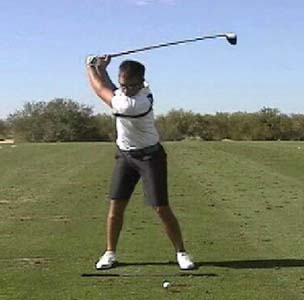
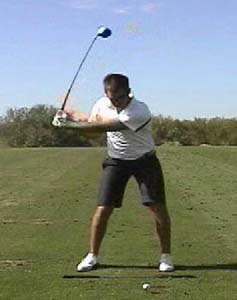
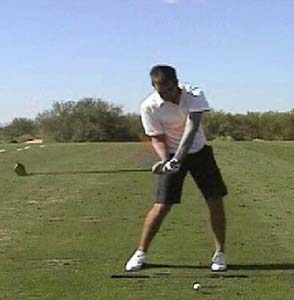
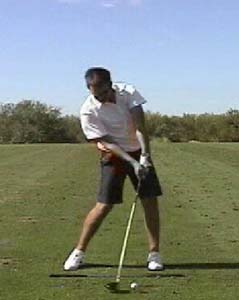
Glossary of wrist movements and P system of classifying a golfer's swing positions
Click here to go to the index page.
Glossary of wrist movements
There are 4 wrist movements and 2 forearm rotatory movements.
Wrist movements
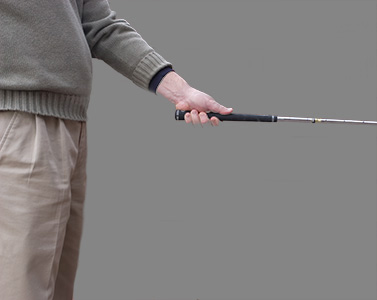
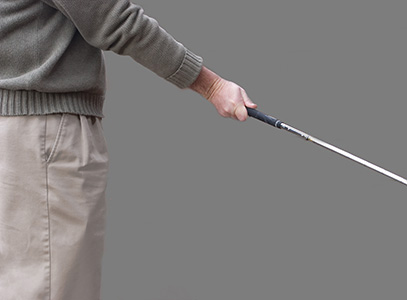
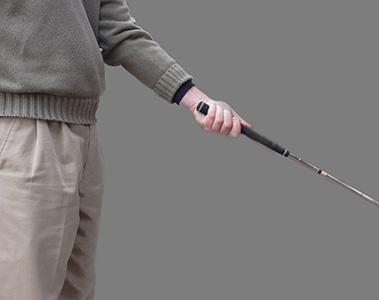
Wrist in neutral position (using the example of a left wrist)
The wrist is in a neutral position when a line drawn along the top of the forearm is in a straight line with the top surface of the index finger.The clubshaft must be in a straight-line relationship with the left forearm (the left wrist must be vertical - neither bent forward, or bent back)
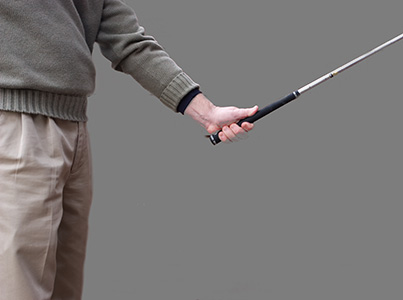
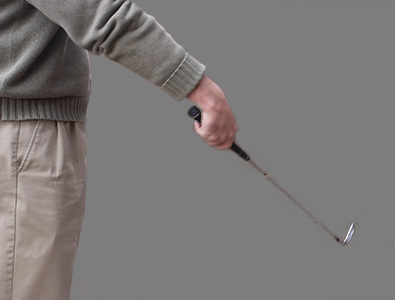
Wrist cocked up (using the example of a left wrist)
- medical term = radial deviation of the wrist
- wrist cocked up so that the left thumb becomes closer to the forearm
- the clubshaft moves vertically, towards the left forearm
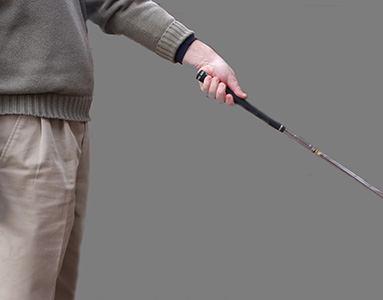
Wrist cocked down (using the example of a left wrist)
- medical term = ulnar deviation of the wrist
- wrist cocked down so that the left thumb becomes further away from the forearm
- the clubshaft moves vertically, away from the left forearm
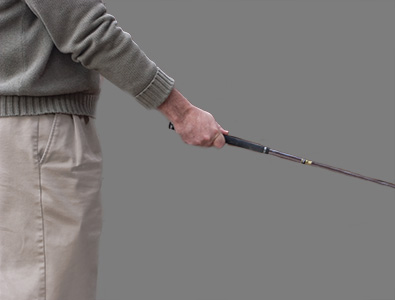
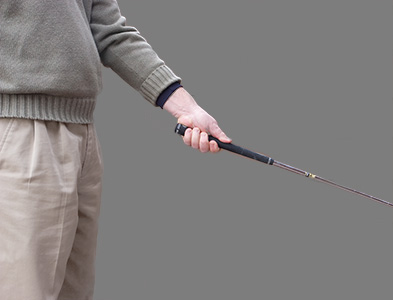
Wrist neutral (using the example of a right wrist)
The wrist is neutral when the clubshaft is straight-in-line with the arm. The back of the wrist will appear to be slightly cupped/scooped due to the fact that the golfer is holding a rounded grip (of finite width) in his hand using a "fist-like" gripping action. When a golfer curls all his fingers into the palm of his hand to create a fist (even in the absence of a grip), it is automatic/natural for the wrist to become dorsiflexed (and it will naturally cause the back of the wrist to appear to be cupped/scooped).
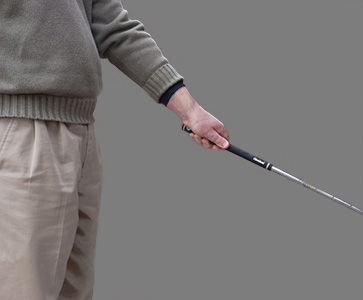
Wrist hinged back (using the example of a right wrist)
- medical term = dorsiflexion of the wrist
- common terms = increasingly scooped wrist position, increasingly cupped wrist position, bent wrist position where the amount of wrist dorsiflexion is greater than the amount seen in a neutral wrist
- the wrist bends back in a horizontal plane, while the wrist remains level (neither up-cocking or down-cocking)
Wrist hinged forward (right wrist)
- medical term = palmar flexion of the wrist
- common terms = arched wrist, bowed wrist
- the wrist bends forward in a horizontal plane, while the wrist remains level (neither up-cocking or down-cocking)
Forearm rotatory movements
- there are two forearm rotatory movements
- the forearm's radial bone rotates over the forearm's ulnar bone, but the wrist remains neutral because no active movements occur in the wrist joint
Forearm and wrist neutral (left wrist)
- forearm neutral, left palm vertical and left palm faces away from the target
Pronation (left wrist)
- forearm rotates clockwise so that the left palm faces downwards
- mnemonic = think of turning the palm down to POUR soup out of the hand
- the wrist and hand rotate to exactly the same degree
Supination (left wrist)
- forearm rotates counterclockwise so that the left palm faces upwards
- mnemonic = think of turning the palm up to hold SOUP in the hand
- the wrist and hand rotate to exactly the same degree
Now, although there should be no "pure" rotary motion happening at the level of the left wrist joint in a skilled golfer's downswing action, a rotary motion of the left wrist at the level of the radiocarpal joint (causing the hand to transcribe a conical motion in space) can occur via the wrist motion known as wrist circumduction.
Here are links to two you-tube videos showing the motion of wrist circumduction.
https://www.youtube.com/watch?v=-g76P5U5Rcw
https://www.youtube.com/watch?v=NkQrSqIRGrQ
The motion of wrist circumduction occurs when you combine the hinging motions of wrist extension (dorsiflexion) and wrist flexion (palmar flexion) simultaneously with the wrist cocking motions of ulnar and radial deviation, so that the hand rotates either clockwise (or counterclockwise) at the level of the proximal wrist joint (radiocarpal joint).A left wrist circumduction motion through impact (between P6.9 and P7.2) is a major cause of inconsistent clubface control through the immediate impact zone in unskilled golfers, and it should be avoided at all costs. A golfer should maintain a FLW (either an AFLW or a GFLW) throughout the immediate impact zone, and preferably throughout the entire downswing by following the swing principle of "maintaining an intact LAFW" throughout the entire downswing and early followthrough
The anatomy of the wrist joint
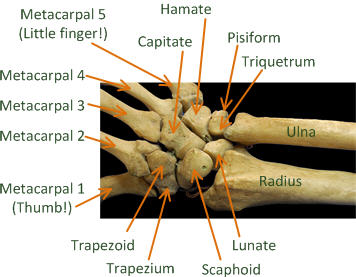
To understand how wrist movements occur within the wrist joint (from an anatomical perspective) consider the following photo showing the wrist bones.
Wrist bones
There are 8 wrist (carpal) bones. Two major carpal bones - the scaphoid bone and the lunate bone - articulate with the forearm radius bone at the radio-carpal joint.
Homer Kelley's TGM-description of wrist motions
Cocking movements (abduction = radial deviation = upcocking; adduction = ulnar deviation = downcocking) occur primarily at the level of the radio-carpal joint. Homer Kelley in his "The Golfing Machine" book doesn't refer to the terms upcocking and downcocking, and he only uses the term cocking (which is any upcocking movement from a downcocked position to a neutral level position, or from a neutral level position to an upcocked position) and uncocking (from an upcocked position to a neutral level position, or from a neutral level position to a downcocked position). He uses the term "level" to signify the neutral positional alignment when the edge of the top of the forearm and the edge of the top surface of the index finger are in a straight line.
Hinging movements of the wrist (palmar flexion and dorsiflexion) occur partly at the level of the radio-carpal joint and partly at the level of the intercarpal joint (primarily between the lunate bone and the capitellum bone). Homer Kelley in his "The Golfing Machine" book doesn't use the term "hinging" with respect to wrist movements. He uses the term "bent" to signify a dorsiflexed (cupped, scooped) wrist, "arched" to signify a palmar flexed (bowed) wrist, and "flat" to to signify a neutral wrist position (a wrist that is neither dorsiflexed or palmar flexed).
At impact, the left wrist will be flat and level, while the right wrist will be bent and level. At address, most golfers hold their hands centrally between their thighs with the butt end of the club pointing at the belt buckle, and in this position both the left and right wrists will be slightly dorsiflexed (bent).
Homer Kelley in his TGM book, incorrectly refers to the rotational movements of supination/pronation as wrist motions, and he uses the term "turned" to signify any wrist rotational motion that occurs in a rightwards-direction (supination of the right hand and pronation of the left hand) and the term "rolled" to signify any wrist rotational motion that occurs in a leftwards-direction (supination of the left hand and pronation of the right hand). "Vertical" refers to the neutral position when the wrist is neither turned or rolled.
P system of classifying a golfer's swing positions
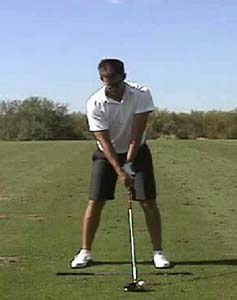
P1 position - address position
P2 position - when the clubshaft is parallel to the ground at the end-takeaway
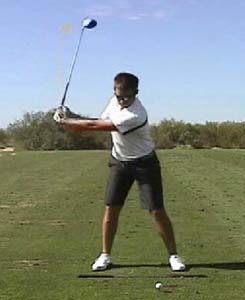
P3 position - when the left arm is parallel to the ground during the backswing action
P4 position - end-backswing position
P5 position - when the left arm is parallel to the ground during the downswing action (end of the early downswing)
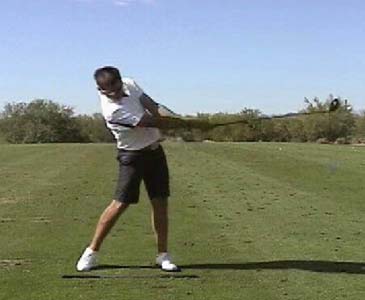
P6 position - when the clubshaft is parallel to the ground during the downswing action (end of the mid-downswing)
P7 position - impact
P8 position - when the clubshaft is parallel to the ground during the followthrough phase of the swing
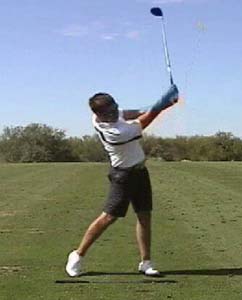
P9 position - when the clubshaft is vertical to the ground during the finish phase of the swing
Jeff Mann.