The AMG Instructors' opinions regarding clubface closure
Consider the following AMG video.
In the info section of their
video, they state as an introduction-: "They'll explain how elite players use
a combination of ulnar deviation,
supination, and wrist extension to properly square the face and create
consistent ball striking."
When one talks about squaring the face by impact, it
is very important to ask a very basic question - is one referring to the fact
that the clubface must be squared relative to the clubhead path by impact (which
hopefully is also square to the target at impact if one wants to hit the ball
straight) or is one talking about squaring the clubface relative to the target
by impact.
If one is referring to the target, then factors such
as the degree of ulnar deviation of the lead wrist or the degree of lead wrist
extension play a role because they affect the alignment of the clubshaft
relative to the ball at impact. However, I always/only refer to the phenomenon
of clubface squaring as being relative to the clubhead path, and I believe that
there is only one biomechanical method used by pro golfers and that is lead
forearm supination (called a PA#3 release action in TGM terminology). I agree
with the AMG Instructors that body rotation plays no role in the clubface
squaring phenomenon (relative to the clubhead path).
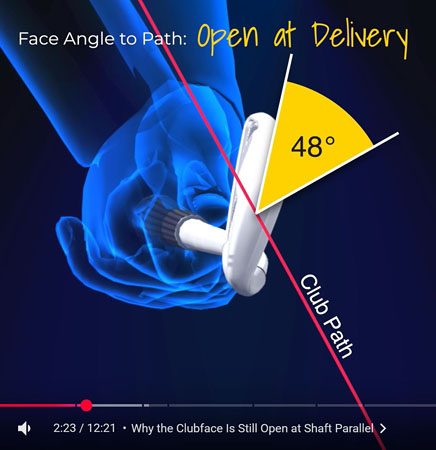
Consider the following capture image from the AMG
video showing the P6 position.
They show a red line that represents the clubhead path and they show that the clubface is open to the clubhead path by 48 degrees. MG states that the range in pro golfers = 45 - 65 degrees.
Consider SW at his simulated P6 position.
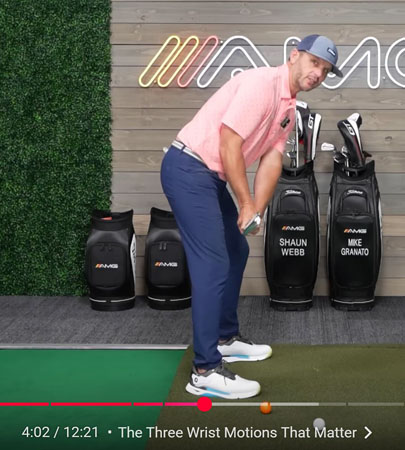
Note that his clubface is tilted beyond vertical in a groundwards direction by ~15 degrees.
Here is another capture image of SW at his simulated P6 position.
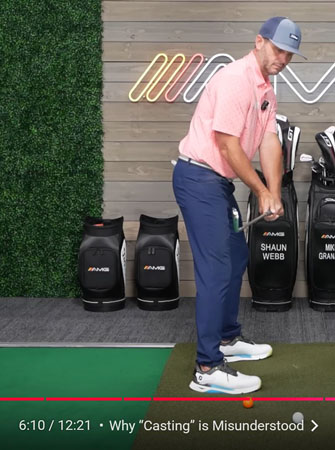
Note that he is standing more erect and note that his lead arm is more vertical. Also, note that he has a GFLW/intact LFFW alignment (where the clubface is straight-line-aligned relative to his lead lower forearm's radial bone) while he is bowing his lead wrist in the previous P6-image. Those factors affect the angle of his clubface - note that his clubface is near-vertical in this image and straight-line-aligned relative to the lead lower forearm's radial bone (and roughly also relative to the watchface area of his lead lower forearm). By contrast, in his first (previous) image he is using a lead wrist bowing maneuver (= reverse motorcycle move) which closes the clubface relative to the watchface area of his lead lower forearm. Most pro golfers do not use the reverse motorcycle move, so this image better represents reality for a pro golfer who uses a neutral lead hand grip.
MG stated that the range in pro golfers = 45 - 65 degrees, but he never discusses in detail what major factor affects the degree of clubface opening relative to the clubhead path at P6.
I think that the major factor affecting this measurement is lead hand grip strength.
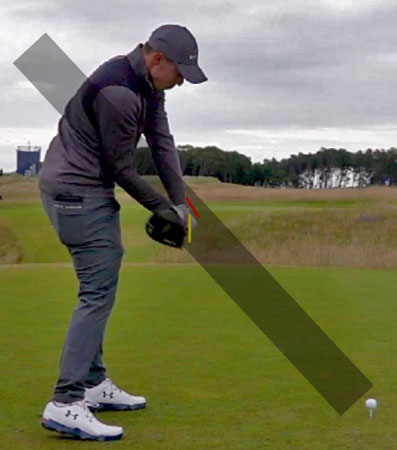
Consider Scottie Scheffler
at his P6 position.
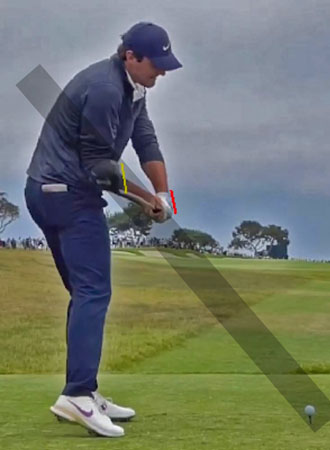
Note that I have drawn a grey-colored zone representing the clubhead path.
Note that I have drawn a red line parallel to
the back of his lead hand and a yellow line parallel to his clubface.
Note that these lines are straight-line-aligned, which is not surprising
considering the fact that SS uses a very weak lead hand grip. Note that
SS is using the intact LFFW/GFLW technique and he is not using the
reverse motorcycle move.
Note that his clubface (yellow line) is more
than 65 degrees open relative to his clubhead path and it is also tilted
back (and not tilted 10 - 15 degrees groundwards as SW wrongly states it
should be at the P6 position).
Consider Matthew Fitzpatrick at his P6
position.
Note that I have
drawn a grey-colored zone representing the clubhead path.
Note that I have drawn a red line parallel
to the back of his lead hand and a yellow line parallel to his
clubface.
Note that the back of MF's lead hand is
tilted upwards (compared to SS's lead hand which is near-vertical)
and yet his clubface is much more closed relative to his clubhead
path (compared to SS). The reason is that MF uses a very strong lead
hand grip, which causes his clubface to be ~60 degrees closed
relative to the back of his lead hand. At P6, his clubface is only
open relative to his clubhead path by ~30 degrees, while SS's
clubface is more open relative to his clubhead path by another 35+
degrees.
The implication of this >35 degrees of
clubface difference (relative to the clubhead path) is very
important - because SS is going to have to use a lot of lead forearm
supination between P6.5 => P7 to square his clubface relative to his
clubhead path by impact, while MF is only going to use a negligible
amount.
MG acknowledges that lead forearm
supination is needed to square the clubface (relative to the
clubhead path) in the later downswing between P6.5 => P7, but he
does not discuss the major effect of lead hand grip strength on the
magnitude of the PA#3 release phenomenon.
Listen to what SW states between the 6:22
- 6:36 minute time point of the AMG-video - he incorrectly states
that the lead forearm must be supinating
while the lead wrist is going into
extension. That's not true!
Here is the graph from the AMG video.
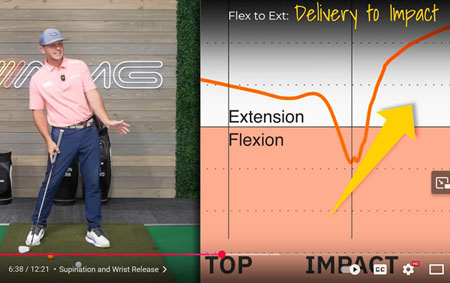
As I have already stated, lead forearm supination mainly happens between P6.5 => P7 in pro golfers, and that can be clearly seen in SW's lead forearm supinatory motion in the AMG-video (see the 6:35 - 6:36 minute time point of the video). However, note that their own graph shows that the lead wrist is moving towards a greater degree of lead wrist flexion during the P6.5 => P7 time period and it even remains maximally flexed for a very short time period post-impact. The lead wrist only moves towards a greater degree of lead wrist extension during the remainder of the early followthrough => and then the later followthrough time period.
Watch what SW demonstrates between the
6:52 - 6:56 minute time point of the video - where he wrongly
claims that every
good pro golfer moves the club in that SW-demonstrated manner
where the clubshaft bypasses his lead arm very soon after
impact, and which involves a large degree of uninterrupted lead
forearm supination.
SW is wrong and that SW-demonstrated
club release action only happens in pro golfers who use a
rolling subtype of non-DH hand release action.
Consider the following capture image
from the AMG video.
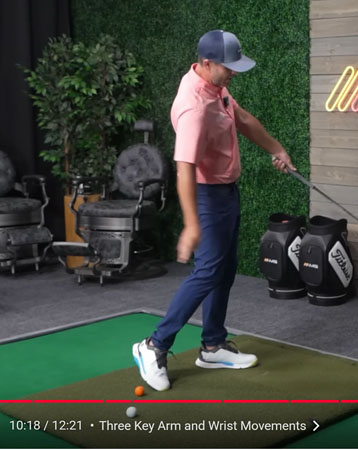
Note that SW is at a simulated P7.5 position where the butt end of the club is pointing towards the middle of his body. Note that his lead wrist is still slightly flexed, and it is not extended, and note that his clubshaft has not bypassed his lead arm (from an angular rotational perspective).
That phenomenon is exactly what is
seen in a pro golfer who uses a DH-hand release action -
like Will Zalatoris.
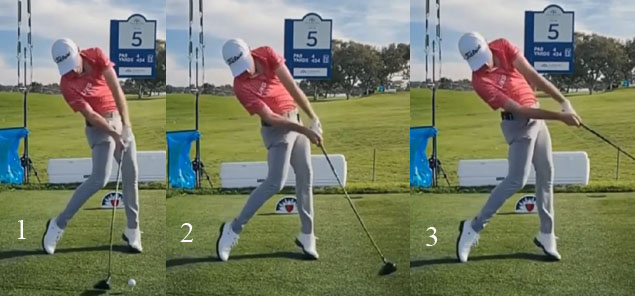
Image 2 shows WZ at his P7.4 position - note that his lead wrist is not extended and it is still slightly flexed, and note that his clubshaft has not bypassed his lead arm (from an angular rotational perspective) and note that the butt end of his club is pointing at his mid-abdomen (as recommended by the AMG Instructors).
The AMG Instructors are
contradicting their own previously-expressed opinion
where they stated that the lead wrist must rapidly
extend immediately post-impact and where they stated
that the clubshaft must rapidly bypass the lead arm very
soon after impact (as demonstrated between the 6:52 -
6:56 minute time point of the video). That's not
universally true in pro golfers! The AMG instructors
show both a rolling subtype of non-DH hand release
action in their video (at the 6:52 - 6:56 minute time
point of their video) as well as a DH-hand release
action subtype (at the 10:17 - 10:28 minute time point
of their video). I think that they need to do a much
better job showing that both of those hand release
options are used by pro golfers!!!
Finally, listen to what MG
states between the 9:19 - 9:26 minute time point of the
AMG-video - where he wrongly states that the lead wrist
must move rapidly towards extension through impact in
order to fully release the club. In those capture images
of Will Zalatoris' driver golf swing's followthrough
action, his lead wrist is not significantly moving
towards extension between P7 => P7.4, and it would be
crazy to claim that he is not fully releasing his club
What about Cameron Champ, who
is one of the longest drivers on the PGA tour?
Here are capture images of his
followthrough action.
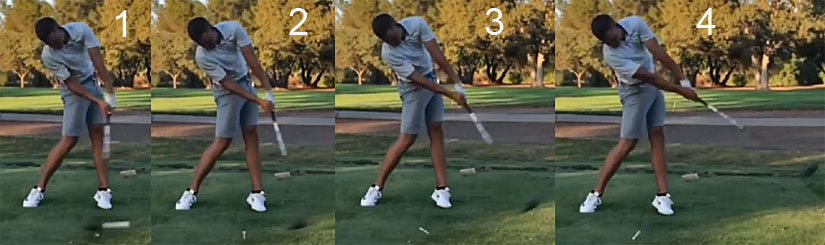
Image 1 is at P7, image 2 is at P7.2 and image 3 is at P7.4.
Note that his lead wrist
is not moving significantly towards extension
between P7 => P7.4, and his clubshaft never bypasses
his lead arm (from an angular rotational
perspective) during that time period.
I think that it it would
be crazy to assert that Cameron Champ is not fully
releasing his club in his driver golf swing action,
and I think that it would be crazy to assert that
he is performing a handle-dragging (punch shot) type
of hand release action.
Jeffrey Mann.