Be Better Golf video on confirming the Malaska Move
Watch Brendon Devore's latest BBG video.
In this video, BD makes the
irrational claim that he has confirmed that the Malaska Move is "real", and not
just a "feel".
BD has for a long time stated that he has a tendency
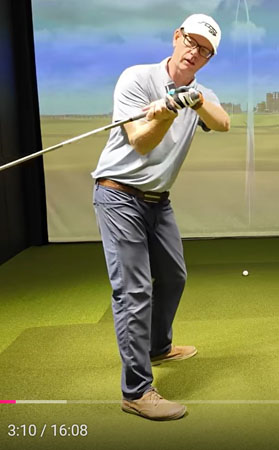
for the clubshaft to fall back during the transition - as seen in the following
capture image from the BBG video.
Note how the clubshaft is falling back to an excessively shallow plane at the transition to the downswing.
BD has improved his pivot motion by generating a
greater degree of torso-pelvic separation during the early downswing and he
discusses this improved lower body rotation phenomenon in the BBG video
(where he talks about rotating his pelvis very actively while keeping his
shoulders more closed). However, that rapid pelvic shift-rotation motion
during the early downswing between P4 => P5 can potentially make the
"clubshaft falling-back" swing fault worse.
To combat the clubshaft falling back, BD believes
that he must perform a clubshaft steepening move that will tumble the
clubshaft in an over-the-plane direction - as a counteracting move. Mike
Malaska called this move his "Malaska Move", and he called it a "feel" move
because it is not visually seen in his "real life" downswing action between
P4 => P6. BD now has another theoretical explanation for this "positive
tumbling move", which he derived from Brian Manzella and he calls it
applying a "positive alpha torque move". It is interesting that he calls it
an alpha torque action because BM originally referred to an alpha motion is
being in the plane of lead wrist uncocking and a beta motion as being a
clubshaft shallowing motion that is perpendicular to the alpha motion which
was happening parallel to the swingplane - see this Golf Digest article
written by BM at
www.golfdigest.com/story/3-moves-to-smash-it
. However, I would not be surprised to learn that BM has revised his
definitions. More importantly, BD makes the controversial claim that this
"positive alpha torque move" is "real", and not just a "feel". Note that BD
does not provide any scientific proof that this positive alpha-tumbling
torque exists, and I have never seen BM supply any proof. I think that it's
just a theory based on Steven Nesbit's theoretical explanation regarding the
forces/torques that are happening during a golf swing. Steve Nesbit's theory
was contested by many other biomechanists (eg. Young Hoo Kwon and
SashoMackenzie and David Tutelman) inciting what BD refers to as the "Alpha
Wars". BD infers that BM has won this war and that this "positive
alpha-tumbling torque" really exists, but I have never seen any evidence to
support BD's claim.
How would a "positive alpha torque" really work
from a biomechanical perspective?
Consider again this capture image of BD's
"clubshaft falling back" swing fault.
How could BD biomechanically enact a positive clubshaft steeping/tumbling torque to counteract this swing fault where the clubshaft has a tendency to fall back?
It could theoretically happen if BD
straightened his very extended trail wrist, but we know that this does
not happen between P4 => P6 in a pro golfer's golf swing action. In
fact, the degree of trail wrist extension may often reach its maximum
degree of extension at ~P5.5.
Note that BD's trail forearm is very supinated in that image, so if he pronated his trail forearm so that it becomes neutral, then that would apply a positive torque in a clubshaft steepening direction. That's the only way that it can work from a biomechanical perspective in a "real life" golf swing. So, how do pro golfers actually apply that positive torque?
The answer is very simple!
Consider Ben Hogan's P4 => P5.5 downswing
action.

Image 1 is at P4, image 2 is at P4.5, image 3 is at P5, image 4 is at P5.2 and image 5 is at P5.5.
The yellow colored lead forearm which is
continuously straight-line-aligned with his clubshaft represents the
intact LFFW (left forearm flying wedge) - ignore the fact that the
lead upper arm is also colored in yellow and only think of the lead
forearm. The red colored trail forearm with the bent back trail
wrist represents the RFFW (right forearm flying wedge). The green
colored trail upper arm attaches the RFFW to the torso at the trail
shoulder socket.
Note how BH
steadily shallows his clubshaft between P4 => P5.5 while keeping his
clubshaft continuously
on-plane (on-plane = when an extension line extended out from the
butt end of the club always points at the ball-target line at every
moment between P4 => P5.5).
Note how his trail palm is continuously parallel to his intact LFFW at every moment between P4 => P5.5.
How is that possible from a biomechanical
perspective?
It is possible if BH actively adducts his
trial upper arm and drives his trail elbow towards its pitch
location alongside his trail hip area by P5.5 using a pitch elbow
motion with perfect timing.
During that active trail upper arm adductory motion, which
transports the RFFW downplane with perfect timing, note how he
increasingly supinates his trail forearm while keeping his trail
wrist fully extended. It is critical to ensure that the trail
forearm is neutral at P4 and also near-neutral between P4 => P5, and
that the degree of trail forearm supination only significantly
increases between P5 => P5.5. If a golfer allows the trail forearm
to become prematurely supinated between P4 => P5 it would cause a
"clubshaft falling-back" swing fault. That is the key move that BH
has mastered and that BD is also mastering in this BBG video - see
the capture image below.
Capture images of BD's early downswing
action - captured from the BBG video.

Image 1 is at ~P4.5, image 2 is at P5 and image 3 is at P5.5.
Note how he is steadily shallowing his
clubshaft between P4 .5 => P5.5 while maintaining an intact LFFW
which is continuously on-plane.
Note how he keeps his trail palm
continuously parallel to his intact LFFW at very moment between
P4.5 => P5.5 - and that is only
possible because he is actively adducting his trail upper arm
with perfect timing and he is simultaneously keeping his trail
forearm neutral between P4.5 => P5,
and only allowing it to supinate more between P5 => P5.5.
The bold-highlighted swing action
prevents any possibility of a "clubshaft falling back" swing
fault during the transition and BD is performing it flawlessly.
BD has a superb golf swing action and he is using his trail
upper arm and RFFW in a perfect/superb manner to support his
intact LFFW. It is the
perfected motion of his trail upper arm and RFFW that is
automatically/naturally applying a positive tumbling torque that
prevents any "clubshaft falling back" swing fault from happening
between P4 => P5 - and there is no need to think consciously
about the fact that the positive torque is
automatically/naturally being applied as it happens at a
subconscious level.
Jeffrey Mann.
https://newtongolfinstitute.proboards.com/thread/1152/bbg-video-confirming-malaska-move