In this 4-year old video, Milo claimed that clubshaft shallowing is due to an active pivot action that would cause the lead upper arm to adduct more closely against the chest wall and he believed that it would cause a greater degree of internal rotation of the lead humerus that would produce clubshaft shallowing. He is wrong because we now have substantial evidence that many pro golfers (eg. Rory McIlroy) have a large air gap between their lead upper arm and their anterior chest wall at P4, which does not decrease during the clubshaft shallowing phase that happens between P4 => P5, and that there is not a greater degree of internal rotation of their lead humerus happening during the P4 => P5 time period. In fact, the AMG instructors have shown that Rory's lead arm is moving rapidly downwards between P4 => P5.5 and that the gap between the chest wall and lead upper arm is rapidly increasing between P4 => P5.5. Also, it has been shown that the Rory's lead humerus is moving towards a lesser degree of internal rotation during that P4 => P5.5 time period when the clubshaft shallows.
Here are capture images of Rory McIlroy at his transition to his downswing.
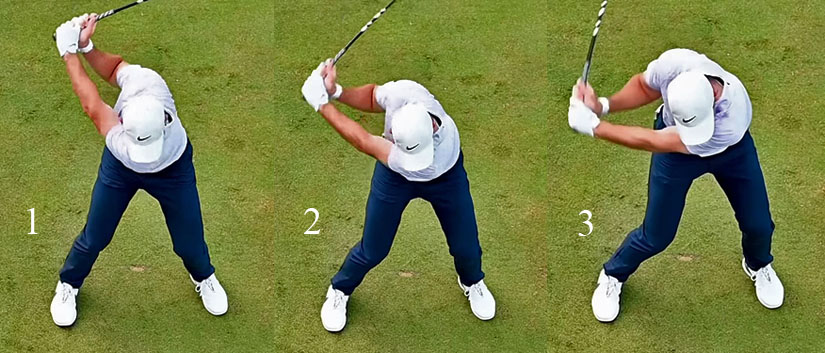
Note that the angle between his lead humerus and his lead anterior chest wall is increasing between image 1 => image 3; and note that his lead humerus is more internally rotated in image 1 compared to image 3.
Another point that Milo emphasises in his video is his claim that a
golfer goes into right bend during the early transition between P4 =>
P5. However, the AMG instructors have clearly shown that Milo's claim is
wrong and that pro golfers (like Rory McIlroy) are still in a large
degree of left-lateral bend between P4 => P5. Finally, Milo states in
his video that he does not like the idea of shallowing the clubshaft via
any independent downward motion of the arms that are associated with a
clockwise forearm rotation - but the "real life" reality is that those
biomechanical motions are the true cause of clubshaft shallowing in pro
golfers.
Here are two other Milo Lines videos that also reflect his wrongheaded
opinions on the role of right lateral bend in the clubshaft shallowing
phenomenon.
Video 1:
Video 2:
Here is another Milo Lines video that is 3-years old.
In this video, Milo correctly states that the major biomechanical
motion causing clubshaft shallowing is trail forearm supination.
However, he incorrectly claims that the trail wrist must be extended
in such a way that the trail palm must face away from the target
during the P4 => P5.5 time period - he uses the analogy of placing
the trail palm against a wall or an analogy of holding a cellphone
in the trail hand so that the face of the cellphone faces away from
the target. However, that never happens in a pro golfer's P4 => P5.5
time period - where the trail palm is
continuously parallel
to the swingplane on which the clubshaft is positioned between P4 =>
P5.5. Both Milo and Henry wrongly claim that if the trail palm is
parallel to the swingplane, rather than being nearly perpendicular
to the swingplane as it faces away from the target, that it will
have a clubface-opening effect. That claim is untrue! The phenomenon
of clubshaft shallowing has no effect on the degree of clubface
opening relative to the clubhead path. So, for example, if a golfer
adopts a weak trail hand grip, the back of his FLW will be
continuously parallel to his steadily shallowing swingplane
between P4 => P5.5 if he performs a clubshaft shallowing action. His
clubface should also be continuously parallel to his
shallowing swingplane if he maintains an intact LFFW/GFLW alignment.
The fact that the clubface will become more horizontal relative to
the ground at P5.5 does not mean that it is more open at P5.5!
Let's consider the clubshaft shallowing move of two pro golfers - Tommy Fleetwood and Joaquin Niemann
Tommy Fleetwood's clubshaft shallowing action - see www.instagram.com/reel/DCBlmjTCQsD/
Here are capture images from the video of his clubshaft shallowing
action.
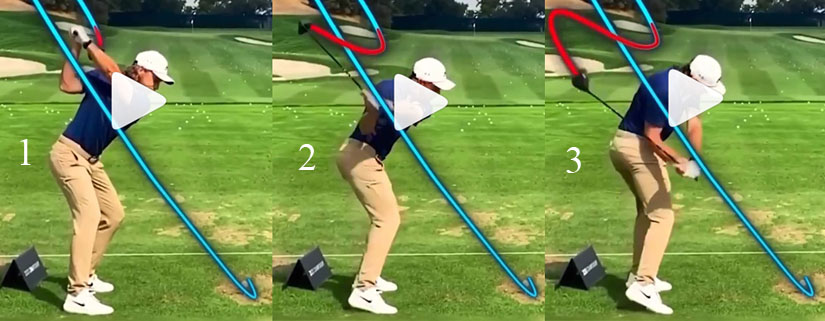
Image 1 is at P4, image 2 is at P5 and image 3 is at P5.5.
Note that his trail forearm is close to neutral at P4.
Note that his trail forearm is starting to supinate by P5 as he actively adducts his trail upper arm towards the trail side of his torso (note how his trail elbow drops well below his lead elbow by P5) - and that produces a small degree of clubshaft shallowing. His trail shoulder is moving slightly lower due to i) increased upper torso flexion, ii) protraction of the trail scapula and iii) lowering of the peripheral end of his trail clavicle. At this point, he is still in a condition of left-lateral bend.
Note that most of his clubshaft shallowing happens between P5 => P5.5 and it is mainly due to an increasing degree of trail forearm supination as he continues to lower his hands from being at mid-sternal level at P5 to being at mid-thigh level at P5.5.
Note that his trail palm remains continuously parallel to his shallowing swingplane throughout the P4 => P5.5 time period, and that it has no clubface opening effect. Note that his trail wrist is not very extended at P4. Note that his trail wrist becomes more extended between P4 => P5.5 and that allows his clubshaft to remain roughly straight-line-aligned relative to his trail forearm. If he did not increasingly extend his trail wrist between P4 => P5.5, he would not be biomechanically able to keep his clubshaft straight-line-aligned with his trail forearm, which is increasingly supinating during that P5 => P5.5 time period.
Note that there has been no significant increase in the dropping-downwards motion of his trail shoulder between P5 => P5.5 despite a large increase in his degree of clubshaft shallowing.
Joaquin Niemann's downswing action
Here are capture images from his video
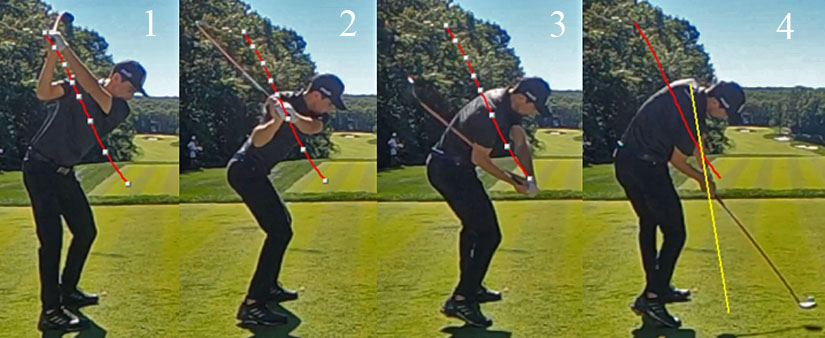
Image 1 is at P4, image 2 is at P5, image 3 is at P5.5 and image 4 is at P7.
The red splined path represents his hand arc path.
Note how he manifests a large degree of squatting motion between P4 => P5 due to increased hip joint and knee joint flexion.
Note how his trail forearm is roughly neutral at P4.
Note how he shallows his clubshaft by a small amount between P4
=> P5 secondary to an active trail upper arm adduction maneuver
that is combined with a small degree of increased trail forearm
supination. Note that he manifests more clubshaft shallowing
(compared to Tommy Fleetwood) at P5 - presumably due to the fact
that he has more trail forearm supination and trail wrist
extension manifesting at the P5 time point.
Note how he shallows his clubshaft by a large amount between P5 => P5.5 mainly due to a large increase in his degree of trail forearm supination.
Note that his trail palm remains continuously parallel to his shallowing swingplane throughout the P4 => P5.5 time period, and that it has no clubface opening effect.
Note that his trail shoulder is much lower at P5.5 (compared to Tommy Fleetwood) because he manifests a greater degree of right lateral bend at P5.5. Note that his degree of right lateral bend increases a lot between P5.5 => P7 and it is very large at impact. Note that his lead arm is very vertical (and not outstretched away from his body) at impact, and note that he has a moderate-sized accumulator #3 angle at impact (= angle between the yellow line drawn down the length of his lead arm and the clubshaft), which is unusual for a golfer who adopts a very strong lead hand grip. Note that his inordinately large degree of right lateral bend happening between P5.5 => P7, which allows him to get his trail shoulder very far downplane by P7, allows him to retain a large degree of trail elbow bend and trail wrist bend at impact. However, he does not have a very large amount of lowering of his trail shoulder happening between P5 => P5.5, and his large degree of clubshaft shallowing happening between P5 => P5.5 is mainly due to his increased degree of trail forearm supination.
Note that both Tommy Fleetwood and Joaquin Niemann are manifesting their greatest degree of clubshaft shallowing between P5 => P5.5, and that their lead humerus is rotating in the direction of a greater degree of external rotation during that P5 => P5.5 time period.
AMG's best video on the topic of clubshaft shallowing is the
following video.
There is a lot of good golf instructional advice in that video. Most
importantly, they emphasize the "idea" that the phenomenon of
clubshaft shallowing is an arm-based motion, and not a body-based
motion (in the manner that Milo Lines teaches). They also show that
the key movement between P4 => P5 is an arm-depression motion where
the trail upper arm is lowered. They also secondly emphasize the
inportant fact that the trail upper arm must be adducted in the
direction of the trail shirt seam, and not directed in front of the
trail side of the upper torso by using an "external rotation of the
trail humerus" motion. That's very good advice.
The value of their video is limited by two facts. They only discuss
the P4 => P5 time period, and not the P5 => P5.5 time period (where
the degree of clubshaft shallowing is usually at its greatest and
where it is very dependent on an increased amount of trail forearm
supination happening). Secondly, when they discuss the P4 => P5 time
period, they discuss 3 phases - see the video starting at the 15:38
minute time point. The first phase shows the motion of the trail
upper arm being adducted towards the trail side's shirt seam, which
is the correct motion of trail arm depression. However, note that
the avatar has his trail forearm significantly supinated and his
trail wrist fully extended at the very start
in all the 3
phases of the described clubshaft shallowing motion. The AMG
instructors do not discuss trail forearm supination - possibly
because they start from a significantly supinated trail forearm
position and they do not show that the degree of trail forearm
supination is changing in the early-mid downswing.
Here is Jon Sinclair's graph of trail forearm supination.
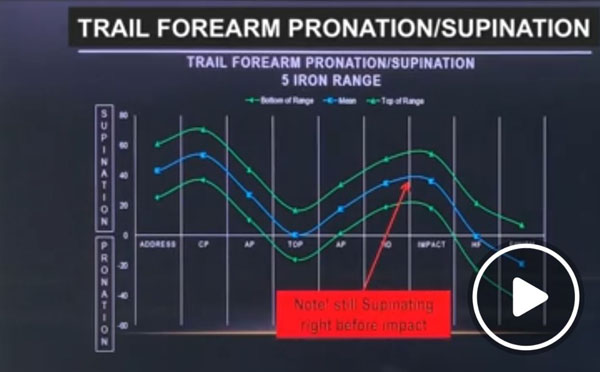
Note that the "average" pro golfer has a neutral trail forearm
at P4 and that the degree of supination is steadily increasing
between P4 => P6.5.
In my discussion of the clubshaft shallowing action of Tommy
Fleetwood and Joaquin Niemann (as examples), I noted that their
trail forearm is close to neutral at P4. I also showed that the
degree of increasing supination is less between P4 => P5 and
much more between P5 => P5.5. I therefore think that it is
useful for a student-golfer to understand this golf
instructional point.
However, I did not emphasize a golf instructional point that the
AMG instructors emphasize a lot.
Consider these Joaquin Niemann's capture images.
Note how he actively adducts his trail upper arm towards the trail side's shirt seam between P4 => P5. That's the correct major trail upper arm lowering-motion which already positions the trail elbow very close to the trail hip area by P5 - P5.2. During that time period, the upper torso is still very closed.
Then, note how his upper torso starts to rotate a lot
counterclockwise to become square by P5.5 and during that
time period, the trail upper arm remains abutted against the
trail shirt seam. A slight degree of increasing depression
of the trail shoulder socket due to acquired right lateral
bend allows him to get the trail elbow slightly closer to
the trail hip joint area - but the trail elbow is not driven
in front of the trail hip area by using an "external
rotation of the trail humerus" motion (which is a golf
instructional point that MG correctly emphasizes). However,
the AMG instructors do not note that the trail forearm is
steadily increasing its degree of supination (as seen in the
Jon Sinclair graph) between P5 => P5.5, which allows for a
greater degree of clubshaft shallowing. Note that the degree
of supination happening between P4 => P6.5 is ~35 degrees,
which is much more than the 20 degrees quoted by MG, and
that the slope is steepest between P4 => P5.5.
I wrote in my previous post-: "The AMG instructors do not
discuss trail forearm supination - possibly because they
start from a significantly supinated trail forearm position
and they do not show that the degree of trail forearm
supination is changing in the early-mid downswing."
I now realise that my statement is wrong because the AMG instructors are seemingly ignorant of the phenomenon of dual forearm supination, and they are seemingly unaware that the trail forearm steadily supinates to a greater degree between P4 => P6.5 in pro golfers. Why do I harbor this opinion?
Consider this AMG video.
In this video, they discuss what they perceive to be the CORRECT right wrist movements that should be used during the downswing.
Starting at the 5:34 minute time point of the video, they start to discuss how the right palm should move during the downswing. Stop the video at the 5:52 minute time point of the video - and note what is printed in a box overlying the video image. It states-: "Until you get to the ball, you want your palm facing down toward the ground".
Here are capture images showing SW demonstrating his "palm
facing the ground" advice.

Image 1 shows SW at a simulated P6 position, where his
trail palm is facing the ground. Note that it is only
possible if a golfer performs a punch elbow motion, and
not a pitch elbow motion, between P4 => P6 where the
trail forearm is rotating counterclockwise in a
pronatory direction, and not clockwise in a supinatory
direction, during the early-mid downswing. Note that his
trail forearm is not significantly supinated at P6 - as
routinely seen in all pro golfers.
Image 2 shows SW at a simulated P6 position when holding a golf club. Note that there is a significant difference in his degree of trail forearm supination, where his trail forearm is significantly more supinated in this image. That causes his "true" palm area (interdigital area and hypothenar area) to be more under-and-behind the club handle, while it is only the thenar area of the right palm (which only represents the thumb metacarpal) that is facing groundwards. That image is more representative of "real life" reality if a pro golfer is using a neutral-to-weak trail hand grip. If a pro golfer uses a strong trail hand grip, then his "true" palm area will be positioned more under the club handle at P6.
Then, listen to what MG starts to assert starting at the 5:57 minute time point of the AMG-video. He states that he wants the clubface to start facing the ground earlier in order to close the clubface earlier, and he infers that the clubface will close earlier if the trail palm faces the ground earlier. Then, listen to what MG states between the 7:35 - 8:04 minute time point of the video. MG states that many golfers think that they must supinate their trail forearm to shallow the golf club, but MG amazingly believes that's the wrong approach because he wrongly infers that a golfer would not be able to square the clubface by impact if the trail forearm increasingly supinates between P5 => P6.5. MG's opinion shows how ignorant he is regarding the phenomenon of dual forearm supination that routinely happens in pro golfers.
Here is Jon Sinclair's image showing how both the trail
forearm and lead forearm perform a supinatory motion
during the mid-late downswing.
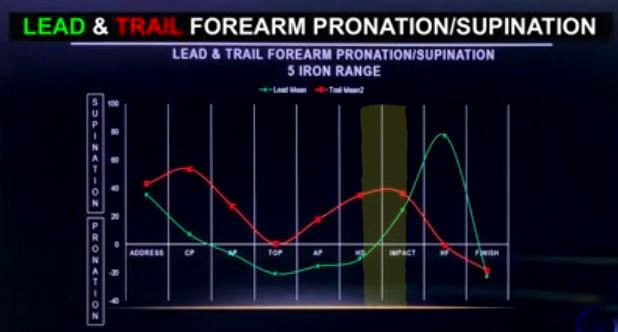
The red graph represents trail forearm supination and the green graph represents lead forearm supination.
Top = P4, AP = P5, MD = P6 and impact = P7.
Note that the trail forearm is progressively
supinating to an increasing degree between P4 =>
P6.5 where it reaches its greatest degree of
supination. Then, between P6.5 => P7, the degree of
trail forearm supination decreases by a very small
amount, but it is still very supinated at impact.
Note that the lead forearm starts to significantly supinate starting at P6 and note that between P6.5 => P7 it is supinating very rapidly (in order to complete a PA#3 release action by impact). Note that both forearms are in a condition of supination between P6.5 => P7.
SW/MG are seemingly totally ignorant of this "real life" reality
Note that MG wrongly states that if the trail
forearm is still supinated in the later downswing
that it implies a clubface that is too open, and he
wrongly believes that it will will force a golfer to
close the clubface later in the downswing just
before impact. That's not true! Clubface closing
routinely happens between P6.5 => P7 in pro golfers
secondary to the rapid lead forearm supinatory
motion that happens during that time period -
representing the standard PA#3 release action seen
in all pro golfers (who do not use a very strong
lead hand grip).
Then, listen to what SW states between the 8:35 - 9:10 minute time point of the video. He not only wants the trail palm to face the ground, he wants the trail palm to face away from the target during the P5 => P5.5 time period in order to close the clubface earlier and by a greater amount - see image 3 of those capture images of SW above. It's crazy advice! The AMG instructors have shown that they can offer good quality golf instructional advice in many of their videos, but this particular video shows that they have a huge deficiency in their understanding of certain elements of golf swing biomechanics.
Here is AMG's latest video (dated 1/31/25).
In that video, the AMG instructors state that a popular drill - where
one places an alignment stick in one's belt loops and where one should
try and get the trail arm/elbow in front of that stick by P6 - is a bad
drill. I fully agree with them.
Starting at the 2:52 minute time point of the video, they discuss
another version of the alignment stick drill where one places the trail
arm behind the stick. Watch the AMG-video between the 2:52 - 4:10 minute
time point of the video where SW shows how the two arms move between P6
=> P7.2+ during the performance of that drill.
I agree that this amended version of the drill is useful. Most importantly, note that when SW performs the drill that his trail forearm is very supinated at his P6 position and that it remains supinated throughout the entire P6 => P7 time period. It is biomechanically impossible to perform that drill correctly (in the manner shown by SW) if the trail forearm is not kept in a biomechanical condition of supination throughout the drill.
Here is a capture image of SW performing that amended alignment
stick drill
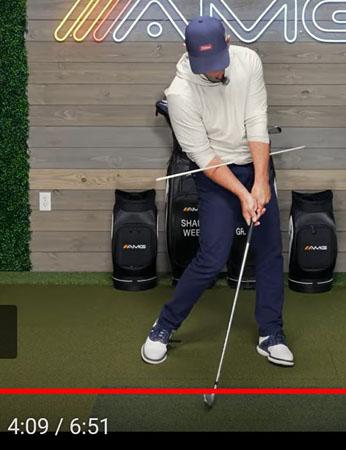
Note how his trail elbow is behind the stick, which is parallel to his pelvic alignment. Note that his trail forearm is very supinated.
Then, go back and look at the AMG video where SW demonstrates his
"trail palm facing the ground" trail arm swing action between the
6:42 - 6:46 minute time points, and note that his trail elbow gets
in front of his pelvis, which is not compatible with what is
happening in their amended alignment stick drill.
The AMG instructors should realise that the trail forearm must be
increasingly supinating between P4 => P6.5, and that it should still
remain supinated between P6.5 => P7. Look at SW's trail palm between the
4:02 - 4:10 minute time point of the video as he moves from the P6
position to the P7 position. Note that his trail palm's "true" palm area
(interdigital area and hypothenar area) is mainly under the club handle
at P6 and that it then becomes more behind the club handle by impact.
However, it is never facing the ground!!!
I have just discovered another video that the AMG instructors did
regarding the topic of clubshaft shallowing.
In this video, they use two drills to train a golfer to perform a
clubshaft shallowing move.
The first drill is the split-hand drill, where the trail palm is placed
under the club handle. That drill correctly ensures that the trail
forearm will be very supinated at P6 and slightly less supinated at P7.
The 2nd drill is the open-hand drill. SW does the drill correctly
although MG describes the drill incorrectly.
Consider these capture images from this video.
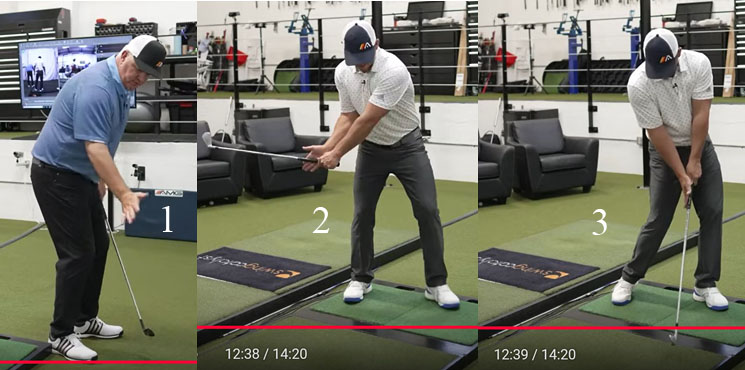
Listen to what MG states between the 12:22 - 12:30 minute time point of the video. He states that the trail hand is going to start to rotate (swivel) so that it gets on top of the clubshaft.
Image 1 shows what he means by rotating the trail hand so that it faces the ground. Note that his trail humerus is too internally rotated and his trail antecubital fossa is facing towards the target. Note that his trail forearm is minimally supinated.
Images 2 and 3 show SW doing the open hand drill correctly.
In image 2 he is at the P6 position. Note that his trail humerus is
neutral so that his antecubital foss is facing the ball-target line.
Note that his trail forearm is markedly supinated so that his trail
palm is facing partially skywards and that places his "true" palm
area (interdigital area and hypothenar area) partially under the
club handle and partially behind the club handle.
Image 3 is at a simulated impact position. Note that his trail palm is behind the club handle and facing the target. Note that he has a lesser degree of trail forearm supination. However, he never pronates his trail forearm during his later downswing and his trail palm's "true" palm area never faces the ground.
I think that if the AMG instructors re-think what is really happening in a pro golfer's downswing action, that they could produce a new video that corrects their mistakes. I also think that they need to i) improve their definition of what is an "on-plane' clubshaft motion; ii) precisely define what is the correct definition of an open clubface; and ii) realise that it is the lead arm/hand that is causally responsible for closing the clubface in the later downswing by performing a PA#3 release action (biomechanically due to lead forearm supination).
The AMG instructors do not understand that an "on-plane" golf swing
action means that if an imaginary extension line is drawn out from
the end of the club that is nearest the ground between P4 => P7 that
it should continuously point at the ball-target line even
while the clubshaft is shallowing planes.
Here is a capture image showing Martin Hall using a Smartstick to
perform an "on-plane" clubshaft motion.
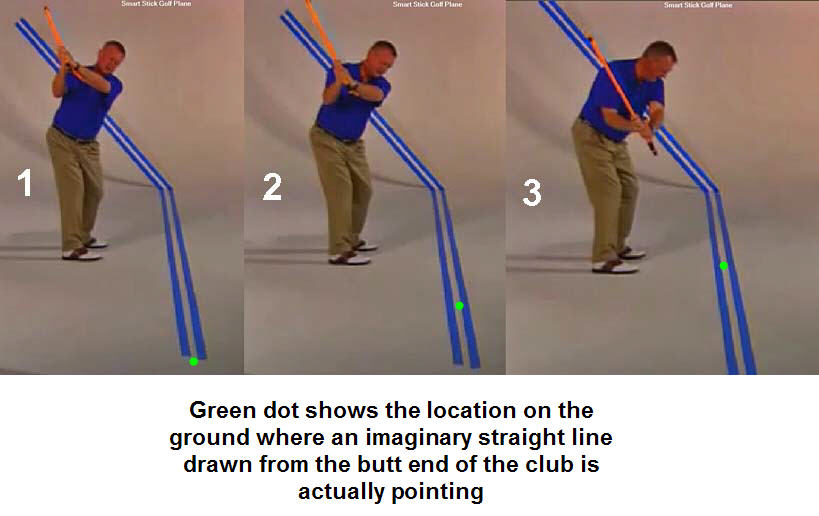
Note that Martin Hall is shallowing his clubshaft to a small
degree during his downswing action, and that the laserlight
continously points at the ball-target line. That represents
an "on-plane" downswing motion of the clubshaft. In this
demonstration, Martin Hall is not shallowing the clubshaft much,
and if he shallowed it more the same "on-plane" principle would
apply and the laserlight should
continuously point at the
ball-target line at every moment between P4 => P7 (except when
the clubshaft is parallel to the ground at P6 when the
laserlight will point at the blue lines on the far wall).
I also think that the AMG instructors should correct their
definition of what represents an open clubface. Listen to what
they say at the 12:05 - 12 :10 minute time point of their video
when SW performs an exaggerated/unaturally large clubshaft
shallowing motion where the clubface is facing more skywards at
P6. MG incorrectly calls that an open clubface - presumably
because the clubface is too horizontal relative to the ground.
However, I think that an open clubface must never be defined
relative to its orientation relative to the ground because that
is affected by the clubshaft angle relative to the ground, and
it should be more precisely defined relative to the clubhead
arc.
I have more to say about the motion of the trail forearm between
P5.5 => P6.5 in a pro golfer.
Consider this AMG video.
Listen to what MG states between the 12:22 - 12:30
minute time point of the video. He states that the trail hand must start to
rotate (swivel) so that it gets on top of the clubshaft.
Here is a capture image of MG demonstrating that
rotary/swivel motion of the trail hand - see image 1.
Image 1 shows MG demonstrating the
counterclockwise swivel motion of his trail hand.
However, that never happens in a pro golfer - as I
mentioned in my previous post.
I am going to expand on this point to better
explain why it does not ever happen.
Here is Jon Sinclair's graph showing how the trail
forearm increasingly supinates between P4 => P6.5 in a pro golfer.
Top = P4, AP = P5, MD = P6 and Impact = P7.
Note that the average
pro golfer (blue graph) increasingly supinates his trail forearm between
P4 => P6.5.
However, there is
variance in the degree of trail forearm supination as shown by the green
graphs, which include the outer limits of one standard deviation. Some
pro golfers have more supination of their trail forearm happening
between P4 => P6.5 due to two factors i) strength of the trail hand grip
and degree of clubshaft shallowing. Increasing the strength of the trail
hand grip and an increased degree of clubshaft shallowing will increase
the degree of trail forearm supination happening at every comparable
moment between P4 => P6.5. However, even if a pro golfer has a weak
trail hand grip and even if he does not shallow the clubshaft much
between P4 => P6, he must still have a supinated trail forearm during
the P4 => P6.5 time period.
I will use Scottie Scheffler, who uses a weak trail hand grip and who does not significantly shallow the clubshaft much in his early-mid downswing, to prove my claim.
Here are capture images of Scottie Scheffler's
driver golf swing action.
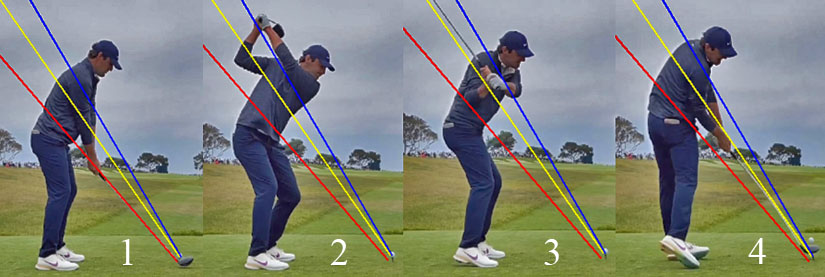
Image 1 is at P1, image 2 is at P4, image 3 is
at P5 and image 4 is at P7.
The red line is his hand plane (original shaft plane). The yellow line is his elbow plane. The blue line is his turned shoulder plane (TSP line is drawn through the trail shoulder at P4).
Note that SS's clubshaft is on the hand plane at address.
Note that SS's clubshaft is slightly above the TSP at P4.
Note that SS only shallows his clubshaft by a very small amount by P5, and it is just above the elbow plane.
Note that SS shallows
his clubshaft down to the elbow plane by P7, and not back down to the
hand plane.
SS's degree of clubshaft shallowing happening
during his early-mid downswing is small, but
he still has to increasingly supinate his
trail forearm between P5.5 => P6.5.
Why?
Consider these capture
images of Scottie Scheffler's driver golf swing action.

Image 1 is at P5.2, image 2 is at P5.5, image 3 is at P6.2, and image 4 is at P6.5.
Note that SS's clubshaft is shallowing down towards his elbow plane at P5.2 and that it then reaches the elbow plane by P5.5. Then, it is going to remain on the elbow plane between P5.5 => P7 and that represents his functional swingplane.
Note the direction of motion of his clubshaft as it moves from being behind his hands at P5.5 to becoming in front of his hands by P6.2 - it passes below his hands, and it does not "tumble" over his hands in an over-the-plane manner, which would happen if he performed a counterclockwise swivel motion of his trail hand (recommended by MG). Note how his trail forearm is increasingly supinating between P5.5 => P6.5 and that is a mandatory biomechanical phenomenon that must happen to allow SS to keep his clubshaft continuously on the elbow plane between P5.5 => P6.5.
Here is Jon Sinclair's graph showing the degree of trail forearm supination happening between P5.5 => P6.5 in pro golfers.
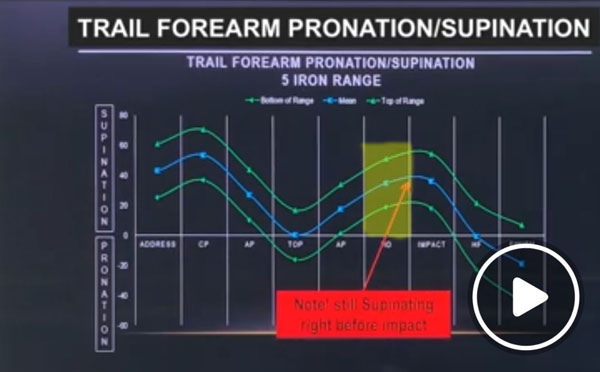
The yellow-highlighted zone represents the P5.5 => P6.5 time period, and it shows that pro golfers are increasingly supinating their trail forearm between P5.5 => P6.5.
SS's trail forearm
supination pattern is probably closer to the lower green line because he
uses a weak trail hand grip and because he does not shallow the
clubshaft very much during his early-mid downswing.
However, he still has to be increasingly
supinating his trail forearm between P5.5 => P6.5 to continuously keep
his clubshaft on his functional swingplane during that time period.
MG's recommended
counterclockwise swivel motion of the trail hand is never performed by a
pro golfer, who keeps his clubshaft continuously on his functional
swingplane between P5.5 => P6.5, because it would result in a "tumble
motion" of the clubshaft in an over-the-plane direction.
Jeffrey Mann.
https://newtongolfinstitute.proboards.com/thread/1160/major-biomechanical-causing-clubshaft-shallowing