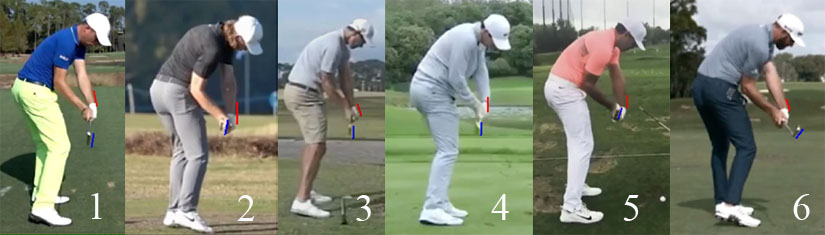
So, consider these capture images of EC's table top drill demonstration
using a neutral lead hand grip.

Image 1 is at simulated P4 position, image 2 is at simulated P5.5
position, image 3 is at a simulated P6.2 position and image 4 is at a
simulated P6.5 position.
At address, EC stood with the back of his lead hand perpendicular to the
ground and that means that his clubface must also be perpendicular to
the ground (presuming a weak-to-neutral lead hand grip where the
clubface will be straight-line-aligned with the lead lower radial bone
and also the back of the lead hand - if the LFFW is intact and the lead
wrist is not bent or bowed).
Note that the back of EC's lead hand, his lead forearm's lower radial
bone and the clubface are horizontal relative to the ground at P4, which
means that they all rotated 90 degrees clockwise during the backswing
action. The primary casual factor for the 90 degree rotation of the back
of EC's lead hand, and therefore the clubface, between P1 => P4 is a
lead forearm pronatory motion of his lead forearm. So, to get a square
clubface by impact EC must reverse the process by performing a lead
forearm supinatory motion between P4 => P7, and you can visually see the
back of EC's lead hand and clubface rolling counterclockwise in images 3
and 4, and the clubface must obviously roll 90 degrees between P4 => P7
in order for it to become square at impact.
In the video, EC states that the clubface should close steadily and
progressively throughout the downswing (secondary to lead forearm
supination) and that the counterclockwise rotation of the clubface
should start happening immediately from the very start of the downswing.
Watch this other EC video on the same topic of "lead forearm supination"
that EC performed with the renown golf instructor, John Dunnigan.
In particular, watch the video between the 10:30 - 11:30 minute time point
of the video where EC and JD discuss when lead forearm supination must start
in the downswing. EC suggests that it should start at P5, but JD interjects
and asserts that it should actually start much sooner and that it should be
initiated immediately after the start of the transition to the downswing.
That's impossible!!!
The "real life" reality is that most pro golfers only start to supinate
their lead forearm at ~P5.5 and they do not supinate their lead forearm in
the early downswing between P4 => P5.5. During the P4 => P5.5 time period,
most pro golfers keep the back of their lead hand and their clubshaft
parallel to their swingplane. The clubface will also be parallel to the
swingplane - but only if they use a weak-or-neutral lead hand grip strength.
Consider these capture images featuring John Dunnigan, which I captured from
the 11:03 - 11:15 minute time points of the EC video.
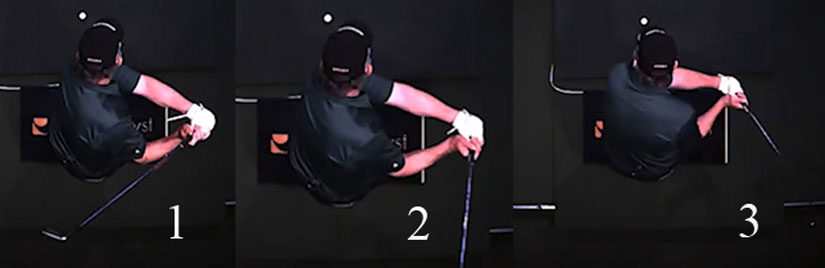
Image 1 is at P4, image 2 is at P5 and image 3 is at P5.5.
Note that JD has stuck a Chinese chopstick into the clasp of his lead hand's
glove so that the chopstick is approximately straight-in-line with his lead
forearm's lower radial bone and roughly parallel to the back of his lead
hand. Note that his clubface is roughly parallel to that chopstick because
he has adopted a neutral lead hand grip, and that at P4 where his clubshaft
is lying on his swingplane, that his i) clubface, ii) clubshaft, iii) back
of his lead hand, iv) lead lower forearm's lower radial bone and the v)
chopstick are all roughly parallel to his swinplane. Between P4 => P5.5 he
is presumably shallowing the clubshaft to a progressively shallower
swingplane, but note that it never causes the chopstick to change its
relationship to the swingplane and it remains roughly parallel to the
instantaneous swingplane on which his clubshaft resides at every instaneous
moment between P4 => P5.5. If he supinated his lead forearm between P4 =>
P5.5 it would cause the chopstick, and therefore the clubshaft, to rotate in
a counterclockwise direction and that would steepen the clubshaft and throw
it over-the-plane (an action which is often called a "tumble" action). That
"tumble action" never happens in a pro quality golf swing action! In fact,
if a pro golfer's clubshaft is shallowing between P4 => P5.5 so that it lies
on a shallower plane at P5.5 (compared to P4), that usually means that his
lead forearm must actually be more pronated at P5.5 (compared to P4).
Here is Jon Sinclair's graph showing the lead forearm pronation-supination
phenomenon in >100 PGA tour pro golfers - based on his 3-D measurements
using the TPI-3D-system.
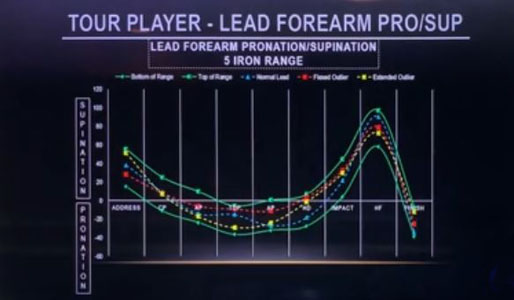
Top = P4 position, AP = P5 position, Mid = P6 position and impact = P7
position.
The green lines represent one standard deviation, which means that ~68% of
pro golfers fall within that range. Note that the green line range show that
the "average" pro golfer's lead forearm is either neutral or slightly
pronated at P4 and that there is no significant movement towards supination
between P4 => P6 and note that the slope of the green graph only starts to
move rapidly in the direction of supination after P6.
Note that there are three individual pro golfers presented in that image.
Note that the red golfer does not change his degree of lead forearm
pronation between P4 => ~P5.5 and he then starts his lead forearm supination
phenomenon after P5.5. That type of pattern would naturally be expected in a
golfer who does not shallow his clubshaft during the P4 => P5.5 time period.
Note that the blue golfer increases his degree of lead forearm pronation to
a small degree between P4 => ~P5.5 and he then starts his lead forearm
supination phenomenon after ~P5.5 - and that type of pattern would naturally
be expected in a golfer who significantly shallows his clubshaft during the
P4 => P5.5 time period. Note that the yellow golfer starts his lead forearm
supination phenomenon earlier - starting between P5 => P5.5. That early lead
forearm supination pattern is usually combined with lead wrist flexion and
it a rare pattern that is seen in only a few pro golfers (eg. Gary
Woodland).
The "evidence" presented in Jon Sinclair's study is very convincing and it
clearly demonstrates that the majority of pro golfers do not start their
lead forearm supination phenomenon before P5.5 and that they only start to
rapidly supinate their lead forearm between P6 => P7.
Two questions then arise - i) what is the primary factor that determines the
magnitude of lead forearm supination happening between P6 => P7 and ii) does
a large degree of pelvic/upper torso rotation between P6 => P7 mean that the
golfer needs to perform less lead forearm supination in order to square his
clubface relative to his clubhead path by impact?
Watch the first EC video between the 6:10 - 7:35 minute time points. Note
that EC opines that if a golfer manifests a lot of body rotation in the
later downswing (and he uses Viktor Hovland and Dustin Johnson as examples)
that the golfer will then need to use less counterclockwise rotation of the
lead forearm in the later downswing in order to square the clubface by
impact. By contrast, EC opines that a greater amount of lead forearm
supination will consequently be required if the golfer has a far more
limited amount of body rotation happening in the later downswing.
EC is totally wrong!!! There is no negative/inverse correlation between the
amount of body rotation happening between P6 => P7 and the amount of lead
forearm supination required between P6 => P7. In fact, there is no causal
correlation at all and the major factor that determines the amount of lead
forearm supination required between P6 => P7 is the strength of the lead
hand grip - pro golfers who use a weak-or-neutral lead hand grip will
require a large amount of lead forearm supination between P6 => P7; pro
golfers who use a moderately strong lead hand grip will require a moderate
amount of lead forearm supination between P6 => P7; pro golfers who use a
very strong lead hand grip will require a very small amount of lead forearm
supination between P6 => P7 - irrespective of the amount of body rotation
happening between P6 => P7.
I will now provide evidentiary proof in order to prove all of my claims made
in the last paragraph.
Let's start with Justin Thomas' driver golf swing action - note that Justin
Thomas uses a weak lead hand grip.
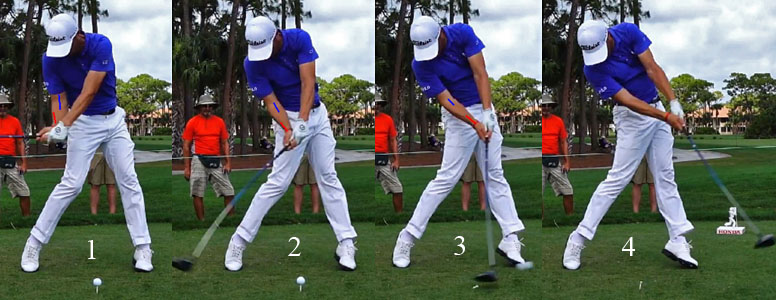
Image 1 is at P6, image 2 is at P6.5 and image 3 is at impact.
Note that the back of his lead hand and his lead lower forearm's lower
radial bone are parallel to the ball-target line at P6. Note that there has
been a small amount of counterclockwise rotation of the back of his lead
hand and his lead forearm's lower radial bone happening between P6 => P6.5
due to lead forearm supination, and that much more is happening between P6.5
=> P7. Note that his lead lower forearm's lower radial bone is angled about
20 degrees to the right at impact, which indicates that it rotated ~70
degrees between P6 => P7 (mainly due to lead forearm supination).
Note that JT has a very open pelvis/upper torso alignment at impact and that
a large amount of body rotation happened between P6 => P7 - but it did not
alter the fact that he needed to use a large amount of lead forearm
supination (~70 degrees) during the P6 => P7 time period in order to get a
square clubface by impact.
Let's now consider Collin Morikawa's driver golf swing action - note that he
also uses a weak lead hand grip.
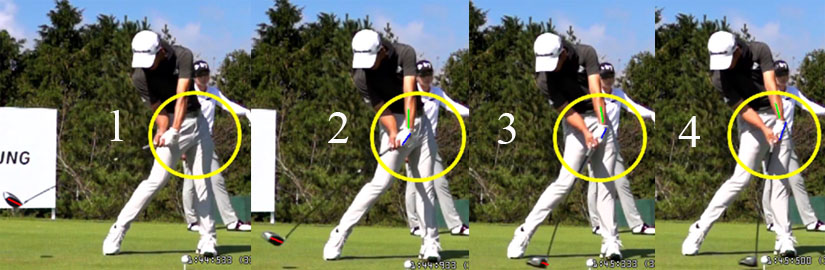
Image 1 is at P6.2, image 2 is at P6.5, image 3 is at P6.8 and image 4 is at
impact.
I have drawn a green line over his lead lower forearm's lower radial bone,
which is an useful marker to estimate how much he is supinating his lead
forearm between P6.2 => P7.
Note that you cannot see a green line in image 1 because his lower lead
forearm's lower radial bone is roughly parallel to the ball-target line at
P6.2. Note that the green line is perpendicular to the ball-target line at
P6.8, which means that his lead lower forearm's lower radial bone has
already rotated ~90 degrees between P6.2 => P6.8. Note that there is another
~10-15 degrees of rotation of his lead lower forearm's lower radial bone
happening between P6.8 => impact, so that he is rotating his lead lower
forearm's lower radial bone ~100-105 degrees between P6.2 => P7 mainly due
to lead forearm supination - despite the fact that he is rotating his body
by a very large amount in his later downswing so that he ends up with a very
open pelvis alignment at impact. That fact shows that having a very active
body rotation in the later downswing does not diminish the amount of lead
forearm supination required during that same time period if one adopts a
weak lead hand grip strength.
Why does Collin Morikawa need an additional ~25-30 degrees of lead forearm
supination in his later downswing to get a square clubface by impact -
compared to Justin Thomas who also uses a weak lead hand grip? The answer is
related to the fact that CM has a very bowed lead wrist at impact, which
angles his clubshaft backwards away from the target creating a large amount
of forward shaft lean. By supinating his lead forearm more than usual (for a
golfer who adopts weak lead hand grip) he can decrease the amount of forward
shaft lean to get his desired amount of forward shaft lean at impact (see
image 4).
Let's now now consider Viktor Hovland's driver golf swing action - note that
he uses a moderately strong lead hand grip.
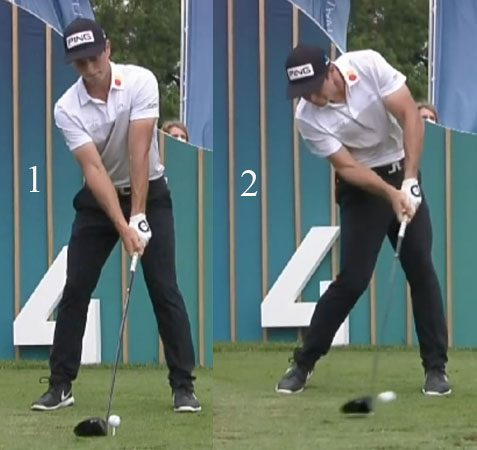
Image 1 shows VH at address - note that his lead forearm's lower radial
bone is angled ~45 degrees to the right secondary to the fact that he
adopts a moderately strong (3+ knuckle) lead hand grip at address.
Image 2 shows VH at impact - note that his lead lower forearm's lower
radial bone is angled ~45 degrees to the right (and it is no different
in degree relative to address).
Consider the amount of counterclockwise rotation of his lead forearm's
lower radial bone that happens between P6 => P7.
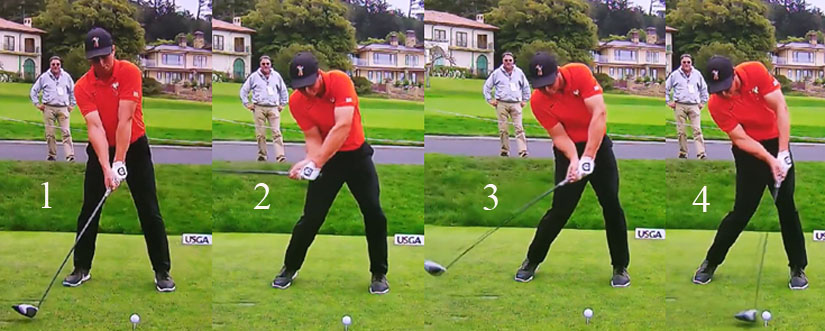
Image 1 is at P1.5 (because this swing video did not start at his P1
position), image 2 is at his P6 position, image 3 is at his P6.5
position and image 4 is at impact.
Note that VH has adopted a moderately strong lead hand grip strength
at address so that his lead lower forearm's lower radial bone is
angled about 45 degrees to the right. Note that his clubface is
presumably facing the target at address (P1) and that it is ~45
degrees closed relative to the back of his lead wrist.
Note that VH's lead lower forearm's lower radial bone is ~90 degrees
open relative to the ball-target line at P6, ~60 degrees open
relative to the ball-target line at P6.5 and ~45 degrees open
relative to the ball-target line at impact. Note that his 45 degrees
open alignment of his lead lower forearm's lower radial bone at
impact allows him to automatically/naturally get his desired amount
of forward shaft lean at impact and it also allows him to get his
clubface square at impact. VH is using very little lead forearm
supination (~45 degrees) during his PA#3 release action that is
happening between P6 => P7 in order to get his clubface square
relative to his clubhead path at impact because he uses a moderately
strong lead hand grip. It is not due to the fact that he is rotating
his body a lot in his later downswing between P6 => P7 so that he
ends up with an open pelvis alignment at impact -
in fact, from a
comparison perspective, note that he is rotating his body even less
counterclockwise in his later downswing than Justin Thomas and
Collin Morikawa and his pelvis is less open at impact.
It is a myth to believe that rotating the body (pelvis/upper
torso) a lot in the later downswing between P6 => P7 decreases the
amount of counterclockwise lead forearm rotation required between P6
=> P7 in order to square the clubface by impact - as EC
wrongheadedly suggested in his video.
I criticised Eric Cogorno (EC) in my initial post for claiming that a golfer
should start the lead forearm supination phenomenon as early as possible in
the downswing, and I demonstrated that it never happens in any pro golfer.
I sent a link to this thread to EC, and I noted that he has now produced
a new golf instructional video on the topic of clubface closing
where he no longer states that counterclockwise of the lead
forearm should occur during the P4 => P5.5 time period.