Comparing pivot motions
In this post, I am going to compare the pivot motion technique taught by Milo
Lines versus the "standard" pivot motion technique.
Milo Lines has produced a fair number of videos on how to rotate the pelvis and
upper body during the downswing and early followthrough, and the following video
is a good explanatory example of his thinking.
I have made capture images of his pivot motion-demonstration seen in the video, and I will use these capture images to comment on his conceptual approach.
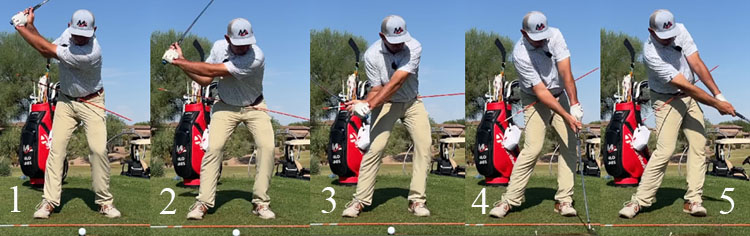
Image 1 shows Milo at his P4 position. Note that he has
placed a rod through his trouser belt loops and its change in angular
displacement is reflective of his degree of pelvic rotation.
Image 2 is at his P5 position. Note that Milo favors an overt squat motion
involving an increased degree of hip joint flexion during the hip-squaring
action that is happening between P4 => P5, and that causes his head to drop as
he acquires an increased degree of anterior pelvic tilt. Milo deliberately wants
to avoid any pelvic sway motion to the left during his hip-squaring phase and he
basically prefers the "idea" that the pelvis motion must be perceived to
primarily be a rotary motion, and not a shift-rotation motion. Milo also does
not want to spin the pelvis in the early downswing, which would cause the trail
pelvis to prematurely leave the tush line and potentially block the space in
front of the trail hip joint area where he plans to position his trail elbow by
P5.5. Milo talks about the "feel" of the pelvis moving back away from the
ball-target line as he squats and acquires an increased degree of anterior
pelvic tilt during the early downswing, which means that he is definitely
avoiding any possibility of acquiring the swing fault of early extension due to
a pelvic thrust motion towards the ball-target line. Another point about his
recommended pelvic motion technique is that he does not want to acquire too much
torso-pelvic separation (dynamic X-factor) during the early downswing and he
wants a golfer to start turning the upper torso counterclockwise very soon after
he starts transitioning into the downswing.
Image 3 is at the P5.5 position where he has continued to rotate his pelvis
counterclockwise to a marginally open position. Note how easily he manages to
get his trail elbow into a desirable pitch location just in front of his trail
hip joint area by P5.5. Note that he is still maintaining a large degree of
anterior pelvic tilt at P5.5 and that creates a potential space in front of his
trail hip area for the pitch location positioning of his trail elbow.
Image 4 is just after P7 (as there was no frame at impact in the video) and
image 5 is at P7.5+. Note how Milo continues to actively rotate his pelvis
counterclockwise between P5.5 => P7.5+ so that he has a very open pelvis
alignment at impact and also during his early followthrough. Another golf
instructional point that Milo emphasises is that he wants to rotate the upper
torso at roughly the same speed as the pelvis during the later downswing and
early followthrough and he talks of the "feel" of the "upper chest covering the
ball" during the later downswing. One major advantage of Milo's firm
recommendation to keep the upper torso rotating actively with the pelvis during
the P5.5 => P7+ time period is that it gets the trail shoulder socket further
downplane so that he does not "run-out-of-trail arm" by P7 - note how easily
Milo can maintain a slightly bent trail arm and a partially extended trail wrist
at P7. Another major advantage of having such an active pelvis/upper torso
rotation that gets both the pelvis and upper torso significantly open by P7 is
that it more easily allows a golfer to get his hands ahead of the ball at impact
thereby ensuring the presence of a desirable amount of forward shaft lean. By
continuing to actively rotate the pelvis/upper torso counclockwise between P7 =>
P7.4 it also makes it more easy for a golfer to perform a DH-hand release action
between P7 => P7.4.
I will emphasize some of these same points when analysing these capture images
of Milo's driver golf swing action.
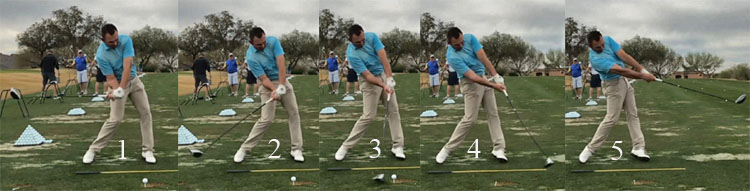
Image 1 is at P6, image 2 is at P6.5, image 3 is at P7,
image 4 is at P7.4 and image 5 is at P7.8.
Note how actively Milo continues to rotate his pelvis/upper torso
counterclockwise between P6 => P7.4+. Note how he manages to get his hands well
forward at impact so that he has a small degree of forward shaft lean at impact.
Also, note how he still has a bent trail arm and a significantly extended trail
wrist at impact, which I think is potentially advantageous because it allows the
trail hand to work as a negative hand couple through impact thereby contributing
to an increased degree of mechanical stability of the lead wrist through the
impact zone. Note how easily/efficiently he can perform a DH-hand release action
between P7 => P7.4, which allows him to keep his clubface square to his clubhead
path all the way between P7 => P7.4.
I personally think that Milo's personal pivot motion is an excellent
biomechanical way to perform a pivot motion that leads to many positive benefits
(as described).
I think that the pro golfer who best exemplifies the same basic pivot motion
pattern as seen in Milo's driver golf swing action is Viktor Hovland.
Here are capture images of Viktor Hovland's driver golf swing action.
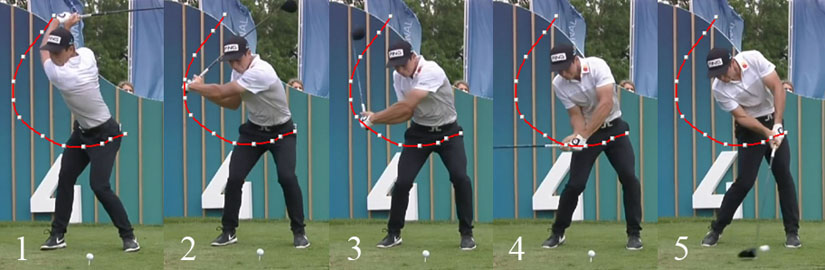
The red splined path represents his hand arc path.
Image 1 is at P4, image 2 is at P5, image 3 is at P5.5, image 4 is at P6 and
image 5 is at impact.
VH has a rightwards-centralised upper torso loading pattern at P4, while Milo's
upper torso is slightly more centralised at his P4 position.
Note how VH squats during his hip-squaring action between P4 => P5, and that
causes his head to drop as he acquires a greater degree of anterior pelvic tilt.
Note how VH continues to actively rotate his pelvis between P5 => P7 and how his
active upper torso rotation (that is combined with a large degree of right
lateral bend) allows him to get his trail shoulder well downplane by P7 - so
that he very easily gets to impact with his hands well forward of the ball,
which ensures the presence of forward shaft lean at impact. Note that VH's trail
arm is still partially bent and that his trail wrist is still significantly
extended at impact and that he has avoided a "running-out-of-trail arm"
scenario.
Here are capture images of VH's followthrough action.
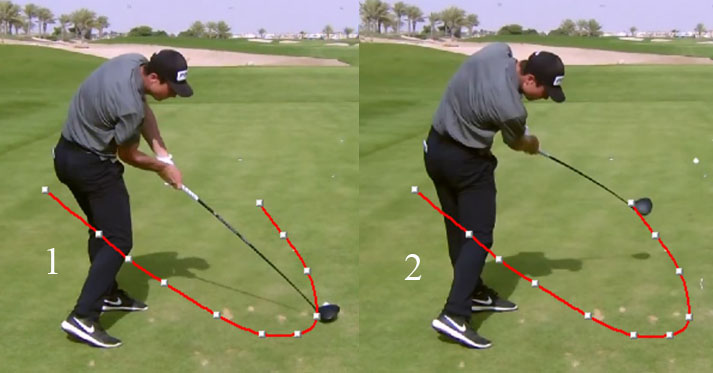
The red splined path is his clubhead path.
Image 1 is at P7 and image 2 is at P7.4.
Note that VH is performing a CP-arm release action (where his lead hand moves
inside-left very efficiently between P7 => P7.4) that is combined with a DH-hand
release action (that allows him to keep his clubface square to his clubhead path
between P7 => P7.4).
Milo aspires to perform a CP-arm release action like VH where his hands/club can
move significantly inside-left during his early followthrough, but he admits
that he does not have the flexibility to perform it as well as Ben Hogan (or) VH
in the following video - see between the 6:19 - 6:34 time point of the following
video.
If you look at Milo's/VH's lead leg through impact,
you will note that they do not straighten their lead leg fully (like Tiger
Woods or Ian Poulter or Rory McIlroy) at impact, or just post-impact, and I
strongly suspect that they could both be reverse-foot golfers.
I first became aware of the differences between a reverse-foot golfer and a
front-foot golfer when I saw this image in a PhD thesis paper by Kevin Ball.
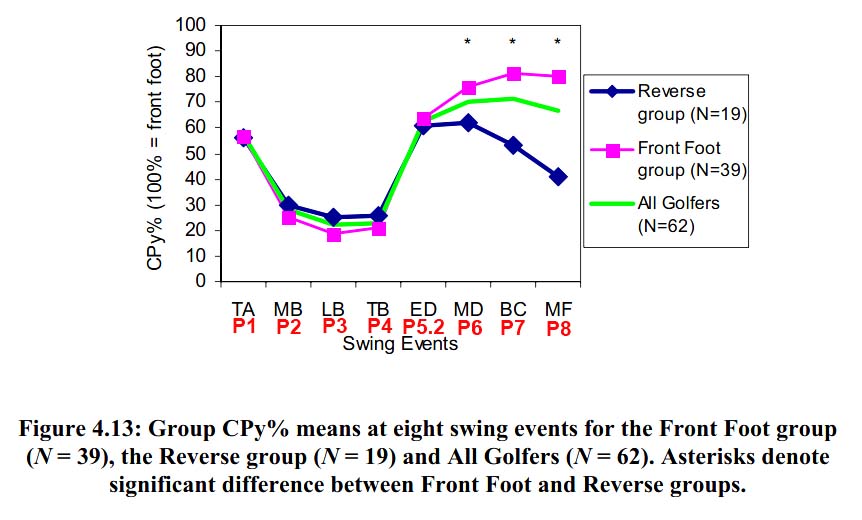
Kevin Ball did a research study where he measured the
COP (center-of-pressure) under the lead foot and trail foot during the
downswing. The above graph shows the COP measurement under the lead foot.
He noted in his study of 62 golfers that they only had 20-30% of their COP
measurement under their lead foot at P4. During the downswing, some of those
golfers steadily increased the COP measurement under their lead foot to a
maximum value of ~80% at impact and he called those golfers "front-foot
golfers". By contrast, there was another subgroup of golfers who increased
the COP measurement under their lead foot in the early downswing to its
maximum value at ~P5.2 and that they then decreased their COP measurement
under their lead foot between P5.2 => P7, and he called that subgroup of
golfers "reverse-foot" golfers.
I do not have the COP measurements of VH, but I have seen Milo's COP
measurements. As a rough approximation, I suspect that Milo has ~85% of his
overall COP measurement under his lead foot at P5.2, and about 60 - 70% at
impact and <60% at P7.4. If I am correct in my estimation of his
COP-measurements, that makes Milo a "reverse foot" golfer who is decreasing
the COP-measurement under his lead foot between P5.2 => P7+. Why could this
be important? I think that it can potentially be much easier to
biomechanically rotate one's pelvis, while maintaining a high degree of
anterior pelvic tilt (like Milo and VH), between P5 => P7 if one is a
reverse-foor golfer, and not a front foot golfer. I think that a front-foot
golfer is not going to be able to rotate the pelvis very efficiently like
Milo/VH who rotate their pelvis counterclockwise between P5.5 => P7
while
maintaining a high degree of anterior pelvic tilt. I suspect that it is
much easier for a front-foot golfer to perform the "standard" pivot motion.
A good example of a front-foot golfer is Grant Waite who gets >80% of his
COP-measurement under his lead foot by impact.
Here is a video of Grant Waite's golf swing action.
Here are capture images from the above video.
Face-on capture images.
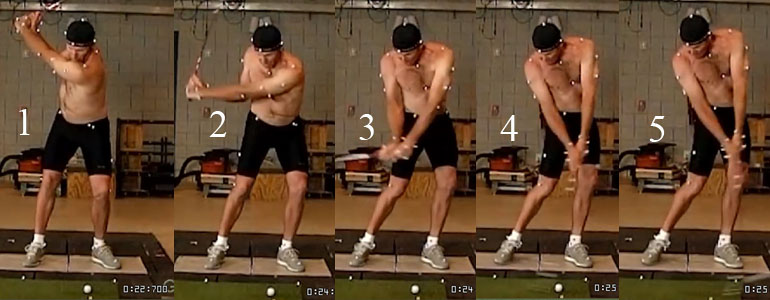
DTL capture image.
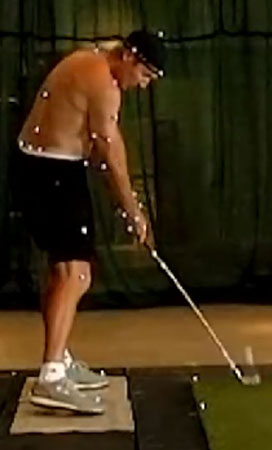
Note that GW manifests many features of a "standard"
pivot motion - i) the pelvis is only slightly open at impact and the upper
torso is barely open at impact (and often parallel to the ball-target line
at impact); ii) the trail shoulder is not that far downplane so that the
trail arm will be less bent, and the trail wrist less extended, at impact
and iii) the hands will be inside the lead thigh at impact; iv) the lead
shoulder socket may be located over the lead foot at impact rather than
being well behind the lead foot at impact (as seen in VH's/Milo's driver
golf swing action) and v) the lead leg will be straighter and the lead hip
joint will more likely be more vertically-aligned over the lead foot at
impact.
Consider other features of a "standard" pivot motion type of golf swing
action.
Capture images of Tiger Woods driver swing action.

Image 1 shows TW at impact and images 2,3 and 4
show his early followthrough action.
Note that TW's pelvis does not continue to rotate counterclockwise much
between P7 => P7.4; that he "runs-out-of-trail arm" very soon after
impact because his trail shoulder socket does not move far enough
downplane; and that he is obliged to use a CF-arm release action during
his followthrough that is combined with either a delayed full-roll
subtype of DH-hand release action or a rolling subtype of non-DH hand
release action.
Here is another pro golfer - Rory McIlroy - who uses the "standard"
pivot motion technique.
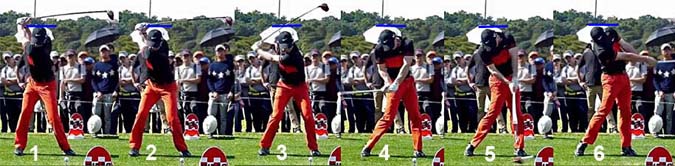
Image 1 is at P4, image 2 is at P4.5, image 3 is
near P5, image 4 is at P6, image 5 is at impact and image 6 is after P8.
Note that Rory has a very fast pelvic shift-rotation motion between P4
=> P6 where he acquires a lot of torso-pelvic separation, and that his
pelvis is slightly open at P6. However, he then stalls his rotary pelvic
motion and there is no further counterclockwise rotation of his pelvis
during his later downswing and early followthrough. Note how he has a
straightened lead leg at impact with his lead shoulder socket and lead
hip joint near-vertically located over his lead foot at impact.
Here are capture images of Rory's early followthrough action - as seen
from an upline viewing perspective.
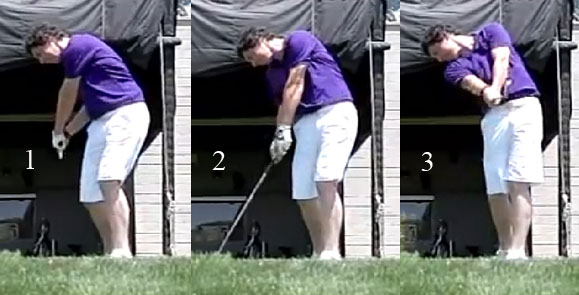
Image 1 is at P6, image 2 is at P7 and image 3 is
at P8.
Note that he does not continue to actively rotate his pelvis
counterclockwise between P7 => P8 and that he performs a CF-arm release
action that is combined with a borderline delayed full-roll DH hand
release action, or a rolling subtype of non-DH hand release action,
between P7 => P8.
I suspect that 95% of pro golfers use the "standard" pivot motion
technique and not the Milo Lines-taught pivot motion technique (which I
think has certain biomechanical advantages)?
Why do they not use Milo's more rotary pivot motion technique?
I do not know the answer. It could be due to a number of factors eg. i)
traditional pivot motion teaching passed along from each generation of
golf instructors to later generations of golf instructors over the past
10+ decades; ii) a lack of flexibility that makes it too physically
difficult to perform the Milo Lines-taught pivot motion with great
ease/efficiency and iii) the fact that many pro golfers use a front-foot
COP-pattern that may not be compatible with the Milo Lines-taught pivot
motion technique.
From an individual student-golfer's perspective, who wants to consider
whether he should use the Milo Lines-taught pivot motion technique, he
first needs to discover whether he has the flexibility and biomechanical
skills needed to perform the Milo Lines-taught pivot motion pattern in a
consistently efficient manner. Unfortunately, I am not aware that Milo
Lines has explored this issue and developed a series of biomechanical
tests to determine whether each student-golfer has the
flexibility-and-biomechanical skills needed to perform his recommended
pivot motion technique in an efficient manner. Also, I do not believe
that Milo has considered the possibility as to whether being a
front-foot golfer (like Brendon Devore) makes it impossible, or very
difficult, to efficiently perform his Milo Lines-taught pivot motion
technique.
Finally, although I (= an amateur golf theorist) personally favors the
Milo Lines-taught pivot motion technique from a purely theoretical
perspective, it is important to realise that the world's greatest golf
ball strikers (both in the past era and the present era) have obviously
learned how to hit consistently accurate shots using the "standard"
pivot motion technique. It may therefore be better for Brendon DeVore to
use the "standard" pivot motion technique if he cannot ever master the
Milo Lines-taught pivot motion technique.
-----------------------------------------------------------------------------------------------------------------------------------------------------------------------
2nd post-:
I have come up with an interesting explanation as
to why golfers who use the "standard pivot" have more posterior tilt in
the later downswing than a reverse-foot golfer (like Milo Lines and
Viktor Hovland) who use the Milo Lines-taught pivot motion.
When you look at ML/VH's later downswing, they are rotating their pelvis
and upper torso counterclockwise at roughly the same speed and they
maintain a relatively high degree of anterior pelvic tilt through
impact.
By contrast, a golfer like Rory McIlroy (who is presumably a front-foot
golfer and who uses the "standard" pivot motion) has a very fast pelvic
rotation between P4 => P6 where he generates a lot of torso-pelvic
separation. Then, his pelvis stalls at ~P5-5 - P6 and he has very little
active pelvic rotation between P6 => P8. However, his upper torso
is rotating very actively and very fast between P6 => P8 as can be seen
in the following capture images.
How does he get the power to rotate his upper torso so fast between
P6 => P8 when his pelvis is more static from a rotary perspective?
The most rational explanation is that he is using an active muscular contraction of his external oblique abdominal muscles. When those muscles actively contract they shorten the distance between the lower rib cage and the pelvis - and that will cause posterior pelvic tilt (as explained by Greg Rose in the following video).
In other words, posterior pelvic tilt is more likely to happen in the "standard" pivot motion where the pelvis leads the upper torso from a rotational perspective in the earlier downswing phase, which is then followed by a secondary phase in the later downswing where the upper torso is rotating faster than the pelvis (which has slowed down after P5.5 as the golfer progressively straightens his lead leg and braces it). For the upper torso to rotate much faster than the pelvis after P5.5, the external oblique muscles must be maximally contracting and that will pull the rib cage closer to the pelvis inducing more posterior pelvic tilt between P5.5 => P7.
Jeffrey Mann.
https://newtongolfinstitute.proboards.com/thread/1054/comparing-pivot-motion-techniques