Brendon is wrong about both of those claims.
The 2606/3207 measurements are actually the measurement of the instantaneous rate of rotation of the back of the lead hand at impact, and the absolute measurements of 53/63 degrees are the absolute amount the back of the lead hand is rotating between P7 => P8, which does not necessarily correlate with the degree of clubface closure relative to the clubhead path. Most importantly, one needs to understand that the rotary metric is a global measurement where the rate of rotation of the lead hand is measured relative to its address position, and that the actual measurement can be affected by motion of the lead hand along the hand arc path as the motion of the lead arm generates a clubhead path and it is not only a reflection of lead forearm rotation (which mainly affects the degree of clubface closure relative to the clubhead path).
Evidentiary proof that Brendon is wrong can be easily derived from this
1.5 hour long Hack Motion-sponsored video featuring Brian Manzella.
The answer to the question as to what the "rotation at impact" measurement in degrees/second really means - listen to the Hack Motion representative's answer to a question between the 1:00:10 - 1:00:58 minute of the video where he states that it depends on the club being swung - ~1,500 degrees/second at impact with a driver and ~500 degrees/second at impact with a short iron. That makes perfect sense to me because one has to factor-in lead arm/clubhead speed at impact and the driver's lead arm/clubhead speed at impact is much greater than a short iron's lead arm/clubhead speed at impact - so even if the pattern of counterclockwise rolling of the lead hand is the same for those two clubs, then the rate of lead hand rolling at impact must be much faster if the lead hand/clubhead is moving faster through impact in a driver swing.
If you look at a number of BM swings using a 6-iron in his video, you will see a range of "rotation at impact" values roughly between 1,274 - 1,623 degrees/second at impact. Brendon recorded values around 1,500 degrees/second at impact in the BBG video. I cannot fathom why Milo would be recording a Hack Motion rotation measurement of 3,207 degrees/second at impact in his normal/regular swing considering that he uses a very strong lead hand grip combined with a DH-hand release action through impact. I therefore have to question the accuracy of those results!
Now, let's discuss what would cause the absolute Hack Motion rotation measurements between P7 => P8 to be different. Brendon implied that a lower measurement would reflect a DH-hand release action (eg. as seen in Milo's regular swing) and that a larger measurement would imply a high degree of rolling of the lead hand through-and-after impact due to the execution of a rolling subtype of non-DH hand release action through impact.
BM's video shows that Brendon is incorrect.
BM performs a number of different types of swing actions in his video, and I can see no evidence that there is any significant difference between a DH-hand release action swing versus a rolling subtype of non-DH hand release swing - with respect to the global amount of counterclockwise rolling of the lead hand happening between P7 => P8. However, there is a major difference between a rolling subtype of non-DH hand release action swing (where the Hack Motion rotation measurements between P7 => P8 are larger) and a flipping subtype of non-DH hand release action swing (where the Hack Motion rotation measurements between P7 => P8 are much smaller).
Here is the "evidence".
Between the 32:59 - 33:43 minutes time points of his video, BM describes how he is going to perform two different types of hand release action swings - an exaggerated rolling release subtype of non-DH hand release action swing versus a lead wrist flicking/flipping type of non-DH hand release action swing where he deliberately chicken-wings the lead arm and allows the lead wrist to rapidly extend through impact.
Here is a capture image of BM performing his rolling subtype of non-DH hand release swing action.
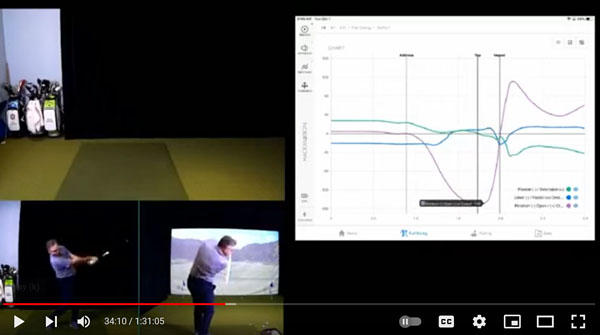
You can see how BM is rolling his trail
hand over his lead hand at P8+ as he transitions from a
pre-impact PA#3 release action directly into a release swivel
action and that causes the purple graph to be very steep
post-impact with a high peak measurement.
Here is a capture image showing BM performing his "flick"/flipping type of release action swing.
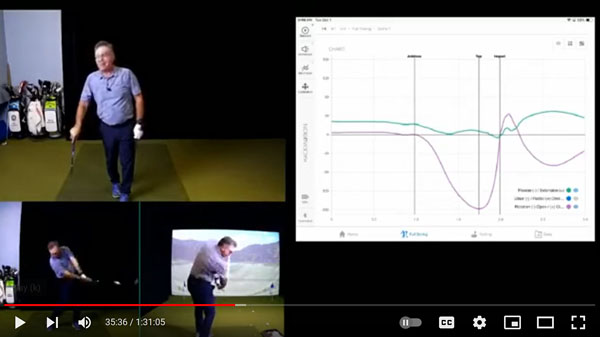
You can see BM stalling the forward motion of his lead arm through impact while he fully straightens his trail wrist => flicking/flipping the clubshaft passed his lead arm.
Note that there is no difference in the shape of the purple curve between P6 => P7 because he has to use the same amount of PA#3 release action to get a square clubface by impact seeing that he uses a neutral lead hand grip in both swings - but his post-impact purple curve is less steep and lower in absolute height.
Here are the actual differences in absolute Hack Motion rotary measurements.
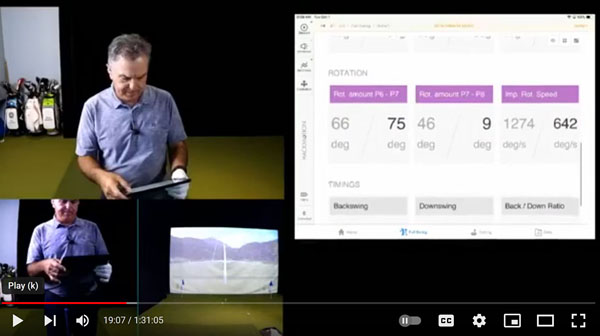
The measurements in gray reflect the rolling release subtype of non-DH hand release action swing and the measurements in black reflect his flipping subtype of non-DH hand release action swing.
Note that there is negligible difference in the P6 => P7 measurements (72 degrees versus 69 degrees), but there is a large difference in the P7 => P8 measurements (70 degrees versus 32 degrees).
In other words, seeing much lower rotary measurements between P7 => P8 likely indicates that the golfer is not rolling his lead arm/hand through impact and that he is likely using a flipping subtype of non-DH hand release action.
Here is a capture image of BM performing what he calls a "hold-off" (handle-dragging type) of hand release action.
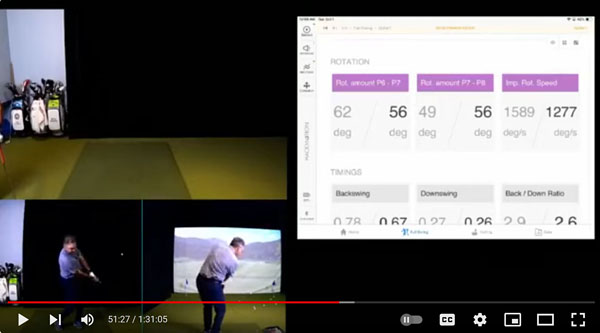
Note that BM is performing a CP-arm release action combined with a DH-hand release action.
Note that the amount of rotary motion of his lead hand between P7 => P8 is 56 degrees, which is slightly less than his exaggerated rolling subtype of non-DH hand release action's measurement of 70 degrees, but very similar to his "stock" swing which has a measurement of 57 degrees (see the 3:15 - 3:42 minute time point of the BM video). In other words, one cannot use Hack Motion's rotary measurements between P7 => P8 to differentiate between a DH-hand release action versus a rolling subtype of non-DH hand release action (if it is not exaggerated).
I personally cannot understand why
any golf instructor would even use the Hack Motion's rotary
measurement as it has no useful discriminatory value. It is
very easy to differentiate between a flipping subtype of
non-DH hand release action versus a rolling subtype of
non-DH hand release action (or versus a DH-hand release
action) using a swing video - and I cannot understand why
any golf instructor would even bother to measure the
global amount of rotation of the lead hand between P7 => P8.
---------------------------------------------------------------------------------------------------------------------------------------------------------------------------------------------------------------
This is my 2nd post analysing the BBG video.
In the 1st post, I demonstrated that there is no significant
difference in the amount of rotation of the lead hand
happening between P7 => P8 in a golfer who uses a DH-hand
release action versus a rolling subtype of non-DH hand
release action.
I will now discuss the P6 => P7 time period.
If you look at Brendon's swing, he had an "average" rotary measurement of the HackMotion device of ~56 degrees between P6 => P7.
Then, note that Milo started to educate Brendon regarding his release action starting at the 8:43 minute time point of the BBG video. One of the major golf instructional points adopted by Brendon is the "idea" of what Brendon calls the "twist fix" where Brendon actively bows his lead wrist between P4 => P6 so that the lead wrist is overtly bowed at P6. This golf instructional advice stems from Milo's belief expressed in the BBG video where he stated that if the clubface is more square at P6, then there would be less need to flip-roll the clubface later.
So, the relevant question arises - does having a slightly more square clubface alignment at P6, secondary to an active lead wrist bowing maneuver, decrease the amount of rotation of the lead hand happening between P6 => P7? Watch Brendon perform the Milo-recommended swing action multiple times between the 8:43 - 14:49 time points of the video. Note that his last swing at the 14:49 minute time point, which Milo thought was very good, had a Hack Motion rotary measurement of 59 degrees between P6 => P7.
Does that surprise you - that performing an active lead wrist bowing maneuver in order to get the clubface slightly more square (relative to the clubhead arc) at P6 does not decrease the amount of lead forearm supination that must happen during the PA#3 release action that is happening between P6 => P7?
It does not surprise me - because there is no "evidence" that using an active lead wrist bowing maneuver decreases the amount of rotation of the lead wrist/hand that has to happen between P6 => P7 in order to get a square clubface by impact. In fact, the "evidence" suggests that it slightly increases the amount of lead forearm supination that must happen during a PA#3 release action in order to get the clubface square by impact.
Jon Rahm, like Collin Morikawa, is a poster child example of a golfer who uses the bowed lead wrist technique combined with a weak lead hand grip.
Here is Jon Rahm's 3D measurements.
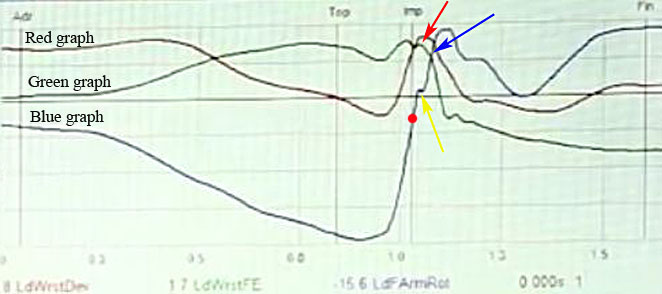
The blue graph is his lead forearm supination graph - note how much, and how fast, he supinates his lead forearm between P6 => P7. I cannot supply you with an actual measurement because I do not know the scale of measurement, but I can surmise that it is very large.
Here are capture images of
his release action - as viewed from face-on.
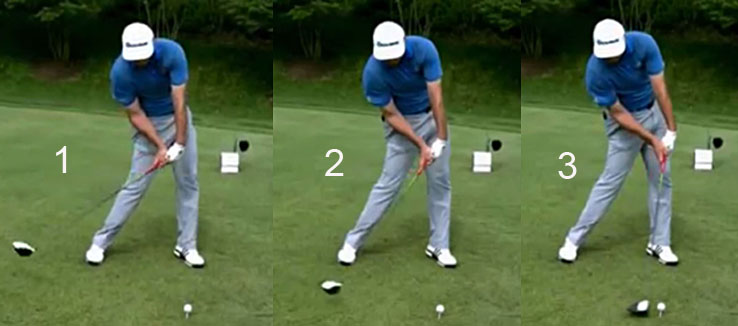
Image 1 is at P6.5 and image 3 is at P7.
Look at his lead forearm's lower radial bone, and note how much its has rotated counterclockwise between P6.5 => P7 - note that it has rotated to an alignment at impact where it has rotated >90 degrees relative to the ball-target line (= probably ~100 degrees).
Here are capture images
of Justin Thomas, who also uses a very weak lead
hand grip, but who does
not use the bowed
lead wrist technique.
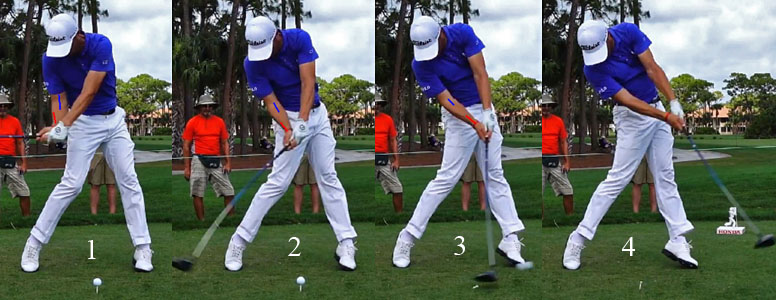
Note that his lead lower forearm's lower radial bone is only rotated ~70 degrees (relative to the ball-target line) at impact (image 3).
I believe that it is a fallacy to believe that using the bowed lead wrist maneuver (= reverse motorcycle move), that squares the clubface slightly more (relative to the clubhead path) during the P4 => P6 time period, decreases the amount of lead forearm supination required during the P6 => P7 time period (as Milo implied in the BBG video).
I suspect that the Hack Motion's rotary measurement between P6 => P7 is mainly affected by the strength of the lead hand grip - being ~25-30 degrees in a pro golfer who uses a very strong lead hand grip, being ~35 - 45 degrees in a pro golfer who uses a moderately strong lead hand grip, being ~50 - 60 degrees in a pro golfer who uses a neutral lead hand grip, and being >65 degrees in a pro golfer who uses a very weak lead hand grip.
Jeffrey Mann.
https://newtongolfinstitute.proboards.com/thread/1047/utility-hack-motions-rotary-metric