Comparing a DH to a non-DH hand release action
In this post I am going to
mainly talk about the differences between a DH-hand release action and a
flipping subtype of non-DH hand release action with respect to their different
biomechanics. Originally, I was just going to analyse my friend's opinion that
the likely cause of a DH-hand release action is due to a delayed release of the
club (= delayed release of PA#2) in this post, but I finally decided to
extensively review my reformulated opinions regarding two topics- i) my revised
definition of a DH-hand release action, and ii) my revised opinions with respect
to whether the two different hand release actions can have a major effect on a
golfer's ability to generate a straight ball flight.
In the past I have defined a DH-hand release action as
being present if the clubshaft does not bypass the lead arm (from an angular
rotational perspective) during the early followthrough time period between P7 =>
P7.2, which usually results in the clubface being square relative to the hand
arc path during that early followthrough time period. I have also inferred that
the main reason that enables a golfer to perform a DH-hand release action is
their ability to ensure that the targetwards momentum of the lead arm is
perfectly matched relative to the acquired forward/targetward momentum of the
released club during that early followthrough time period. Many pro golfers, who
perform a DH-hand release action between P7 => P7.2 (or even further to P7.4),
also maintain a bent (extended) trail wrist during that early followthrough time
period even though it is not an obligatory requirement in my definition of a
DH-hand release action. I have also stated that their is no mandatory causal
connection between what happens pre-impact in terms of the biomechanics causing
the efficient release of PA#2 (release of the club) and the efficient release of
PA#3 (which is due to lead forearm supination) and the post-impact biomechanics
causing the efficient execution of a DH-hand release action. My friend, Jim
George, has a different personal perspective, and he believes that it is
artificial to separate the release phenomenon into a pre-impact phase and a
post-impact phase because he thinks of the release of the club as being a single
golf swing biomechanical phenomenon (singular set of biomechanical actions) that
starts at the release point and continues through impact to the end of the
followthrough (or to at least P7.4+). He also hypothesised that a DH-hand
release action is most likely due to a delayed release of the club while a
non-DH release action is due to a non-delayed (standard) release of the club. In
other words, he hypothesised that the timing of the release of the club is the
major factor that causes a DH-hand release action versus a non-DH hand release
action through impact. I decided to test his hypothesis by more thoroughly
comparing the hand release actions of a large number of pro golfers and I will
present some of their release actions in this post in order to demonstrate why I
believe that his hypothesis is not supported by the "real life" reality of the
hand release actions of many pro golfers.
To start off, I have to define what represents a
non-delayed (standard) release of the club versus a delayed release of the club
(= release of PA#2 in TGM terminology). The release of the club is due to lead
wrist ulnar-deviation that causes the angle between the club and the lead arm to
start to increase during the downswing (in the plane of lead wrist radial =>
ulnar deviation and where that release plane is usually parallel to the
swingplane if the clubshaft is always on-plane during the entire downswing
action). Most pro golfers have at least a roughly ~90 degree angle between the
lead arm and the clubshaft at P4 and it is often referred to as the clubshaft
lag angle. The club release action happens when that angle start to increase
during the mid-downswing, starting usually between P5.2 => P5.5 and that would
represent a non-delayed (standard) release pattern.. If the club starts to
release before P5.2, I would be inclined to refer to that release pattern as an
early release pattern and if it starts to release after P5.5 then I would be
inclined to refer to it as a delayed release pattern. For comparison purposes, I
am going to arbitraily compare different pro golfers start-of-the-release
patterns at P6 when the clubshaft is parallel to the ground because all pro
golfers will reach this same P6 time point where the clubshaft is parallel to
the ground.
What I have noted is that most pro golfers (who
perform a non-delayed/standard release action) will likely reach the P6 time
point with their lead hand either just outside their trail thigh or opposite the
outer half of their lead thigh, and their lead arm will be angled across the
front of their chest at a ~45 -60 angle relative to the ground (or relative to
the clubshaft which is parallel to the ground). By contrast, pro golfers who use
a delayed release pattern, will likely have their lead hand opposite their
mid-trail thigh or opposite the inner half of their trail thigh, or even just
inside their lead thigh, at P6; and their lead arm will be angled >60 degrees
relative to the ground.
Here are two examples of pro golfers who use a delayed
release action.
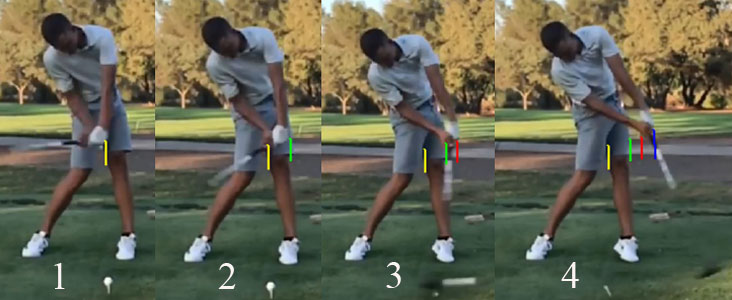
Example number 1: Cameron Champ's delayed release
action.
Image 1 is at P6, image 2 is at
P6.5, image 3 is at P7 and image 4 is at ~P7.4.
Note that I have drawn a yellow line along the front
of his lead hand at P6 and it is inside his trail thigh. Also, note that his
lead arm is angled at a ~80 degrees relative to the ground at P6. Those two
features allows me to classify his club release action as being a delayed
release action.
Note that I have drawn a green line at the front of
his lead hand position at P6.5, a red line opposite the front of his lead hand
position at impact and a blue line opposite the front of his lead hand position
at P7.4. Looking at these lines allows one to roughly assess where his lead hand
is positioned relative to the ball during his release action. Note that his lead
hand has almost reached the ball by P6, and that his lead hand is already
bypassing the ball at P6.5. By impact, his lead hand is well ahead of the ball,
which allows him to have forward shaft lean at impact. Note that his lead hand
is well ahead of the outer border of his lead thigh at P7.4. Note that he is
performing a DH-hand release action between P7 => P7.4 and that he has
maintained a bent trail wrist all the way between P7 => P7.4. This DH-hand
release pattern is compatible with my friend's hypothesis that a delayed club
release action will result in a DH-hand release action during the early
followthrough time period.
Example number 2: Dustin Johnson's delayed release
action.
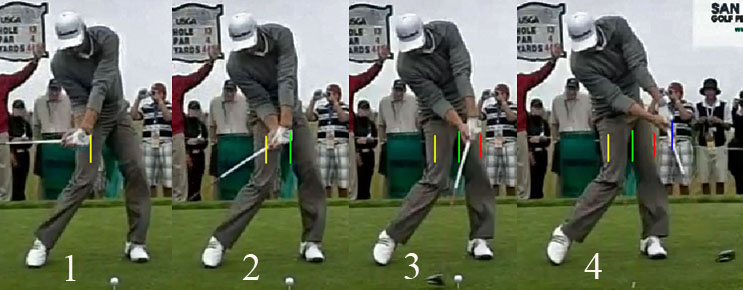
Image 1 is at P6, image 2 is at
P6.5, image 3 is at P7 and image 4 is at ~P7.4.
Note that I have drawn a yellow line along the front
of his lead hand at P6 and it is opposite his mid-trail thigh. Also, note that
his lead arm is angled at a ~70 degrees relative to the ground at P6. Those two
features allows me to classify his club release action as being a delayed
release action. Note that his lead hand is ~4 - 6" behind the ball position at
P6, which gives his lead hand an opportunity to travel more distance between P6
=> ball position (compared to Cameron Champ) during his late downswing. Note
that his lead hand reaches the ball position by P6.5 and it is well ahead of the
ball at impact, which allows him to have forward shaft lean at impact. Note that
his lead hand is well ahead of the outer border of his lead thigh at P7.4. Note
that he is performing a DH-hand release action between P7 => P7.4 and that he
has maintained a bent trail wrist all the way between P7 => P7.4. This DH-hand
release pattern is compatible with my friend's hypothesis that a delayed club
release action will result in a DH-hand release action during the early
followthrough time period.
Another pro golfer who use a delayed release action is
Joaquin Niemann, and he also performs a DH-hand release action between P7 =>
P7.4. I do not know of any pro golfer who does not perform a DH-hand release
action if he uses the delayed release action technique. If you know of an
example, please let me know.
However, the hypothesis that a pro golfer, who uses a
non-delayed/standard release action, will always perform a non-DH hand release
action is invalid because there are many examples of pro golfers, who are DHers,
that use the non-delayed/standard release action. I will present two comparative
examples in this post. When making a comparison, I decided to not use pro
golfers who use a very strong lead hand grip because that predisposes them to
having a lot of forward shaft lean at impact, which may cause them to favor
using a DH-hand release action post-impact. I also decided to take ball position
into account and in my two comparisons I will make sure that the ball position
is roughly the same.
Comparison example number 1-:
Scottie Scheffler and Will Zalatoris. Both of those pro golfers place their ball
very close to their lead foot when hitting a driver and both of them use a weak
lead hand grip and a neutral/weak trail hand grip.
Capture images of Scottie Scheffler's
non-delayed/standard release action.
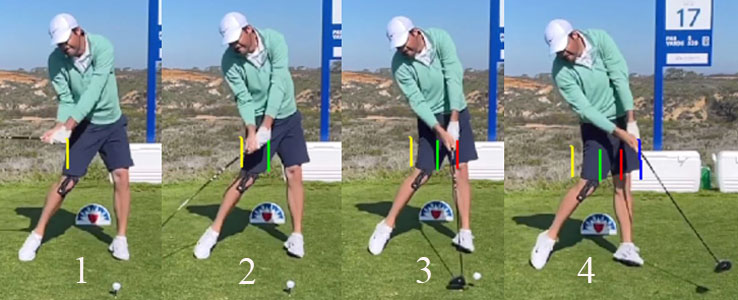
Image 1 is at P6, image 2 is at
P6.5, image 3 is at P7 and image 4 is at P7.4.
Note that I have drawn a yellow line just in front of
his lead hand at the P6 position (image 1), a green line just in front of his
lead hand at his P6.5 position (image 2), a red line just in front of his lead
hand at the P7 position (image 3), and a blue line just in front of his lead
hand at the P7.4 position (image 4).
Note that the yellow line is just outside his trail
thigh at P6, which means that he is using a non-delayed/standard release action.
Note that his lead hand is opposite the ball at impact and that he has no
forward shaft lean at impact. Note that he has a large lead hand travel distance
between the yellow line and the red line to successfully complete his sequential
release of PA#2 => PA#3. Note that his lead hand has travelled ~50% of that lead
hand travel distance at P6.5. Note that his lead hand is still moving
targetwards between P7 => P7.4 and there is no obvious stalling of the forward
motion of his lead hand during the early followthrough time period between P7 =>
P7.4. Note that the clubshaft is bypassing his lead arm (from an angular
rotational perspective) during his early followthrough, and that he is therefore
using a non-DH hand release action post-impact. Note that he has a slightly bent
trail arm and slightly bent trail wrist at P7, and also at P7.4 (but to a lesser
degree). Note that he is using a puck release action ( a term coined by Nick
Bradley) where his trail palm remains partially under/behind his club handle
through impact and he does not roll his trail palm over his lead hand during the
P7 => P7.4 time period.
Here is a capture image of a puck release action -
captured from Nick Bradley's book called "The 7 Laws of the Golf Swing".
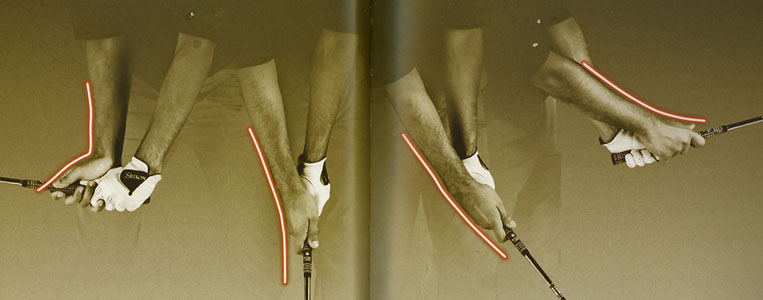
Image 1 is at P6, image 2 is at
P7, image 3 is at P7.4, and image 4 is at P8+.
Note that the trail wrist is bent at P7, and that it
straightens partly or fully by P7.4. However, the trail palm does not roll over
the trail hand (which is extending by a small amount) during the P7 => P7.4 time
period. Note that the clubshaft is bypassing his lead arm (from an angular
rotational perspective) between P7 => P7.4 while the lead wrist is increasingly
extending, which allows me to classify the puck release action as being a
flipping subtype of non-DH hand release action. If there is a significant amount
of lead forearm supination simultaneously happening during the early
followthrough time period between P7 => P7.4, then I would classify that type of
non-DH hand release action as being a flip-rolling subtype of non-DH hand
release action.
Note that Scottie Scheffler is performing a flipping
subtype of non-DH hand release action during his early followthrough, and not a
flip-rolling subtype of non-DH hand release action.
Capture images of Will Zalatoris' non-delayed/standard
release action.
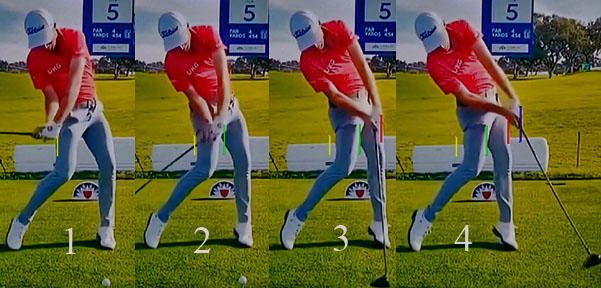
Image 1 is at P6, image 2
is at P6.5, image 3 is at P7 and image 4 is at P7.4.
Note that I have drawn a yellow line just in front
of his lead hand at the P6 position (image 1), a green line just in front of
his lead hand at his P6.5 position (image 2), a red line just in front of
his lead hand at the P7 position (image 3), and a blue line just in front of
his lead hand at the P7.4 position (image 4).
Note that the yellow line is just outside his
trail thigh at P6, which means that he is using a non-delayed/standard
release action. Note that his lead hand is opposite the ball at impact and
that he has no forward shaft lean at impact. Note that he has a large lead
hand travel distance between the yellow line and the red line to
successfully complete his sequential release of PA#2 => PA#3. Note that his
lead hand has travelled ~50% of that lead hand travel distance at P6.5. Note
that his lead hand is still moving targetwards between P7 => P7.4 and there
is no obvious stalling of the forward motion of his lead hand during the
early followthrough time period between P7 => P7.4. Note that he is not
allowing his clubshaft to bypass his lead arm (from an angular rotational
perspective) between P7 => P7.4, which means that he is performing a DH-hand
release action. Note that he has a significantly bent trail arm and
significantly bent trail wrist at P7 and also at P7.4. Note that he is not
stalling the forward motion of his lead arm at impact and that his lead hand
moves a lot targetwards between P7 => P7.4. Note that his lead wrist is not
significantly extending between P7 => P7.4. Note that his lead arm is angled
towards the target at P7, and even more so at P7.4, and that is because his
lead shoulder socket is further back at impact due to the fact that he has
more secondary axis tilt and right lateral bend than Scottie Scheffler.
These capture images show that it is optional for a pro golfer to use a DH-hand release action when performing a non-delayed/standard release action.
Note that both Scottie
Scheffler and Will Zalatoris have to use a lot of lead forearm supination
between P6.5 => P7 to complete their PA#3 release action so that the back of
their lead hand can face the target at impact, which causes their clubface
to be square at impact. Note that they both also succesfully complete their
release of PA#2 so that the clubshaft catches-up to their lead arm by
impact. I can see no significant differences in their biomechanical
movements responsible for the successful completion of their release of
PA#2/PA#3 during the pre-impact phase between P6 => P7 - even though the
biomechanics responsible for their personal post-impact hand release action
are slightly different.
What is Will Zalatoris doing differently from a
biomechanical perspective that allows him to perform a DH-hand release
action (no-roll subtype) post-impact between P7 => P7.4?
I think that a major difference is that Will
Zalatoris has a much more active pivot motion that gets his pelvis and upper
torso more open at impact. His more active pivot motion (involving a
significant degree of right lateral bend) also allows his trail shoulder to
get further downplane by P7.4, which allows him to avoid a
"running-out-of-trail arm" phenomenon, which would more likely result in a
variably greater degree of straightening of his trail arm/wrist before P7.4.
It looks like he is actively moving his lead arm targetwards during the P7
=> P7.4 early followthrough time period and that he is not stalling the
forward motion of his lead arm through impact - but he is not using a
handle-dragging technique (which can markedly decrease a pro golfer's ablity
to maximise his clubhead speed at impact). All these biomechanical features,
which are often seen in a pro golfer who uses the no-roll subtype of DH-hand
release action, have to be pre-progammed by a pro golfer before he initiates
his downswing action.
What causes Scottie Scheffler's clubshaft to
bypass his lead arm during the P7 => P7.4 time period? I strongly suspect
that it is simply due to the fact that there is a small degree of mismatch
between the forward momentum of his lead arm relative to the acquired/gained
forward momentum of his clubshaft and that it is not due to any active trail
hand slap-hinge action, where the trail hand is applying a positive
push-pressure (positive trail hand couple torque) against the aft side of
the clubshaft below the coupling point (mid-hands point) in the later
downswing just before impact. Why do I harbor this belief that any trail
wrist straightening action seen through impact, or seen soon after impact
between P7 => P7.4, in Scottie Scheffler's driver golf swing action is
passive and not active?
I am going to use Rory McIlroy's driver swing
action (which is nearly identical to Scottie Scheffler's driver swing
action) as an example because I already have the relevant capture images
needed to present my argument.
Here are capture images of Rory McIlroy's P6 =>
P7.4 time period when swinging a driver.
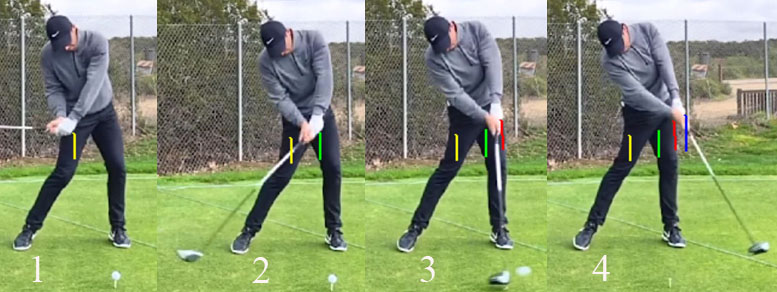
Image 1 is at P6, image 2 is at P6.5, image 3 is
at P7 and image 4 is at P7.4.
Note that I have drawn a yellow line just in front
of his lead hand at the P6 position (image 1), a green line just in front of
his lead hand at his P6.5 position (image 2), a red line just in front of
his lead hand at the P7 position (image 3), and a blue line just in front of
his lead hand at the P7.4 position (image 4).
Note that Rory's lead hand is opposite the outer
half of his lead thigh at P6, which indicates that he is using a
non-delayed/standard release action.
Note that his lead hand nearly reaches the ball
position at P6.5, which gives him less lead hand travel distance to complete
his release of PA#3 by impact. However, because he uses a moderately strong
lead hand grip he does not have to use much lead forearm supination between
P6.5 => P7, and he has no problem getting his clubface to become square by
impact.
Note that his lead hand is roughly
straight-in-line with his ball position at impact, and he has minimal
forward shaft lean at impact.
Note that he maintains the forward momentum of his
lead hand between P7 => P7.4, and he only manifests a small degree of
clubshaft flipping when he performs a flipping subtype of non-DH release
action during his early followthrough. Note that he maintains a small degree
of trail arm bend and trail wrist extension all the way to P7.4 and he is
not "running-out-of-trail arm".
Note that he is performing a puck release action
through impact, and not a roller release action where the trail palm rolls
over the lead hand soon after impact (due to trail forearm pronation).
Note the remarkable similarity (from a
biomechanical perspective) between Scottie Scheffler's and Rory McIlroy's
hand release action through impact.
Note that there is no evidence to suggest that
Rory McIlroy is using an active slap-hinge release action due to his trail
hand applying a positive push-pressure against the aft side of the club
handle below the coupling point through impact. Note that his peripheral
clubshaft is bent forward at P6.5 and at P7, which suggests that he has a
negative trail hand couple phenomenon (negative alpha torque phenomenon)
happening during his late downswing and through impact.
Here is another series of capture images of Rory
McIlroy's driver swing action.
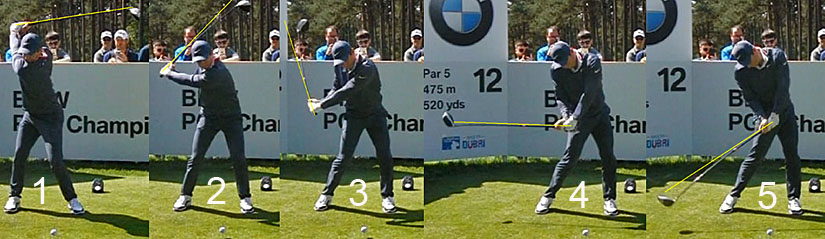
Image 1 is at P4, image 2 is at P5, image 3 is at
P5.5, image 4 is at P6 and image 5 is at P6.4.
I have drawn a yellow line along his proximal
clubshaft. Note that his entire clubshaft forms a straight line with that
yellow line at his P4 position, which means that no alpha torque is being
exerted at this time point.
Note that his peripheral clubshaft is bent back a
lot at P5 and to a lesser degree at P5.5, which means that he is applying a
positive alpha torque during his early-mid downswing between P4 and P5.5.
However, note that his clubshaft is marginally
bent forward at P6 and significantly bent forward at P6.4 (and it remains
bent forward all the way to impact). This means that the change from having
a positive alpha torque to having a negative alpha torque happens around
P5.5 - P6 and one can reasonably conclude that Rory McIlroy is applying a
positive alpha torque during the "swing power generation phase" of his
downswing between P4 and P5.5 (as a result of his pivot-induced release of
PA#4) and that his club then releases (due to the physics causing the
release of PA#2) starting between the P5 => P5.5 time point of his
downswing. During his later downswing, his peripheral clubshaft is traveling
faster than his proximal clubshaft as a result of the forces causing the
release of PA#2 and one can reasonably conclude that he is not applying any
push-pressure against the aft (back) side of the club handle with his trail
hand (operating as a positive trail hand couple) in order to make it travel
faster at any time point during his later downswing.
The two renown biomechanists (Dr. Kwon and Sasho
MacKenzie) and a golf physicist (David Tutelman) have all agreed that a
positive trail hand couple phenomenon does not exist during the late
downswing and/or at impact in pro golfers, but a fair number of golf
instructors believe that a pro golfer is applying a positive push-pressure
against the aft side of the club handle below the coupling point during the
later downswing and at impact. For example, Terry Rowles and Mike Adams
believe that a pro golfer, who uses an on-top (weak) trail hand grip (which
they refer to as a face-opener grip), should be applying a positive
push-pressure with the trail hand starting in the early downswing in order
to apply what they perceive to be a necessary clubface-closing action that
is needed to counteract the face-opening influence of a weak trail hand
grip.
Here is a capture image of Terry Rowles
demonstrating a drill where he uses a swim-paddle mitt on his trail hand to
demonstrate how an on-top golfer should have his trail palm facing
groundwards so that he can apply a positive push-pressure against the aft
side of the club handle during the mid-late downswing action.
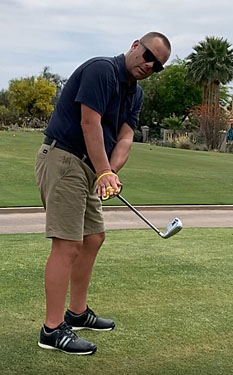
Here are capture images of Mike Adams using a swim
paddle mitt on his trail hand.

Note how Mike Adams is using his trail hand to
push against the aft side of the club handle below the coupling point and
how he eventually rolls his trail hand over an extending trail hand after
impact.
Terry Rowles and Mike Adams not only believe that
an on-top golfer should be applying a push-pressure against the aft side of
the club handle during the mid-late downswing, but they seemingly also
believe that the golfer should continue to apply that push-pressure through
impact.
Watch the following video of Mike Adams giving a
lesson to an "on-top" golfer.
https://vimeo.com/244953449/d28a95cd1f?fl=pl&fe=cm
Watch the video between the 8:24 - 8:48 minute
time points.
Note that Mike Adams wants that golfer to follow
through more inside-left after impact in order to correct his excessive
in-to-out clubhead path at impact. Note that he instructs the golfer to
apply push-pressure with his trail hand against the aft side of the club
handle below the coupling point.
Now, if Terry Rowles and Mike Adams want to teach
their student-golfers (who use an on-top trail hand grip) to apply a
positive push-pressure against the aft side of the club handle below the
coupling point during the late downswing, and through impact, then they are
obviously free to teach that golf swing technique; but where is the
scientific evidence that pro golfers (who use an on-top trail hand grip like
Scottie Scheffler and Rory McIlroy) are using a positive trail hand couple
torque during the late downswing and at impact? I have never seen Terry
Rowles and Mike Adams present any scientific evidence that shows that
Scottie Scheffler and Rory McIlroy are applying a positive trail hand couple
torque ( = push-pressure against the aft side of the club handle below the
coupling point) during the late downswing and at impact. I think that Terry
Rowles should get together with Phil Cheetham and Sasho MacKenzie to perform
a golf research study where they place pressure sensors on the aft side of
the club handle just below the coupling point, so that they can actually
measure the precise amount of push-pressure that is being exerted by the
trail hand during the late downswing, and at impact, in pro golfers who use
an on-top trail hand grip.
There is another belief that Terry Rowles promotes
in a golfer who uses an on-top (weak) trail hand grip. Because Terry Rowles
believes that a weak trail trail hand grip is a face-opener grip, he
believes that the golfer should start his trail arm/hand clubface-closing
action sooner. When Terry Rowles talks of the trail upper limb performing a
clubface-closing action, he uses the analogy of a boxing punch action - as
seen in the following capture image.
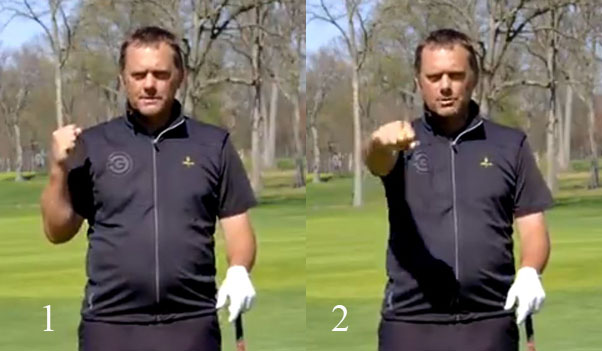
Image 1 shows Terry Rowles with a flexed trail
elbow and he is ready to perform a punch action.
Image 2 shows him performing the punch action by
fully straightening his trail arm. Note how his trail fist rotates ~90
degrees counterclockwise secondary to a trail forearm pronatory motion.
Terry Rowles seemingly believes that the trail arm
must fully straighten and that the trail forearm must subsequently pronate
during the later downswing and through impact in a golfer who uses an on-top
(weak) trail hand grip - as demonstrated in the following capture images.
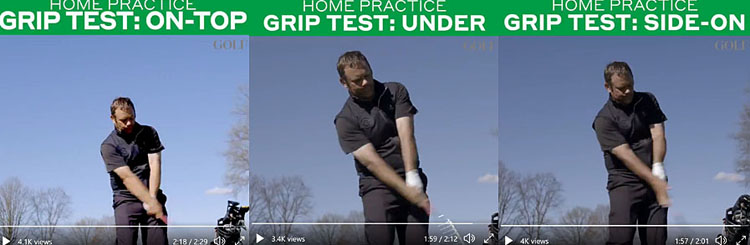
These capture images are derived from a video
where Terry Rowles demonstrates how different strengths of trail hand grip
affect the motion of his trail hand through impact.
Note how his use of an on-top trail hand grip
supposedly causes his trail palm to roll over his extending lead hand
through impact secondary to a trail forearm pronatory motion (image 1) and I
refer to that type of hand release pattern as a rolling hand release pattern
or a hand-crossover release pattern; while an under (strong) trail hand grip
supposedly results in a puck release pattern, where the trail palm works
under the lead hand through impact (image 2). In the side-on variation
(image 3), note that he is still performing a puck release pattern, but his
trail hand is more behind the club handle rather than being more under the
club handle.
As I have demonstrated, both Rory McIlroy and
Scottie Scheffler perform a puck release pattern (that is similar to image
3) and they do not perform a rolling hand release pattern, which Terry
Rowles recommends for an on-top golfer (as seen in image 1). Also, note that
they do not stall the forward motion of their lead arm/hand through impact -
as seen in those capture images of Mike Adams and Terry Rowles performing a
rolling hand release action. My conclusion is that those two pro golfers are
therefore not performing a golf swing action in the manner recommended by
Terry Rowles. I believe that Rory McIlroy and Scottie Scheffler are using a
pivot-induced TGM swinging action (lead arm swinging action) golf swing
technique, while Terry Rowles in his video demonstration is using a
different golf swing technique where he actively uses his trail arm to
execute his personal golf swing action.
Watch this Terry Rowles video where he
demonstrates his on-top golf swing action -
x.com/GOLF_com/status/1385009350985539585
Note that he states that he believes that the
trail hand controls the clubface, and at the 2:02 - 2:20 minute time point
of the video he shows a drill where he opens the clubface by 15 degrees and
then tries to hit the ball straight.
Here are capture images of his hand release action
through impact.
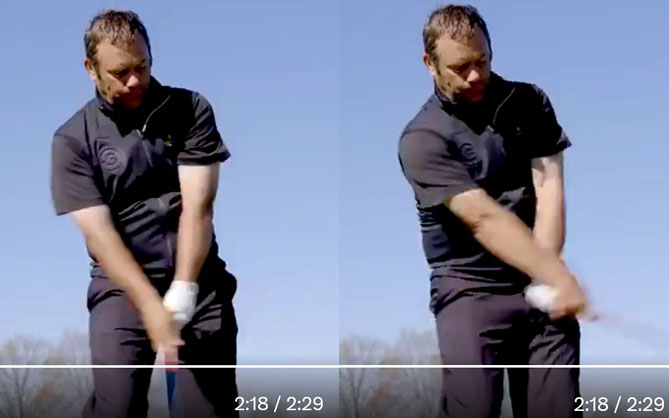
Image 1 is at P7 and image 2 is at ~P7.7.
Note how he is not performing an active pivot
motion to release his lead arm (release PA#4) during his early-mid downswing
and note that his pelvis/upper torso are facing the ball-target line at
impact. Note that he is stalling the forward motion of his lead arm through
impact. Note how he fully straightens his trail arm and pronates his trail
forearm through impact.
Those two capture images are from a drill, while
here is a capture image from his full golf swing action that he performs at
the end of the video.
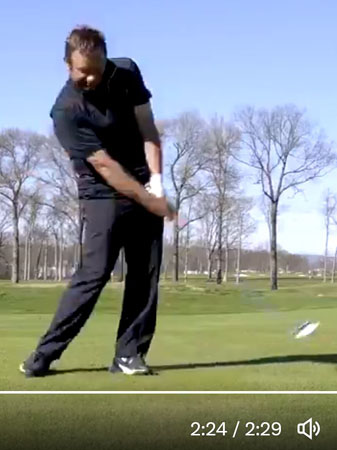
Note how he is fully
straightening his trail arm and trail wrist through impact.
However, note that his pattern of hand release
action through impact actually looks more similar to the puck release
pattern of hand release action performed by Scottie Scheffler and Rory
McIlroy in the sense that he is not stalling the forward motion of his
lead arm as much at impact (compared to his drill golf swing action),
and he is not performing a hand cross-over (roller release) type of hand
release action through impact. However, note that his trail forearm is
more pronated at P7.4 - compared to Scottie Scheffler's and Rory
McIlroys trail forearm at their P7.4 position. So, it is theoretically
possible that his trail hand is actively performing a slap hinge type of
hand release action through impact. That is why I would very much like
to see Terry Rowles perform a golf research study using pressure sensors
that are placed on the aft side of the club handle just below the
coupling point - in order to determine whether he is applying more
push-pressure with his trail hand against the aft side of the club
handle during the P6 => P7.4 time period in his drill golf swing action
versus his "real life" full golf swing action; and whether there is a
difference in his "real life" full golf swing action's pressure sensor
measurements compared to Scottie Scheffler's and Rory McIlroy's pressure
sensor measurements.
Comparison number 2-:
Louis Oosthuizen and Viktor Hovland. Both of those pro golfers use a
moderately strong trail hand grip and they both place their ball further
back towards the middle of their stance in their driver swings.
Capture images of Louis Oosthuizen's
non-delayed/standard release action.
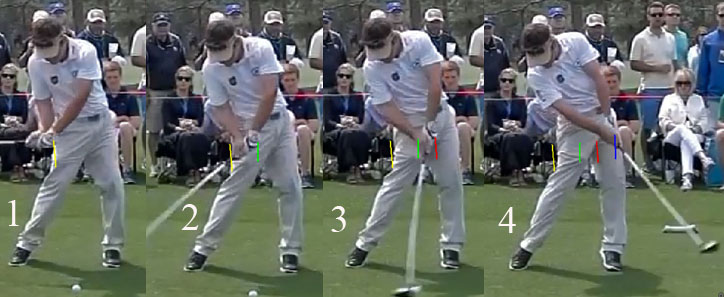
Image 1 is at P6,
image 2 is at P6.5, image 3 is at P7 and image 4 is at P7.4.
Note that I have drawn a yellow line just
in front of his lead hand at the P6 position (image 1), a green line
just in front of his lead hand at his P6.5 position (image 2), a red
line just in front of his lead hand at the P7 position (image 3),
and a blue line just in front of his lead hand at the P7.4 position
(image 4).
Note that the yellow line is just outside
his trail thigh at P6, which means that he is using a
non-delayed/standard release action. Note that his lead hand reaches
the ball position by P6.5, which gives him less lead hand travel
distance to complete his PA#3 release action by impact. However, he
uses a moderately strong lead hand grip, so he does not have to use
much lead forearm supination during his PA#3 release action. Note
that his lead hand is marginally ahead of the ball at impact, which
allows him to have forward shaft lean at impact. Note that his lead
arm continues to move targetwards between P7 => P7.4, but his
clubshaft is bypassing his lead arm (from an angular rotational
perspective) as he performs a puck style hand release action as a
biomechanical feature of his flipping subtype of non-DH hand release
action.
Capture images of Viktor Hovland's
non-delayed/standard release action.
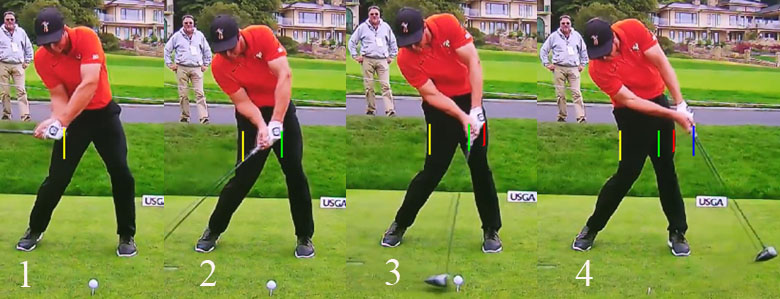
Image 1 is at
P6, image 2 is at P6.5, image 3 is at P7 and image 4 is at P7.4.
Note that I have drawn a yellow line
just in front of his lead hand at the P6 position (image 1), a
green line just in front of his lead hand at his P6.5 position
(image 2), a red line just in front of his lead hand at the P7
position (image 3), and a blue line just in front of his lead
hand at the P7.4 position (image 4).
Note that the yellow line is just
reaching the outer border of his trail thigh at P6, which means
that he is using a non-delayed/standard release action. Note
that his lead hand reaches the ball position by P6.5, which
gives him less lead hand travel distance to complete his PA#3
release action by impact. However, he uses a moderately strong
lead hand grip, so he does not have to use much lead forearm
supination during his PA#3 release action. Note that his lead
hand is marginally ahead of the ball at impact, which allows him
to have forward shaft lean at impact. Note that his lead arm
continues to move targetwards between P7 => P7.4 by a large
amount and that he is not allowing the clubshaft to bypass his
lead arm (from an angular rotational perspective), which means
that he is performing a DH-hand release action. Note how he
maintains a bent trail arm and a very extended trail wrist all
the way to P7.4 - and that is only physically possible because
he avoids a "running out of trail arm" scenario by executing a
very active pivot motion that gets his pelvis/upper torso to
become very open at impact and where his trail shoulder socket
moves very far downplane by P7.4.
I think that the biomechanical
explanations that account for the differences in Louis
Oosthuizen's flipping subtype of non-DH hand release action
versus Viktor Hovland's DH-hand release action are the same as
the biomechanical explanations that I provided in my explanation
of the differences seen in Scottie Scheffler's flipping subtype
of non-DH hand release action versus Will Zalatoris' DH-hand
release action - so I will not repeat the explanations.
Note that both
Louis Oosthuizen and Viktor Hovland use a non-delayed/standard
release action, and not a delayed release action, thereby
disproving my friend's hypothesis about the timing of the
release action and the subsequent pattern of hand release action
happening between P7 => P7.4.
Louis Oosthuizen's i) lead arm does
not move as assertively through impact and ii) he also has a
greater degree of trail arm/trail wrist straightening at P7.4
compared to Scottie Scheffler - even though they both perform a
flipping subtype of non-DH-hand release action. However, I still
strongly suspect that both pro golfers are not using an active
slap hinge release action through impact and that Louis
Ooosthuizen's greater degree of trail arm/trail wrist
straightening phenomenon through impact is passive (and not
active). I would very much like to see a golf researcher perform
my recommended golf research study using preesure sensors placed
on the aft side of the club handle just below the coupling point
in order to determine whether the trail hand is applying any
positive push-pressure against the aft side of the club handle
between P6 => P7.4 in pro golfers (like Louis Oosthuizen) who
perform a greater degree of flipping in their flipping subtype
of non-DH hand release action.
Finally, I would like to discuss two
topics - i) my revised definition of a DH-hand release action
and ii) the question as to whether a pro golfer who uses a
DH-hand release action can hit the ball more consistently
straight than a pro golfer who uses a non-DH hand release
action.
I first published my opinions
regarding a DH-hand release action in 2012 in this review paper
-
www.perfectgolfswingreview.net/HandRelease.htm
I now think that I got many things
wrong. At the time, I believed that there was an advantage to
keeping the clubface square relative to the hand arc path from
P7.0 => P7.2 by preventing the clubshaft from bypassing the lead
arm (from an angular rotational perspective) during that early
followthrough time period, which I then used to define a DH-hand
release action. I then divided DH-hand release actions into two
subgroups - i) a no-roll subtype (as seen in the DH-hand release
actions of Will Zalatoris and Viktor Hovland) and ii) a delayed
full-roll subtype (as seen in the driver golf swing actions of
pro golfers like Ernie Els and Tiger Woods)..
As an example of a delayed full-roll
subtype of DH-hand release action, I used the driver golf swing
action of Ernie Els.
Here is an animated gif of Ernie Els
driver golf swing action.
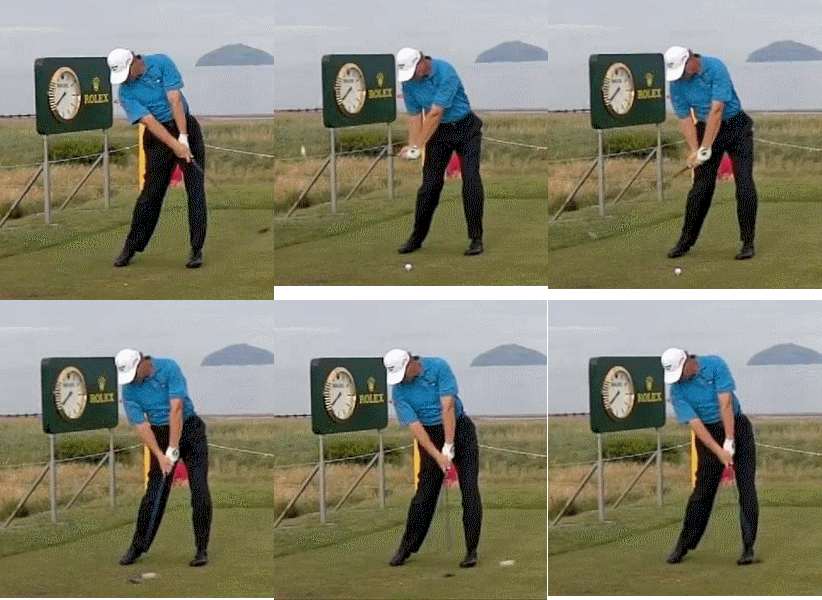
Note that
he has a FLW at impact and also in the first-and-second
animated images immediately after impact (which are roughly
at the P7.1 and P7.2 positions) where his clubshaft has not
significantly bypassed his lead arm (from an angular
rotational perspective). I therefore labelled his hand
release action as being a DH-hand release action. However,
if you look at his overall pivot motion and his overall
pattern of lead/trail arm motion through impact, it is
basically identical to that manifested by Scottie Scheffler
and Rory McIlroy. Note that he is performing a puck release
type of hand release action through impact and note that his
clubshaft is bypassing his lead arm (from an angular
rotational perspective) by a significant amount between P7.2
=> P7.4 and note how his trail arm/wrist straightens fully
by P7.4. The only difference is the timing of his clubshaft
flipping motion where it does not appear to be significantly
bypass-flipping relative to his lead arm at P7.2 (which is
my arbitrary/unscientific point of defining a DH-hand
release action). However, if one examines multiple examples
of Rory McIlroy's driver golf swing action, one can find
that the timing and the degree of his clubshaft flipping
motion post-impact varies and it can sometimes be defined as
being a DH-hand release action (delayed full-roll subtype)
even though the underlying biomechanics in terms of his
pivot motion and his pattern of lead/trail arm motion
between P7 => P7.4 is the same. I have therefore decided to
regard a delayed full-roll subtype of DH-hand release action
as being the same as the flipping subtype of non-DH hand
release action from a biomechanical perspective, where the
only difference is the amount of the clubshaft flipping
motion present at the arbitrary P7.2 time point.
When I now think of a DH-hand
release action, I now only think of the no-roll subtype
where the trail arm and trail wrist remain partially bent
all the way to P7.4 and where the clubshaft does not bypass
the lead arm (from an angular rotational perspective) before
P7.4 - as seen in the capture images of Cameron Champ's,
Dustin Johnson's, Will Zalatoris' and Viktor Hovland's early
followthrough action. I also used to previously believe that
the advantage of a no-roll subtype of DH-hand release action
is that it allows a pro golfer to more consistently keep the
clubface square relative to the clubhead path throughout the
entire P7 => P7.4 early followthrough time period. I still
think that my belief is true, but irrelevant in terms of
consistently hitting a straight shot because there is no
scientific evidence that demonstrates that keeping the
clubface square relative to the clubhead path for longer
than a few inches post-impact is advantageous. To hit the
ball consistently straight with a driver a pro golfer must
zero-out the clubhead path and zero-out the clubface angle
at impact and hit the ball with the clubface's sweetspot.
What happens at P7.2, or P7.4, in terms of the clubface's
degree of squaring relative to the clubhead path is
irrelevant.
Consider yet again these capture
images of Louis Oosthuizen's flipping subtype of non-DH hand
release action.
Note
that he has a high degree of clubshaft flipping at P7.4
(image 4) and note that his clubface is not square
relative to his clubhead path.
However, that fact is
irrelevant with respect to his ability to consistently
generate a straight ball flight.
Consider his clubface motion
immediately post-impact.
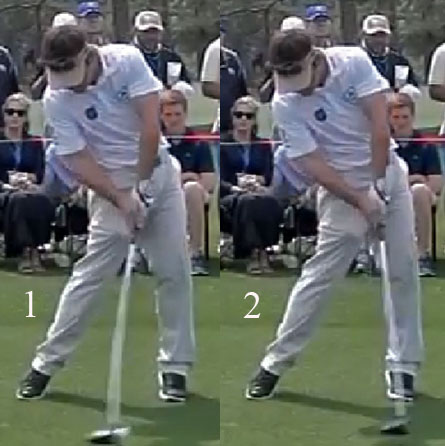
Image 1 is at P7 and image 2 is
where his clubhead is about 6" post-impact.
Note that his clubface is still
square relative to his clubhead path even though there is
visual evidence that his clubshaft is flipping passed his
lead arm due to a finite amount of lead hand motion in the
direction of a greater degree of lead wrist extension.
What I have repeatedly noted when
examining the P7 => P7.1 time period of pro golfers, who
perform a flipping subtype of non-DH hand release action, is
that the degree of increased lead wrist extension happening
is very small (~5 degrees by P7.1) and that they still keep
the clubface square relative to the clubhead path for many
inches post-impact despite their small degree of lead wrist
flipping motion. I now believe that small variations in the
degree of lead wrist flipping between P7 => P7.1 is
inconsequential, and I now believe that there is no benefit
to using a DH-hand release action (compared to a flipping
subtype of non-DH hand release action) when it comes to
hitting the ball consistently straight. I now reject my
previous theory that using a DH-hand release action (where
the degree of increased lead wrist extension happening
between P7 => P7.1 is smaller in amount) is beneficial in
terms of a pro golfer's ability to consistently generate a
straight ball flight pattern.
So, if there is no practical value
to performing a no-roll subtype of DH-hand release action
thorugh impact, then why do a subset of pro golfers perform
that type of hand release action between P7 => P7.4? I think
that there are a number of factors that can predispose a pro
golfer towards performing a DH-hand release action, rather
than a flipping subtype of non-DH hand release action, and I
will now discuss some of those factors.
Consider the hand release action
performed by Mike Malaska, a golf instructor based in
Arizona, who previously played competitive golf in a few PGA
tour events.
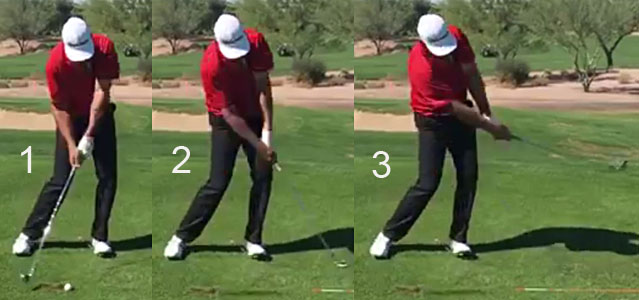
Image 1
is at P6.8, image 2 is at ~P7.3 and image 3 is at ~P7.8.
Note that when Mike Malaska's
clubshaft approaches impact that his hands are ahead of
his clubhead and he is likely to manifest his desired
amount of forward shaft lean at impact. So, he does not
flip pre-impact.
Then, note what happens in his
early followthrough time period - note that he performs
a puck release action through impact with a very
straightened trail wrist motion. Note how fast he
straightens his trail arm and trail wrist after impact
and flips the clubshaft passed his lead arm, which is
stalling its forward motion post-impact. Why does it
happen? Mike Malaska describes how he performs a full
golf swing in many of his you-tube channel's videos, and
he states that he deliberately performs an active trail
arm throw motion starting at ~P6 while using a reactive
pivot motion. Note that his pelvis and upper torso are
roughly parallel to the ball-target line at impact and
that his pelvis only rotates more open after impact.
That reactive pattern of pivot motion is deliberate -
and Mike Malaska describes how he pulls his lead
buttocks back away from the ball-target line in response
to his trail arm throw motion. Note that when he
performs his active trail arm throw motion that he
throws his trail upper limb to a fully straight trail
arm/fully straight trail wrist alignment while allowing
his lead wrist to bend freely so that it does not impede
the targetwards motion of his thrown clubshaft. Because
Mike Malaska is very skilled at performing a trail arm
throwing motion, he can keep the clubface square to his
clubhead path through impact for many inches and he can
routinely hit the ball straight in a consistent manner.
Mike Malaska's "armsy" golf
swing action, which is combined with a relatively static
pivot motion, is occasionally used by some pro golfers
when they hit specialised shots eg. flop shots, bunker
shots and short iron shots around the green. However,
most pro golfers do not use his "armsy" golf swing
technique for their full golf swing action (eg. when
using a driver, fairway woods and long irons) and they
use a pivot-induced TGM swinging action (lead arm
swinging action) technique. In a pivot-induced TGM
swinging action, the primary purpose of the pivot motion
is to get the lead arm to travel very fast during the P4
=> P5.5 time period so that the lead hand reaches its
maximum speed by ~P5.5 and they then sequentially
release PA#2 and PA#3 during the P5.5 => P7 time period.
Most pro golfers start their pivot motion with a pelvic
shift-rotation motion with a variable degree of
torso-pelvic separation that allows them to keep their
shoulders slightly closed during the P4 => P5.5 time
period. They then usually reach impact with an open
pelvis (eg. 45 degrees open) and a slightly open upper
torso alignment (eg. 10 - 20 degrees open). They also
develop a finite amount of secondary axis tilt during
the later downswing as a result of their active
pelvic-shift rotation maneuver +/- a finite amount of
right lateral bend.
Let's consider an example.
Capture images of Scottie
Scheffler's driver golf swing action.
Image 1 is at P6, image 2 is
at P6.5, image 3 is at P7 and image 4 is at P7.4.
Note that he has reached the
P6 position with a slightly open pelvis alignment while
keeping his upper torso alignment closed. Then his
pelvis continues to rotate counterclockwise to become
more open by impact. Note how he acquires a slightly
greater degree of secondary axis tilt and a small degree
of right lateral bend by impact. His upper torso becomes
slightly open at impact, but to a lesser degree compared
to his pelvis. As his upper torso rotates
counterclockwise between P6 => P7 his shoulders are
turning in a more ferris-wheel manner that allows his
trail shoulder socket to get further downplane; and he
obviously gets his trail shoulder socket far enough
downplane by P7 to avoid "running-out-of-trail arm", and
he reaches impact with a slightly bent trail arm and a
slightly bent trail wrist.
It is very likely that his
lead arm reaches its maximum speed near ~P5.5 and then
slows down by ~25% between P5.5 => P7. I don't have
measurements for his lead hand speed at P5.5 and P7, but
I suspect that the average lead hand speed for a pro
golfer could be ~24 mph at P5.5 and ~20 mph at P7 in a
driver golf swing action. It is not unusual for the lead
hand speed to slow down between between P5.5 => P7 in a
pro golfer's driver swing action thereby allowing for
the successful completion of the sequential release of
PA#2 => PA#3 by impact.
Note that although he has a
fair amount of secondary axis tilt at impact where his
head is still vertically positioned above a point on the
ground that is just inside his trail foot, that his lead
shoulder socket is vertically positioned above the ball
position at impact where his lead arm/clubshaft are in a
straight-line-aligment at impact. Also, note that his
lead upper arm is still closely adducted against the
pectoral area of his lead upper chest wall at impact.
Between P7 => P7.4 his lead arm becomes angled more
towards the target because his lead hand is still moving
targetwards, but the upper half of his lead upper arm
still remains closely abutted aganist his lead upper
chest wall.
Here are capture images of
Rory McIlroy' driver golf swing action.
Note that the descriptions that I provided with
respect to the pivot motion and lead/trail arm
motions of Scottie Scheffler's driver golf swing
action also apply to Rory McIlroy. There are
negligible differences eg. Rory McIlroy gets his
trail shoulder socket slightly further downplane by
P7 so that his trail elbow and trail wrist are
slightly less straightened at impact.
Now, let's consider the
driver swing action of Will Zalatoris, who uses a
DH-hand release action through impact.
Note that he has a more
assertive pelvic rotary motion during his early-mid
downswing and he has an overtly open pelvic
alignment at P6. Note that his upper torso has a
slightly closed alignment at P6 and it obviously
requires a greater degree of torso-pelvic separation
to achieve this pelvis-upper torso alignment at P6.
Note how he continues to
rotate his pelvis very actively between P6 - P7 and
he has a very open pelvic alignment at impact.
Note that he develops more
secondary axis tilt than Scottie Scheffler/Rory
McIlroy by impact. He also manifests more right
lateral bend that allows him to get his trail
shoulder socket further downplane by impact, which
allows his trail arm and trail wrist to be more bent
at impact (even though his lead hand is opposite the
outer border of his lead thigh at impact).
Note that his lead hand is
slightly ahead of his lead thigh at P7.4 and there
is a small degree of separation of his lead upper
arm away from his lead upper chest area at P7.4 -
suggesting that his lead arm is possibly traveling
marginally faster (compared to Scottie Scheffler and
Rory McIlroy). However, it could just be due to the
fact that his lead shoulder socket is further back
at impact relative to his ball position. Note how he
can still maintain a slightly bent trail arm and a
slightly bent trail wrist all the way to P7.4 even
though his trail elbow is still closely aligned
relative to his trail hip joint area (which is
closer to the target because his pelvis is far more
open at impact).
I think that the major
reasons for all these biomechanical differences,
which are causally responsible for his ability to
perform a no-roll subtype of DH-hand release action,
is due to the fact that Will Zalatoris has the
athleticism and flexibility to perform a more
physically-assertive pivot motion. However, there is
no reason to believe that it increases his ability
to successfully complete his sequential release of
PA#2 => PA#3 by impact, and there is no reason to
believe that he can more consistently hit the ball
straighter than his fellow pro golfers who use a
non-DH hand release action (like Scottie Scheffler
and Rory McIlroy).
Jeffrey Mann.
https://newtongolfinstitute.proboards.com/thread/1153/comparing-dh-non-release-action