Kwon's opinion on how best to rotate the pelvis
Watch this BeBetterGolf video featuring Kwon.
In that video, Kwon compares two elite pro golfers - player 1 who is using a
vertical-centralised (or small degree of leftwards-centralised) upper torso
loading pattern during his backswing action and player 2 who is using a
rightwards-centralised upper torso loading pattern during his backswing action.
Kwon claims that player 1 is going to produce a better pelvic/torso rotation
during the downswing. He gives two reasons for his "opinion". He claims that
player 1 is getting his body's COM shifted to the right more between P1 and P4
(compared to player 2 who shifts his pelvis targetwards in his later backswing).
Secondly, Kwon claims that player 1 can generate a greater moment (torque),
which is required to rotate the pelvis/upper torso counterclockwise in his early
downswing, because he has a larger moment arm operating between P4 => P5 - even
if he does not necessarily generate a larger magnitude of vertical GRF.
I don't disgaree with Kwon's
theoretical reasoning, which is based on his
theoretical methodology of describing the effect of vertical GRF's that
he believes are causally responsible for rotating the pelvis/upper torso
counterclockwise during the early downswing. However, I believe that his
"theoretical model" does not correlate with the "real life" reality of many pro
golfers' driver golf swing actions.
First of all, his theoretical model produces a moment (torque) that operates in
the frontal plane. However, the pelvis and upper torso rotate in a much more
horizontal plane in the early-mid downswing and they do not really rotate in the
"up-and-down" manner demonstrated by Kwon. Secondly, Kwon totally ignores the
contribution of pelvic girdle muscles (trail sided lateral pelvic rotator
muscles) in causing a counterclockwise pelvic rotation between P4 => P5.
Consider some examples of pro golfers who use a rightwards-centralised upper
torso loading pattern, and who are capable of generating very high clubhead
speeds at impact in their driver swings.
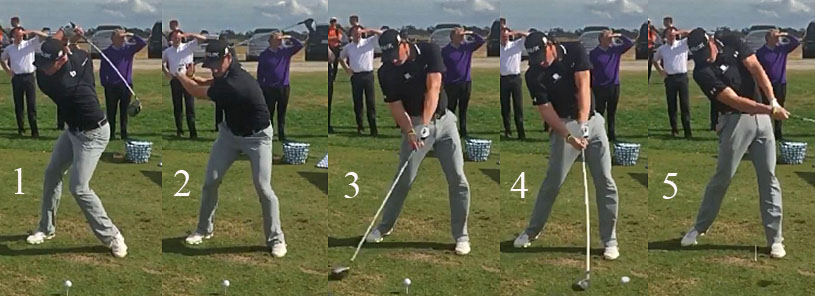
First example - Tim Burke (2015 world long-drive champion).
Image 1 is at P4. Note that he is using a rightwards-centralised upper torso loading pattern and that he has not shifted his pelvis (and therefore body's COM) rightwards between P1 => P4.
Note how efficiently he can rotate his pelvis between P4 (image 1) and P5
(image 2) and that his pelvis is rotating more horizontally during that
hip-squaring phase. I don't believe that he is
primarily using a
moment arm (produced by vertical GRFs) to rotate his pelvis counterclockwise
between P4 => P5, and I suspect that he is primarily using his trail-sided
lateral pelvic rotator muscles to rotate his pelvis counterclockwise away
from his "stabilised" trail leg/foot (that is suppplemented by a horizontal
GRF being generated by his lead foot).
Here is a second example of a long-drive champion -
Jamie Sadlowski -
who uses a rightwards-centralised upper torso loading pattern.
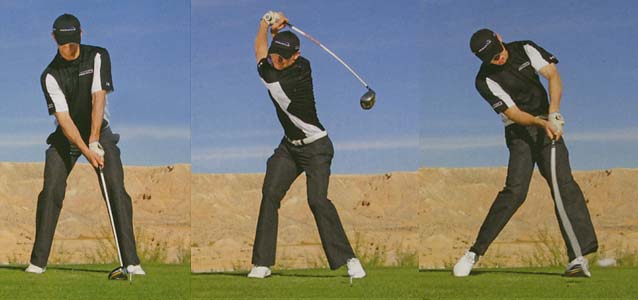
Image 1 is at address. Note that JS has his spine tilted to the right at address and that his head is vertically over a point on the ground that is just inside his right foot.
Image 2 is at P4. Note that he uses a rightwards-centralised upper torso
loading pattern and he makes no attempt to pull his spine targetwards in
a reverse-pivoting fashion between P1 => P4 (as recommended by Kwon) and
that his head has not moved targetwards during his P1 => P4 time period.
Third example - featuring
Jack Nicklaus.
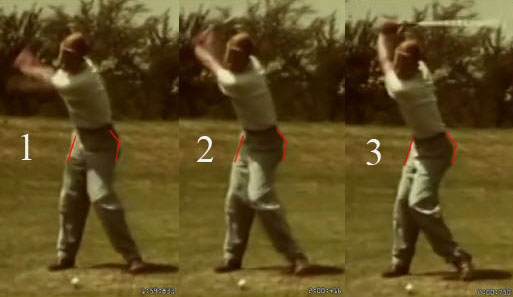
Image 1 is at P3 and image 3 is at P4.
Note how JN pushes his pelvis targetwards during his clockwise
pelvic rotation that happens between P1 => P4, and note that he has
a rightwards-centralised upper torso loading position at P4.
Fourth example - featuring Milo Lines.
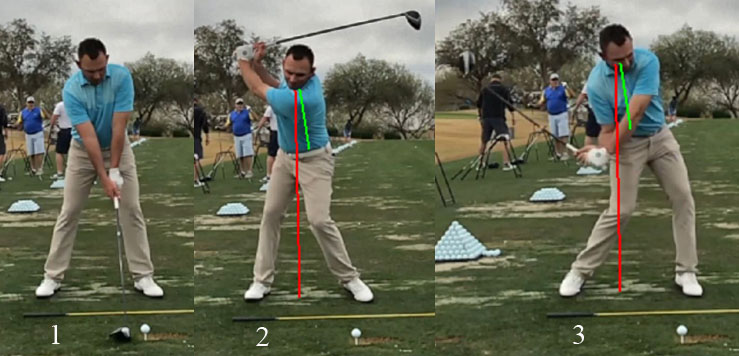
Image 1 is at address. Note that Milo Lines has a small degree
of rightwards spinal tilt at address, and that his head is
behind the center of his stance.
Image 2 is at P4. Note that he has a rightwards-centralised
upper torso loading pattern (green line is parallel to his
spine). I have drawn a red line vertically downwards from the
center of his head and it is still positioned behind the center
of his stance. Note that he is not reverse-pivoting and pulling
his spine to a more vertical orientation (as recommended by
Kwon).
Note how efficiently he rotates his pelvis between P4 (image 2)
and P5.5 (image 3). Note that his pelvis is mainly rotating
horizontally, and there is no up-and-down motion in the
frontal plane axis.
Here are comparison images of Milo Lines and Jamie Sadlowski at
P5.5.
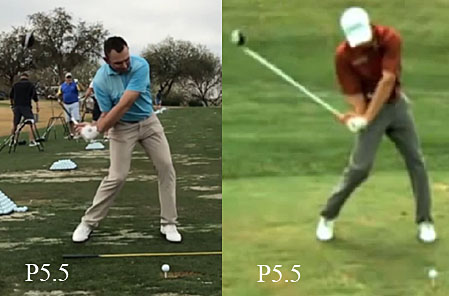
Note that they both have a similarly efficient
counterclockwise pelvic rotation
happening in a
relatively horizontal plane between P4 => P5.5, even
though they both started from a rightwards-centralised upper
torso loading position at P4.
In my previous post I contested Kwon's opinion that a pro
golfer should have a centered (either vertical-centralised
or left-centralised) upper torso loading pattern by P4. I
demonstrated that many pro golfers, who are long drivers of
the golf ball, have a rightwards-centralised upper torso
loading pattern at P4.
I also disagree with Kwon's "shurn motion" teaching principle where he wants a golfer to first shift the pelvis in a re-centering motion between P3.8 => P4.5+ while increasingly pressure-loading the lead foot, and where he then wants the golfer to secondly use the pressure-loading of the lead foot to induce a pelvic rotation. I have argued that many pro golfers are rotating their pelvis counterclockwise from the very start of the downswing and that they are shifting their pelvis targetwards at the same time, with the degree of pelvis shift depending on the pelvic loading pattern at P4 (being greater for a golfer who has a rightwards pelvic loading pattern like Mickey Wright, being less for a golfer who has a centralised pelvic loading pattern like Jamie Sadlowski and being the least amount if the golfer has a leftwards pelvic loading pattern like Jack Nicklaus).
I thought that it would be instructive to analyse Milo
Lines' driver swing in terms of the vertical/horizontal
GRFs being generated and I contacted Milo to ask if he
had been measured with a Swing Catalyst system. Milo
sent me his Swing Catalyst tracing video, which lasts 22
seconds. Milo was measured by Scott Lynn as part of
their Driving Force video project - see
www.bebettergolf.net/drivingforce.html. You can
purchase that Driving Force video for $30. Note that
there is teaser video at the bottom of that webpage that
lasts 11 minutes. I have not purchased the full video so
I do not know what opinions were expressed by Scott Lynn
in the full video.
What I am going to do in this post is provide my
personal interpretation of Milo's Swing Catalyst
measurements of his driver swing, and I am also going to
make some golf instructional points that reflect my
personal (subjective) opinion.
Milo starts at address with his pelvis centered and with
his COP measurements distributed equally (50%) under
each foot. Milo has a triggering motion where he
momentarily increases the COP measurement under his lead
foot to 95% of the total measurement, and that
presumably allows him to push off the lead foot to
initiate his backswing action.
Here is Milo at his P2.5 position.
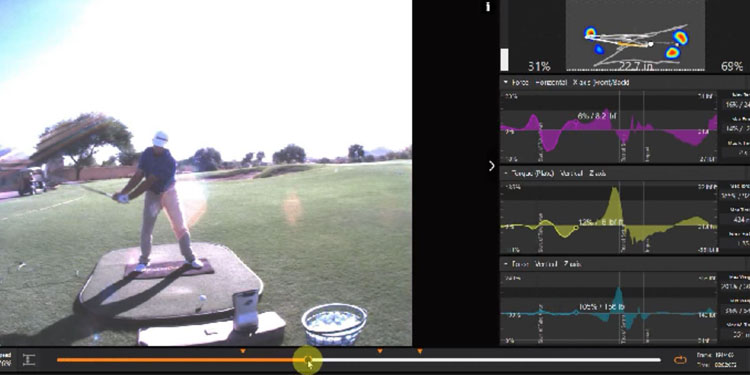
This is the time point when the COP measurement under his trail foot reaches its maximum value (=69% of his total COP value as shown in the upper right corner of the image).
Here is a capture image of Milo at ~P3.8 (just
before he starts to rotate his pelvis
counterclockwise).
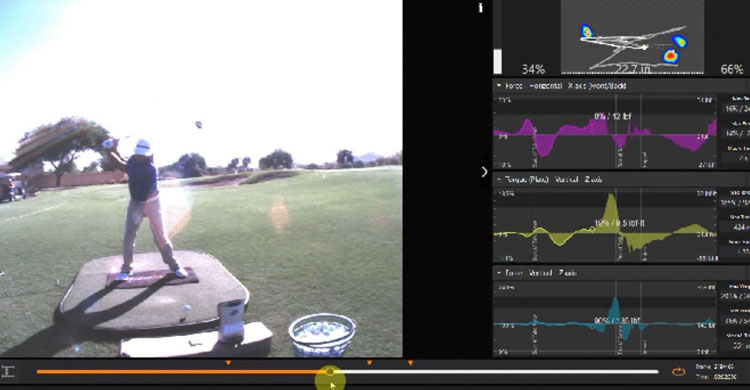
Note that he has 66% of his COP measurement
under his trail foot. The tour average at P4 is
80%, but there is a large variance - JB Holmes
has 100% at P4 while S&T golfers have only
50-60% at P4.
Note that Milo uses a rightwards-centralised
upper torso loading pattern during his backswing
action, but he uses a centralised pelvic loading
pattern where his pelvis does not shift away
from the target (as seen in Mickey Wright's and
Gary Woodland's driver golf swing action).
Therefore, it is understandable that that he
does not have >80% of his pressure-loading COP
measurement under his trail foot at ~P4 if his
pelvis is still relatively centered between his
feet at ~P4.
Here is a capture image of Milo at P4.5.
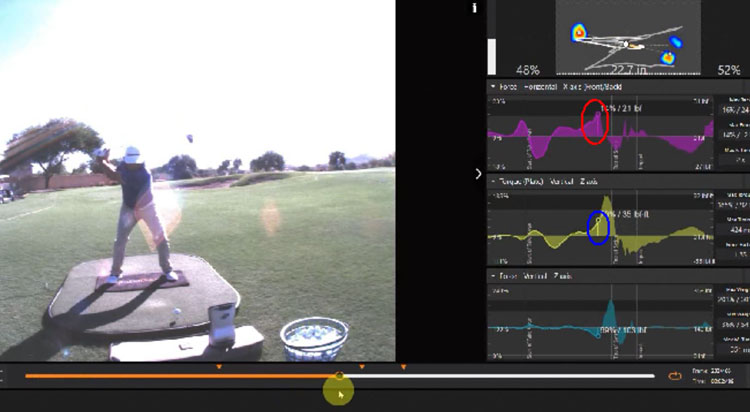
This is the end of the hip-squaring phase where Milo manifests the "Sam Snead sit-down squat look". Note that he still has 52% of his overall COP measurement under his trail foot. That means that he could perform a very efficient hip-squaring counterclockwise pelvic rotary motion between P3.8 => P4.5 without any marked degree of pressure-loading of the lead foot as recommended by Kwon and Sasho MacKenzie. I strongly suspect that Milo is using the active muscular contraction of his trail-sided lateral pelvic rotator muscles to induce his pelvis to rotate counterclockwise away from his "stabilised" trail leg/foot.
Look at the
magenta colored graph. That graph measures
the amount of horizontal side-force in a
targetwards direction that is being exerted
by the trail foot. I have drawn a red
circular marker to show that Milo reaches
his peak horizontal force at P4.5 (see the
vertical line capped by a small transparent
circle in the magenta colored graph). The
black zone represents the pro tour average.
Note that Milo's peak horizontal force just
reaches the lower edge of the pro tour zone.
It is understandable why Milo does not need
to produce a large amount of horizontal
force under his trail foot in his early
downswing - because his pelvis is already
centered at P4 and he does not have to
re-center his pelvis by performing a large
amount of pelvic shift motion during his
hip-squaring phase that ends at P4.5. That
fact also shows that Kwon's generic golf
instructional philosophy of shifting the
pelvis
before
rotating the pelvis does not necessarily
make sense. Milo has already rotated his
pelvis counterclockwise to square by P4.5
with no
preliminary
pelvic shift motion.
Look at the yellow
colored graph. That graph measures the
amount of horizontal GRF-generated torque
being generated under the two feet to
produce what Kwon calls the pivoting torque
- as seen in this capture image at perfectgolfswingreview.net/KwonTorque3Two.jpg
. I have drawn a blue circular marker to
show that Milo has only generated a small
amount of horizontal GRF torque by P4.5 (see
vertical line capped by a small transparent
circle). That means that Milo's very
efficient hip-squaring pelvic rotary motion
is happening between P3.8 => P4.5
without
a major contribution from a pivoting torque.
I think that it is only possible because
Milo is
primarily
using the
active muscular contraction of his
trail-sided lateral pelvic rotator muscles
to square his pelvis and he is not dependent
on using his horizontal GRF pivoting torque
forces (where the lead foot pushes away from
the ball-target line while the trail foot
pushes towards the ball-target line).
The cyan-colored graph is the vertical GRF graph produced by the lead foot. Note that Milo is not yet producing any measurable amount of vertical GRF torque at this point of his downswing, and that he efficiently squared his pelvis by P4.5 without even needing to pressure-load his lead foot in the manner recommended by Kwon and Sasho MacKnezie.
Here is Milo at
his P5.5 position.

I have drawn a
red circular marker over his yellow
graph to show that Milo is reaching his
peak horizontal GRF torque value at P5.5
and that the amount of pivoting torque
being generated is very large (at the
top level of the black pro tour zone).
In other words, I think that Milo starts
his pelvis rotation in his early
downswing by using his trail-sided
lateral pelvic rotator pelvic girdle
muscles, but then continues to actively
rotate his pelvis between P4.5 => P5.5
by
primarily using a horizontal
GRF-generated pivoting torque.
I have drawn a
blue circular marker over his
cyan-colored vertical GRF graph to show
that Milo is producing a significant
amount of vertical GRF under his lead
foot by P5.5 (that has reached ~60% of
his peak value). That significant amount
of vertical GRF under his lead foot is
needed to brace his lead leg/foot and
prevent any pelvic swaying motion while
he is actively generating a huge amount
of horizontal GRF torque to continue his
counterclockwise pelvic rotation - note
how i) his lead knee remains bent, how
ii) the outer border of his lead pelvis
remains well inside his lead foot, and
how his pelvis opens up more. I disagree
with Kwon's opinion that the lead leg
must straighten under the influence of a
large amount of vertical-GRF being
generated under the lead foot in order
to induce a counterclockwise pelvic
rotation - and I think that the main
function of generating a finite amount
of vertical GRF under the lead foot is
primarily to brace the lead leg/foot
while the pelvis is being rotated
counterclockwise by the horizontal GRF
pivoting torque.
Here is a
capture image of Milo at impact.
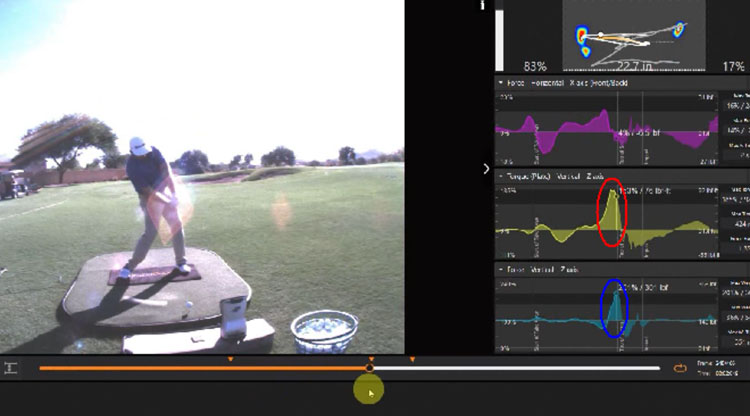
Note that
Milo has 83% of his overall COP
measurement under his lead foot at
impact - and that classifies Milo as
being a
front-foot
pattern golfer
(and not a reverse foot pattern
golfer).
Note that
his vertical GRF under his lead foot
reaches its peak value at impact.
Note that his horizontal GRF torque
value is still very large (and well
within the black zone), and I
believe that it is allowing Milo to
continue to rotate his pelvis to a
very open alignment position by
impact (and through impact).
Note that
although Milo generates a very large
vertical GRF under his lead foot in
his later downswing, that he does
not
overly straighten his lead leg by
impact (as seen in Tiger Woods
driver swing and the driver swings
of pro golfers who are "jumpers"
like Justin Thomas, Justin James and
many S&T golfers).
I
personally think that Milo has a
superb pelvic motional pattern
during the downswing of his driver
swing action, and I believe that he
is using a non-Kwon pelvic motional
pattern that much better fits the
pelvic motional pattern that I
personally recommend when it comes
to describing/elucidating the
underlying biomechanics/mechanics.
Jeffrey
Mann.
https://newtongolfinstitute.proboards.com/thread/931/kwons-opinion-best-rotate-pelvis