I personally think that casting could be caused by a deliberate/active lead wrist uncocking action that happens too soon (before ~P5.5) and a golfer should obviously avoid any active lead wrist uncocking action. In a professional quality golf swing action, the release of the club (= release of PA#2) will happen automatically/naturally starting between ~P5.2 => P5.5 and the golfer should not have to actively induce the lead wrist uncocking phenomenon by actively contracting any lead forearm muscles.
I think that the major cause of casting is due to the improper motion of the trail limb - in particular, either due to i) straightening of the trail arm and/or ii) an uncocking action of the trail wrist where the thenar area of the trail palm applies a force against the side of the club handle in a direction that is directed away from the target.
Here is Kwon's diagram on
the forces being applied to the club handle during the downswing of a
skilled golfer.
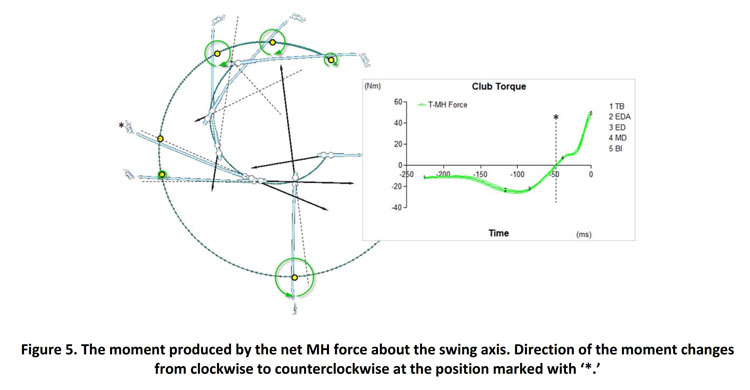
During the early downswing between P4 => P5.2, the mid-hand force (which is mainly due to the lead hand pulling the club handle down the hand arc path) induces the club to want to rotate clockwise (in a jack-knifing direction), and after P5.2 it will induce the club to rotate counterclockwise (in a club releasing direction). To prevent jack-knifing, the trail hand (working as a couple) must apply a counteracting force of equal magnitude to prevent jack-knifing so that the same degree of clubhead lag is maintained during the P4 => ~P5.2 time period. That force is generated by extensor action (which is due to a very small degree of trail arm straightening action) and/or a small degree of trail wrist uncocking action that is perpendicularly outward relative to the hand arc path.
Consider Dustin
Johnson's early-mid downswing action.
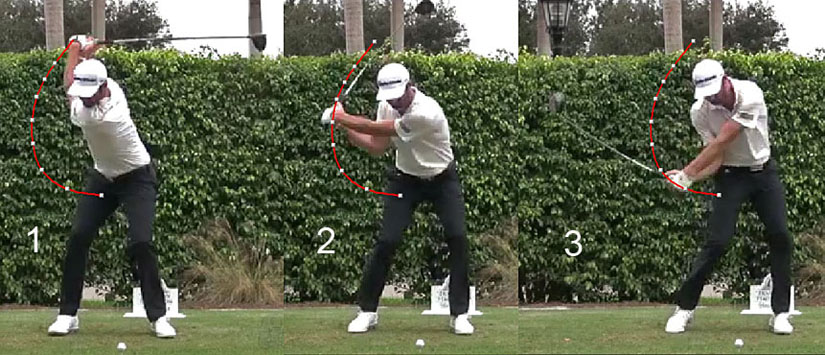
The red splined path is his hand arc path.
Image 1 is at P4, image 2 is at P5 and image 3 is at P5.5.
Note that DJ maintains the same degree of clubhead lag angle between P4 => P5 and he prevents any jack-knifing or casting. Note that his trail palm is parallel to his swingplane and that requires a finite amount of trail wrist extension. Note that the plane of trail wrist extension is perpendicular to the plane of jack-knifing/casting so changes in the degree-of-extension is not a major factor that could cause casting between P4 => P5. Casting would most likely be caused by a force that is working in a direction that is outwards (= away from the target direction) relative to the hand arc path - and the most likely biomechanical phenomena that would predispose to casting would be i) straightening of the trail elbow and/or ii) the trail wrist moving towards ulnar-deviation which would cause the thenar area of the trail palm to push against the club handle in a casting direction. Therefore to prevent casting, DJ is maintaining a bent trail elbow and maintaining his same degree of trail wrist upcocking during his active trail upper arm adduction maneuver.
Note that DJ is starting to lose a certain degree of clubhead lag between P5 => P5.5 and that is due to the fact that his trail elbow is starting to straighten by ~20 degrees while he maintains the same degree of trail wrist upcocking/extension. That small degree of trail elbow straightening is a natural/automatic phenomenon that happens because the distance between his trail hand and trail shoulder socket is naturally/automatically increasing during that P5 => P5.5 time period. If that distance increases too much, that would predispose to casting and excessive loss of clubhead lag. What would cause that distance to increase too much? It would happen if his trail shoulder socket is not moving far enough downplane while he is simultaneously completing his active trail upper arm adduction maneuver, so a skilled golfer needs to ensure that he has the appropriate amount of downplane motion of the trail shoulder socket between P4 => P5.5, which requires a complex variable combination of variable amounts of upper torso rotation, upper torso flexion, protraction of the trail scapula and a small degree of right lateral bend.
In summary, to
prevent casting between P4 => ~P5.2 a golfer should perform an
active trail upper arm adduction maneuver using a pitch elbow motion
of the trail arm where he avoids any tendency to excessively
straighten his trail elbow and/or trail wrist in the plane of trail
wrist ulnar-deviation; and he must simultaneously ensure that his
trail shoulder socket moves far enough downplane by ensuring that
his pivot motion (that is casually responsible for the motion of his
trail shoulder socket) is appropriately performed.
Jeffrey Mann.
https://newtongolfinstitute.proboards.com/thread/1142/milo-lines-stop-casting-video