Analysing Milo Lines' pelvic motional technique
Here is a Milo Lines video where he describes, and demonstrates, his recommended downswing's pelvic motion technique.
Milo Lines and Henry Falls
describe/demonstrate a pelvic motional technique that they believe is the
"right" way to perform the downswing's pelvic motion and they also describe a
"wrong" way to perform a pelvic motion during the downswing and early
followthorugh.
I will start off by describing their preferred
technique.
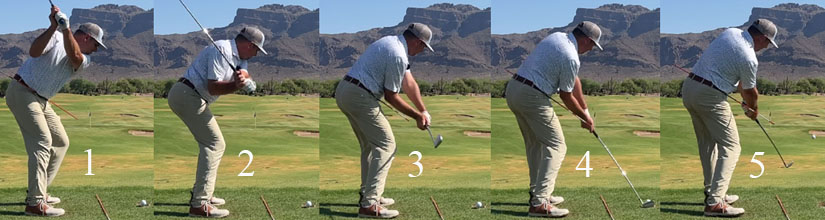
Here are capture images of Milo Lines performing his
downswing action.
Image 1 is at P4, image 2 is at P5, image 3 is at P6, image 4 is at P7 and image 5 is at P7.4.
Note that Milo has placed an alignment stick in
his belt loops to show the alignment of the pelvis during his downswing
action.
Note that Milo has anterior pelvic tilt at
address, which he increases to a significant degree between P4 => P5 by
performing a squat move involving an increased degree of hip joint flexion.
Note that he has squared his pelvis by P5. One of the reasons that Milo
promotes the squat move is to create a lot of space in front of his rotating
body for the arms/clubshaft.
Note that he remains in anterior pelvic tilt at P6
while he continues to rotate his pelvis counterclockwise. An important
biomechanical feature of his technique is that he gets his trail elbow in
front of that alignment stick between P5 => P6. That is biomechanically
possible because he ensures that his upper torso rotates fast enough to
nearly catch up to his pelvis by P6 and he specifically wants to avoid
generating a lot of torso-pelvic separation in his early downswing action -
note how his trail elbow has already moved ahead of his trail shirt seam at
P5 and even more so by P6.
Note that he continues to actively rotate his
pelvis counterclockwise so that it is open by P7. He also specifically
rotates his upper torso very actively and he talks about the pelvis/upper
torso rotating as a single unit. He also talks about the "feel" of the chest
covering the ball during his P5 => P7 time period and he talks of the "feel"
of his active chest rotation powering his golf swing action in the later
downswing. Note that his pelvis is still in anterior pelvic tilt at impact.
Between P7 => P7.4 he continues to rotate his pelvic/upper torso counterclockwise while still being in the biomechanical condition of anterior pelvic tilt and he performs a CP-arm release action post-impact.
Here are face-on capture images of his downswing
action.

Image 1 is at P4, image 2 is at P5, image 3 is at P5.5, image 4 is at P7 and image 5 is at ~P7.7.
Note that I have drawn two red lines alongside
the outer border of his pelvis at P4. Note that he has a very rotational
pelvic motion between P4 => P7 and his pelvis does
not shift
left-laterally in a targetwards direction during his P4 => P7 time
period. Also, note that how stacked his upper torso is positioned
relative to his lower torso (pelvis) during his entire downswing action
and he acquires very little secondary axis tilt and right lateral bend.
Milo's pelvic motional technique works very
well for him and Henry and I have no objection to their idiosyncratic
pelvic motional technique, which they are free to teach to their
student-golfers. However, I object very strongly to their claim that
their pelvic motional technique is the "right" way to perform a pelvic
motion during the downswing action, rather than simply stating that it
is an alternative pelvic motional technique that they personally favor
over the standard pelvic motional technique seen in many pro golfers.
During the first 1.5 minutes of the video
ML/HF describe the "wrong" way to perform a pelvic motion.
Note that HF states between the 0:00 - 0:10
minute time point of the video that many golfers try to "spin" their
pelvis as fast as possible at the start of the transition to the
downswing and they end up as he demonstrates at the 0:05 minute time
point of the video = with the pelvis being very open and with a lot of
torso-pelvic separation that causes the pelvis to become much more open
than the upper torso during the early downswing time period. At the 1:00
- 1:10 minute time point of the video, HF states that it can causally
predispose to the "Ole move" (named after Tiger Woods) that causes the
trail elbow to get trapped behind the trail hip at the P5.5 => P6 time
point.
Listen to Milo, and
watch Milo's demonstration, between the 1:17 - 1:34 minute time point of
the video - where he states that generating too much torso-pelvic
separation causes the pelvis to rise prematurely and that it causes the
upper torso and club to fall-back => look at Milo and Henry
simultaneously demonstrating a "fall-back" posture at the 1:28 minute
time point of the video. I agree that the "fall-back" phenomenon is a
swing fault that can potentially happen if an active pelvis
shift-rotation move is performed during the early downswing, but it does
not happen in pro golfers who use the standard pelvic shift-rotation
pattern, that is used by the majority of PGA tour pro golfers.
Let's look at how two modern-day pro golfers perform a pelvic motion during their downswing action.
I will start off with the greatest pro golfer
of the modern era (~2024) - Scottie Scheffler (SS).
Here are capture images of SS's pelvic motion.
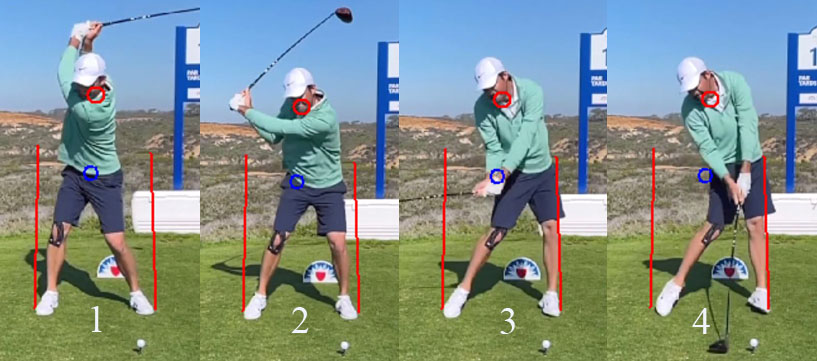
Image 1 is at P4,
image 2 is at P5, image 3 is at P6, and image 4 is at P7.
I have drawn two vertical red lines outside his feet at P4, and a small blue circular marker over his lower swing center and a small red circular marker over his upper swing center at P4.
Look at how much his lower swing center
has moved targetwards between P4 => P6, and it is probably about 6
-8" of left-lateral shift. However, that does not cause his upper
torso to "fall-back" - note that his upper swing center is still
located at the same position at P6 that it manifested at P4. There
is also no evidence that he is prematurely lifting up his pelvis in
an inappropriate manner during the P4 => P6 time period.
Consider these DTL capture images of SS's
downswing action.

Image 1 is at P5.5, image 2 is at P6, image 3 is at P6.5 and image 4 is at P7.
Note that SS has a slightly open
pelvis at P5.5 and that it is even slightly more open at P7, but
he does not manifest a lot of pelvic rotational motion during
his later downswing between P5.5 => P7. What he does manifest is
an increasing degree of secondary axis tilt and a small degree
of right lateral bend that is secondary to his assertive pelvic
shift-rotary action. Note that he is still in anterior pelvic
tilt at P5.5 but that he moves towards an increasing degree of
posterior pelvic tilt during his later downswing.
Most
importantly, note that his trail elbow is abutted against his
trail shirt seam at P5.5 and it remains in the same relative
position all the way between P5.5 => P7. If SS had an alignment
stick in his belt loops (as seen in Milo's capture images) his
trail elbow would be behind the alignment stick at P5.5/P6. Why?
Note that SS keeps his upper torso slightly closed relative to
his pelvis during his mid-downswing time period due to the fact
that he manifests a finite degree of torso-pelvic separation and
his upper torso even looks slightly closed at impact. Note that
SS never has an "Ole move" swing fault as a result of having a
moderately large amount of torso-pelvic separation during his P5
=> P7 time period.
Capture image
of SS's followthrough action.
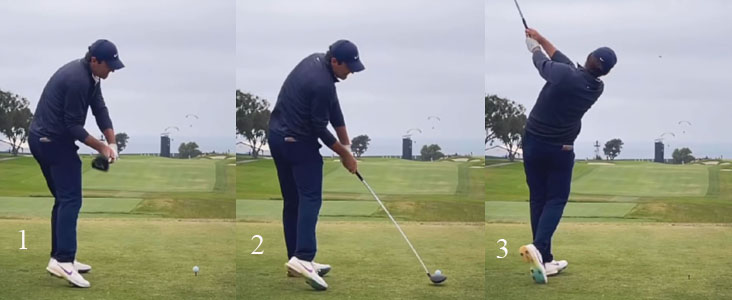
Note that SS uses a CF-arm release action with a high arm/club finish between P8 => P9 and his arms/club do not move inside-left immediately after impact.
Now, let's consider another superb PGA
tour pro golfer - Xander Schauffele (XS).
Capture images of XS's downswing
action.
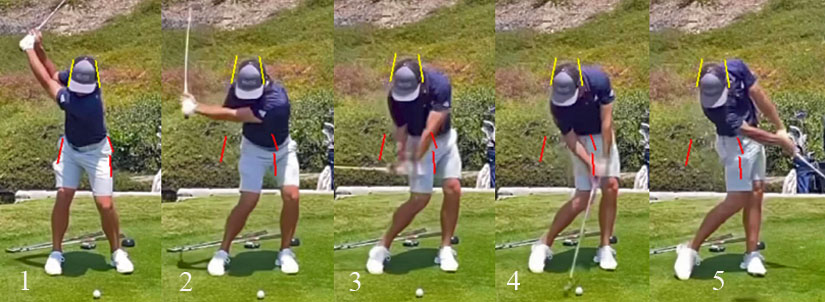
Image 1 is at P4, image 2 is at P5, image 3 is at P6, image 4 is at P7, and image 5 is at P7.7.
I have drawn red lines alongside
the outer border of his pelvis and yellow lines alongside
the left-and-right sides of his head at his P4 position.
Note how
actively XS performs a pelvic shift-rotary pelvic motion
between P4 => P6 - without any tendency for his upper torso
to "fall back" and without prematurely lifting up his
pelvis (in the manner demonstrated by ML in his video).
Consider
how super-assertively
XS performs a pelvic-shift rotation maneuver when swinging a
driver.
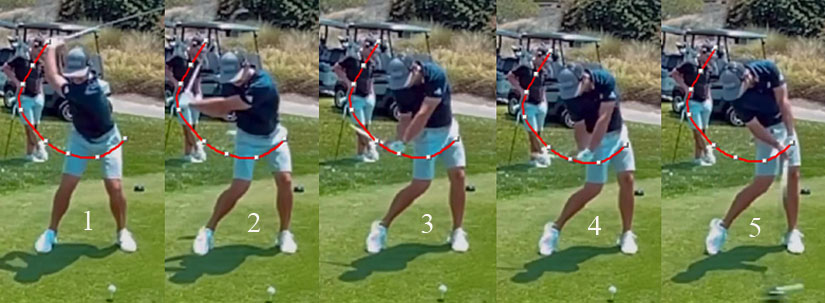
Image 1 is at P4, image 2 is at P5, image 3 is at P5.5, image 4 is at P6 and image 5 is at P7.
The red splined path is his
hand arc path.
Note the remarkable amount of
torso-pelvic separation he manifests between P4 => P6
and note that he does not allow his upper torso to
"cover the ball" (as recommended by Milo) and he
actually manifests a large degree of secondary axis tilt
and right lateral bend at impact where his lower swing
center is well ahead of his upper swing center
(secondary to his assertive pelvic shift-rotation
maneuver). Most
importantly, note how his pelvis is in a biomechanical
condition of posterior pelvis tilt between P5.5 => P7.
Note how his trail elbow
remains in close proximity to his trail shirt seam at
P5.5 and at P6 and it never moves far away from that
same area between P6 => P7.
Consider these DTL capture
images of XS's downswing action.
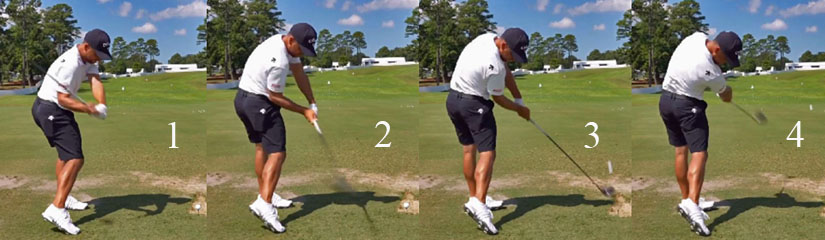
Image 1 is at P5.5, image 2 is at P6, image 3 is at P7 and image 4 is at P7.7.
Most importantly, note that he
still has a small degree of anterior pelvic tilt at P5.5,
but as he continues to perform an assertive pelvic
shift-rotary motion between P5.5 => P7 that he manifests an
increasing degree of posterior pelvic tilt. Note that he
keeps his pelvis well ahead of his upper torso (from a
shift-rotary perspective) throughout his entire downswing,
which requires a large degree of torso-pelvic separation -
and note how he then secondarily acquires a lot of secondary
axis tilt and right lateral bend between P6 => P7.
Note how his trail elbow remains
in close proximity to his trail shirt seam at P5.5 and at P6
and it never moves far away from that same area between P6
=> P7.
Note that XS uses a CF-arm release
action between P7 => P7.7 and he does not swing inside-left
immediately post-impact. Like Scottie Scheffler, his
arms/club finish up high between P8 => P9.
XS manifests many of the
biomechanical elements that ML/HF assert is the "wrong way"
to perform a pelvic motion, and both ML and HF stated in the
Milo-video that it is an "ouchy-ouchy" way to perform a
pelvic motion during the downswing. However, I believe that
as long as a pro golfer's pelvis is in posterior pelvic
tilt, and not anterior pelvic tilt, during his active pelvic
shift-rotation maneuver that it will not be a
"back-unfriendly" way to perform an active pelvic motion
during the downswing.
Many PGA tour golfers use Milo's
rotary pelvic motional technique when hitting short irons,
but I can only think of two pro golfers who use his
recommended pelvic motional technique when swinging a driver
- Vikor Hovland and Joaquin Niemann. The majority of pro
golfers (eg. Tiger Woods, Rory McIlroy and Nelly Korda) use
an active pelvic shift-rotation technique (as demonstrated
by Scottie Scheffler and Xander Schauffele), where they move
into a greater degree of posterior pelvic tilt after P5,
when performing a full golf swing action with a driver or a
long iron. It makes sense to me why they use that standard
pelvic motional technique, rather than the Milo Lines pelvic
motional technique where he remains in anterior pelvic tilt
during the entire P4 => P7+ time period. I personally think
that many golfers will find that it is biomechanically very
difficult to continue to
actively rotate the pelvis
counterclockwise during the later downswing and early
followthrough while remaining in anterior pelvic tilt.
Jeffrey Mann.
https://newtongolfinstitute.proboards.com/thread/1165/analysing-lines-pelvic-motional-technique