Capture images of Ben
Hogan's lead hand grip.
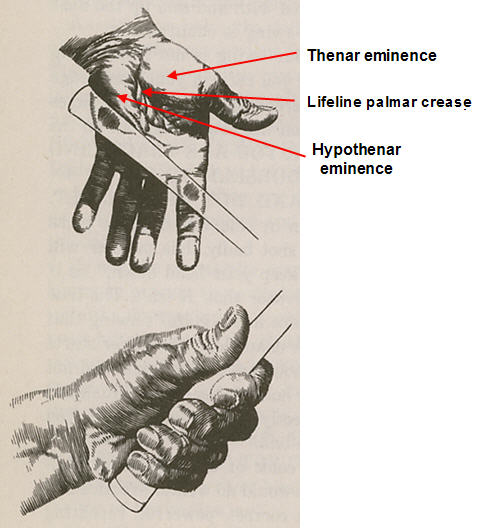
Note that BH placed the club handle diagonally across his lead palm from a point just below his hypothenar eminence to a point across the middle of the proximal phalanx of his index finger. His low palmar grip resulted in slightly less lead wrist mobility, but many pro golfers use a low palmar grip pattern with great success.
BM is strongly opposed to using a mid/high palmar grip pattern where the club handle goes over the hypothenar eminence.
Image of a mid-palmar
grip pattern.
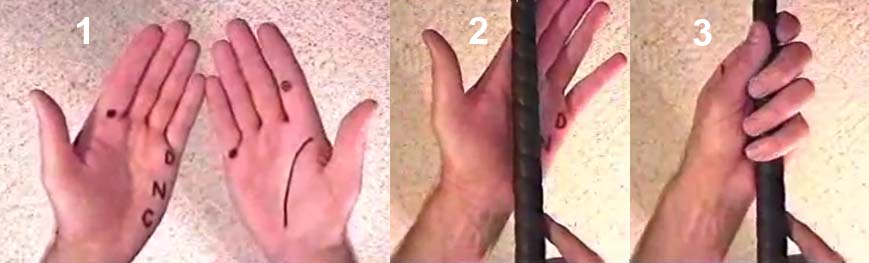
Note that the club handle goes over the hypothenar eminence creating a much smaller angle between the clubshaft and the longitudinal axis of the lead forearm. Many pro golfers use this type of grip pattern for putting because it creates greater stability at the expense of lead wrist mobility.
However, one of the longest drivers on the PGA tour - Bryson DeChambeau - uses a mid-palmar grip pattern for his driver and irons. Bryson DeChambeau uses JumboMax Tour Series XL grips, which are 3/8 in larger in diameter than standard grips and he places the club handle down the middle of his lead hand in a mid-palmar grip pattern. That means that the angle between his club handle and the longitudinal axis of his lead forearm is much smaller at address/impact - BDC states that it results in greater lead wrist stability at the expense of mobility. Although I do not personally recommend a mid-palmar grip pattern for a full driver/iron golf swing, BDC does show that it is possible to still hit the ball a long distance using a mid-palmar lead hand grip pattern that favors stability over mobility - and note that Moe Norman also used a mid-palmar grip pattern.
I think that BM is being far too didactic and narrow-minded by asserting that every golfer should adopt a finger grip pattern for the lead hand grip.
Watch the BBG video between the 8:30 - 10:30 minute where BM claims that his lead hand grip's finger grip pattern not only allows for a large degree of lead wrist mobility in the plane of lead wrist radial => ulnar deviation, but he also claims that it allows a golfer to more easily twist the club handle about its longitudinal axis by allowing the lead wrist to more easily bow and unbow. BM personally recommends the use of the reverse motorcycle move, combined with the twistaway maneuver, during the downswing because he wrongheadedly believes that it will decrease the amount of lead forearm supination required during the late downswing's PA#3 release action between P6.5 => P7. I have definitively shown that it is not true! I believe that most pro golfers (who use a non-strong lead hand grip) do not use the reverse motorcycle move/twistaway maneuver and they either use the intact LFFW/GFLW technique or the bowed lead wrist technique - as described in my downswing chapter at perfectgolfswingreview.net/downswing.htm#topic6 . I can readily agree that a handle twisting phenomenon must happen in the late downswing in a pro golfer who uses a non-strong lead hand grip, but the correct biomechanical mechanism should be via a lead forearm supinatory phenomenon and not via a lead wrist bowing phenomenon.
Watch the BBG video between the 10:30 - 12:30 minute time points where BM discusses the relationship between the back of the lead hand and the clubface. BM states that the angle difference must be around 15 - 20 degrees although he does mention that some pro golfers who adopt a very weak lead hand grip (like Jon Rahm and Collin Morikawa and Ben Hogan and Johnny Miller) have a <10 degree angle difference. Stop the BBG-video at the 12:28 minute time point where BM shows a clubface that is much more closed than ~30 degrees closed relative to the back of his lead hand - BM states that it should never happen! BM is totally wrong about this issue and pro golfers, who use a very strong lead hand grip, have their clubface closed by 30 - 60 degrees relative to the back of their lead hand at address/impact.
Capture images of
Matthew Fitzpatrick at impact.
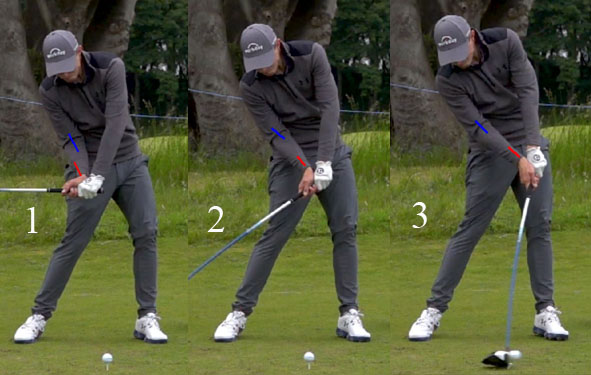
Matthew Fitzpatrick uses an ultra-strong lead hand grip.
Image 1 is at P6, image 2 is at P6.5 and image 3 is at P7.
Note that the back of his lead hand faces the ball-target line at P6 and also at impact and that there is no (or very little) counterclockwise rotation of the back of his lead hand happening between P6 => P7 secondary to a lead forearm supination phenomenon. Note that although the back of his lead hand is roughly parallel to the ball-target at impact, his clubface is facing the target, which means that there is probably greater than a 60 degree angle difference between the back of his lead hand and his clubface!
Starting at the 13:23 minute time point of the BBG-video BM starts to opine on the trail hand grip. BM wants to separate the trail hand's index finger from the middle finger in order to create a trigger finger grip pattern with the trail thumb opposed relative to the index finger in a pinching action. He also wants the ventral aspect of the trail index finger's proximal phalanx to be directly behind the aft side of the club handle at impact so that it faces the target. He also wants the trail hand grip to preferably be weak, so that the "true" trail palm area (area just proximal to the base of the 2nd - 5th fingers) is facing the target at impact. BM is entitled to his subjective opinion, but he has provided no rational reason for his preferences about having a weak trail hand grip where the "true" palm area faces the target impact. I suspect that it relates to his "personal belief" that the trail palm should be applying a positive push-pressure against the aft side of the club handle between P6 => P7 and his personal opinion that a golfer should use the rotation-about-the-coupling point hand release action through impact.
BM once
produced a video called the "Two Drills ... again video" which
previously used to be available at
vimeo.com/33692125.
In that video he uses a plastic bottle (masquerading as a
piñata- a piñata is a papier-mâché or other type of container
that is decorated) to demonstrate his
rotation-about-the-coupling point hand release action.
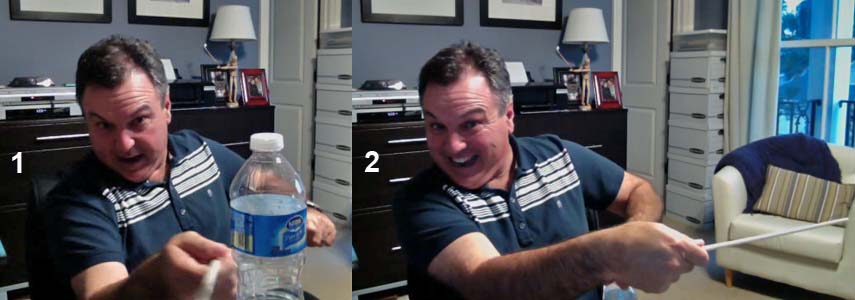
In image 1, Brian Manzella asks the question - "what would happen if you gave a person a short stick and asked him to efficiently hit the bottle (actually a piñata) with maximum speed - if you abruptly removed the bottle (actually a piñata) in a Charlie Brown manner"? In image 2, Brian Manzella demonstrates the answer - the right wrist would bend forward (flatten) soon after impact. In other words, if a golfer allows the clubhead to pass through impact at maximum speed due to the free release of the clubhead, then the right wrist would straighten/flatten (palmar flex) soon after impact. In this demonstration, it may look like Brian Manzella is performing an active slap hinge release action, but he claims that he is not actively straightening his right wrist in his recommended RACP-release action - because he wants there to be no "force-across-the-shaft" at the exact moment of impact. The right wrist straightens through impact because it passively follows the forward/gained momentum of the RACP-released club, which has been freely released through impact. Note that he still has a slightly bent right wrist at impact (which will ensure a FLW) at impact, and the right wrist only fully straightens/flattens immediately after impact.
I do not believe that pro golfers have a positive trail hand couple force between P6 => P7 or at impact in a full golf swing action, and I do not have any sympathy for BM's rotation-about-the-coupling point hand release action through impact.
Many pro golfers adopt a strong trail hand grip and their trail index finger/trail palm never faces the target at impact.
Here is an
example - featuring Justin Thomas.
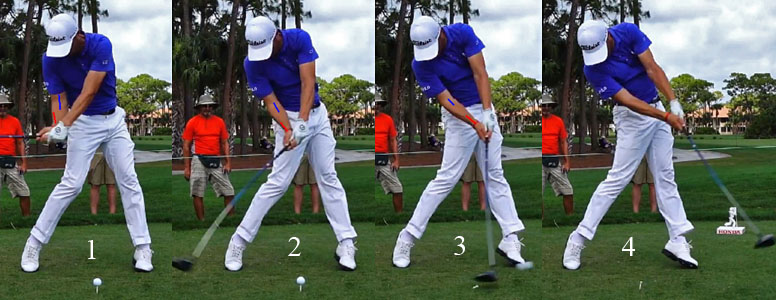
Image 1 is at P6, image 2 is at P6.5, image 3 is at P7 and image 4 is at P7.4.
Note that his trail palm/ventral aspect of his trail index finger is under the club handle between P6 => P7.4 and it never faces the target.
Note
that JT uses a DH-hand release action between P7 => P7.4
and he never allows the clubshaft to flip passed his
lead arm through impact and he maintains an extended
trail wrist to well beyond impact.
Jeffrey Mann.
https://newtongolfinstitute.proboards.com/thread/1138/video-brian-manzella-discusses-grip