Brian Manzella's ignorance regarding a DH-Hand release action


Watch this Instagram video featuring Brian Manzella. 

http://instagram.com/p/CnVCFyHKSX0 

In that video BM discusses what one should do with the wrists through impact.

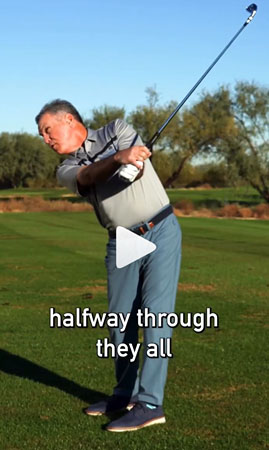
BM believes that the lead hand should rotate counterclockwise secondary to lead forearm supination while the trail forearm pronates so that the trail hand can roll over the lead hand after impact (representing what is called a "release swivel action) - and BM poses at the P8.5 position showing the completion of his release swivel action.

Here is a capture image from that video of BM showing that P8.5 position.


BM categorically states that all great pro golfers throughout the history of pro golf look like this at the P8.5 position when they are halfway through their followthrough action.

I would agree with BM that the majority of pro golfers will use a release swivel action in their later followthrough after P7.5 if they want to get the clubshaft to lie on the swingplane where the butt end of the club often points at the ball-target line (indicating that their clubshaft is on-plane) at the P8.5 position.

However, there are two ways to get to that P8.5 position - where the trail forearm's pronatory action has rolled the trail palm over a supinating left hand.

The one way is to start the release swivel action immediately after P7 so that the release swivel action is completed early before P8.

Here are capture images of BM demonstrating that type of rolling subtype of non-DH hand release action through impact.
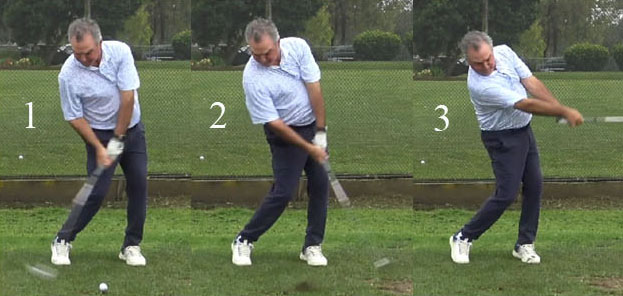


Image 1 is at P6.8 - note that the back of BM's lead hand (glove logo) is still visible immediately pre-impact.

Image 2 at P7.2 shows how much his lead hand has rotated counterclockwise through impact secondary to a lead forearm supinatory motion while his trail palm is starting to rotate over the top of the club handle, and that represents the start of his release swivel action, which causes the clubshaft to bypass his lead arm (from an angular rotational perspective) by P7.2.

Image 3 shows that BM has completed his release swivel action by P8. 

However, many pro golfers do not perform a release swivel action between P7 => P7.5 and they delay it so that it only happens between P7.5 => P8.5.

Here is an example - featuring Justin Thomas.


Here are capture images of his followthrough action between P7 => P8.5.


Image 1 is at impact. Note that JT has minimal forward shaft lean at impact and he is obviously not using a "handle-dragging" release technique. I have drawn a red line over his lead forearm's lower radial bone and it is rotated counterclockwise about 70 -80 degrees by impact secondary to his PA#3 release action (which is biomechanically due to lead forearm supination) because he uses a weak lead hand grip.

Image 2 is at P7.3. Note that he is not continuing to significantly supinate his lead forearm between P7 => P7.3 (see the angular relationship between that red line and a line drawn down the middle of his lead antecubital fossa). Note that he is allowing his lead humerus to rotate counterclockwise to a small degree and that allows him to keep his clubface square to the clubhead path between P7 => P7.3. Note that the clubshaft has not bypassed his lead arm (from an angular rotational perspective), which means that he is using a DH-hand release action in his early followthrough.

Image  3 is at P7.5. Note that he is not continuing to significantly supinate his lead forearm between P7.3 => P7.5 (see the angular relationship between that red line and a line drawn down the middle of his lead antecubital fossa). Note that he is allowing his lead humerus to rotate counterclockwise to a small degree and that allows him to keep his clubface square to the clubhead path between P7.3 => P7.5. Note that the clubshaft has not bypassed his lead arm (from an angular rotational perspective), which means that he is using a DH-hand release action in his early followthrough.

Note that JT does not roll his trail palm over the top of his club handle, or over his lead hand, between P7 => P7.5 and his trail palm is mainly behind the aft side of his club handle at P7.5.

Image 4 is at P8 when he is starting to fully straighten his trail wrist and also starting to pronate his trail forearm so that his trail hand is now starting to roll counterclockwise over his supinating lead hand - and that represents the start of his release swivel action, which is fully completed by P8.5 (image 5).

However, JT does not perform a release swivel action between P7 => P7.5 and he delays it so that it only starts after P7.5.

Delaying the release swivel action so that it only happens after P7.4 does not mean that a pro golfer is using a "handle-dragging" hand release technique that restricts the full release of the club and it only means that he is likely using a DH-hand release action rather than a non-DH hand release action.

BM is seemingly oblivious of the differences between a "handle-dragging" release action and a DH-hand release action. BM is also seemingly ignorant of the biomechanical differences between a rolling subtype of non-DH hand release action and a DH-hand release action.

An intellectual question that intrigues me is why prominent golf instructors - like Jon Sinclair and Brian Manzella - cannot understand why it is possible to have a quiescent phase (from a lead forearm supinatory motion perspective) between the rapid lead forearm supinatory motion happening during a PA#3 release action and the rapid lead forearm supinatory motion happening during a release swivel action.

Jon Sinclair has stated that he cannot envisage that it is biomechanically possible to temporarily slow down the speed of lead forearm supination (that happens between P6.5 => P7 during a PA#3 release action), so that the rate of lead forearm supination decreases dramatically between P7 => P7.4 before then speeding up again post-impact during the execution of a release swivel action.

Here are capture images of Justin Thomas's PA#3 release action.


Image 2 is at P6.7 (which is about 18" before the clubhead reaches impact). Note that the back of JT's lead hand is facing the ball-target line and his lead forearm's lower radial bone is roughly parallel to the ball-target line.

Image 3 is at impact where the back of JT's lead hand and his lead lower forearm's lower radial bone have rotated ~70 degrees between P6.7 => P7 while the clubhead has traveled a distance of 18" along the clubhead path at a very fast speed of >100mph. That obviously means that the speed of lead forearm supination, which is casually responsible for the counterclockwise rotation of the lead hand, is happening very fast between P6.7 => P7.

However, when you look at his speed of lead forearm supination happening between P7 (image 3) and P7.4 (image 4) by evaluating the rate of rotation of his lead forearm's lower radial bone relative to the middle of his lead elbow's antecubital fossa (elbow pit), you can see that it must be very slow - and that allows JT to prevent the clubshaft from bypassing his lead arm (from an angular rotational perspective) between P7 => P7.4 and it allows him to keep his clubface square to his clubhead path between P7 => P7.4.

The opposite scenario to JT's DH-hand release action can be seen in this video of Christina Ricci demonstrating her "lighting fast" roller hand release action.


Note that CR states that the release of PA#3 plus the release swivel action that causes a counterclockwise rotation of the lead hand must be completed between the two thighs, so that by the time her hands bypass her lead thigh, the release swivel action must already be completed.

That is the antithesis of what is happening in Justin Thomas' driver golf swing action.


Image 1 is at impact, and we know that his clubshaft was rotating very fast (around its longitudinal axis) between P6.7 => P7.

However, his rate of clubshaft rotation around its longitudinal axis is very slow between P7 => P7.4 before it speeds up dramatically between P7.4 => P8.5 as he performs his release swivel action, which only starts after P7.4.

What enables JT to separate the rapid lead forearm supination phase happening between P6.7 => P7 (representing the release of PA#3) from the rapid lead forearm supination phase happening between P7.4 => P8.5 (representing the release swivel action) with a quiescent phase where there is a negligible rate of lead forearm supination happening between P7 => P7.4? How does JT achieve this from a biomechanical perspective, which makes a DH-hand release action biomechanically possible?

There are a number of principles that make it biomechanically possible.


1) First of all, JT does not attempt to fling the clubhead passed his hands through impact - as BM recommended in that Instagram video.


2) Secondly, JT does not attempt to actively induce a rapid PA#3 release action using a very actively forceful lead forearm supinatory muscular force (combined with a very actively forceful trail forearm pronatory muscular force) with the intention of completing both the PA#3 release action and the release swivel action by the time his lead arm just bypasses his lead thigh.

What JT is really doing is executing an intact LFFW/GFLW golf swing action between P4 => P7 while letting the PA#3 release action happen passively/naturally using no lead forearm supinatory force/trail forearm pronatory force.
Here is my demo - in "artificial" slow motion - showing the intact LFFW/GFLW concept.


Image 1 is at P4, image 2 is at P5.2, image 3 is at P5.5, image 4 is at P6.5, image 5 is at impact (where I have the desired amount of forward shaft lean due to expertly controlling the rate of counterclockwise rotation of the intact LFFW during the PA#3 release action) and image 6 is at P7.1 (where I have an intact LAFW as well as an intact LFFW).

The red piece of cardboard represents the "idea" of an intact LFFW where the clubshaft is continuously straight-line-aligned with my lead lower forearm's lower radial bone (see short piece of black tape placed over my lead lower forearm's lower radial bone) throughout the entire downswing and early followthrough.

Justin Thomas is using the intact LFFW/GFLW swing technique in his driver swing action between P4 => P7.

Then, when the clubshaft becomes straight-line-aligned with both his lead forearm and lead upper arm at ~P7 - P7.1, he maintains an intact LAFW alignment between P7.1 => P7.4+ by ensuring that the lead arm's angular velocity is perfectly matched with the clubshaft's angular velocity and by ensuring that the entire LAFW (lead arm + clubshaft) rotate counterclockwise at the same rotary speed that allows the clubhead to remain square relative to the clubhead arc between P7.1 => P7.4+. Then, after P7.4 he transitions into a release swivel action, which requires a lot of lead forearm supinatory motion over a short period of hand travel distance between P8 => P8.5.

What makes it physically/biomechanically possible to separate the rapid lead forearm supinatory phase of the PA#3 release action from the rapid lead forearm supinatory phase of the release swivel action are the biomechanical actions bold-highlighted in the previous paragraph, and which can be clearly seen in images 1, 2 and 3 of the following capture images.


Jeffrey Mann.

https://newtongolfinstitute.proboards.com/thread/1036/brian-manzellas-ignorance-release-action