Analysing Danny Maude's "turn-the-face-down" swing video
Watch the following Danny Maude (DM) video.
In this video, DM states that a
"vital ingredient" must happen during the downswing in order to ensure that the
clubface is square to the target at impact when the golfer has the physical
condition of forward shaft lean at impact - and that "vital ingredient" is his
"turning-the-face-down" method of closing the clubface relative to the clubhead
path by impact.
DM correctly states that it is optimal for a golfer to
manifest forward shaft lean at impact by ensuring that the hands are slightly
ahead of the clubhead at impact, and he correctly infers that it can create an
open clubface alignment at impact, which will predispose to push-sliced shots.
He then correctly states that a golfer needs to use a counterclockwise rotation
of the lead forearm, which is called a PA#3 release action in TGM terminology
and that is due to a lead forearm supinatory motion happening between P6.5 =>
P7, in order to square the clubface by impact. However, when you examine his
demonstrated
clubface-squaring technique there are two strange facts -i) he squares the
clubface without performing a PA#3 release action and he talks about "turning
the clubface down" which is not a feature of a PA#3 release action. In the
standard PA#3 release action, a lead forearm supinatory motion will cause the
clubface to rotate counterclockwise relative to the clubhead path, but it will
not turn the clubface in a downwards direction.
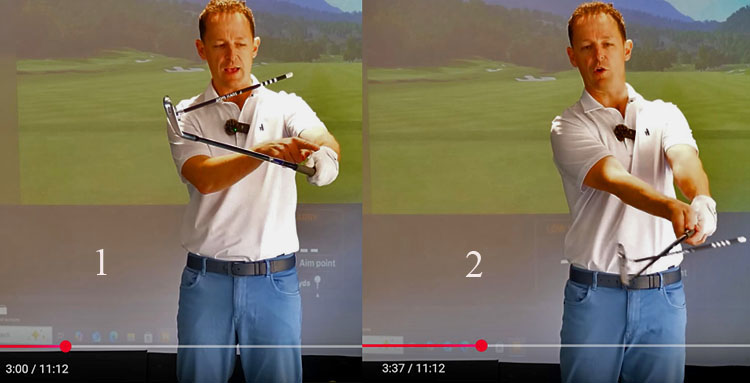
Here are capture images from the video showing DM
demonstrating his clubface-closing methodology.
Image 1 shows DM manifesting a forward shaft lean alignment, which causes the clubface to be open. Note that his trail index finger is pointing at his lead forearm's lower radial bone, which is rotated clockwise in a pronatory direction, and it is not vertical and perpendicular to the functional swingplane. Note that the glove logo on the back of his lead hand is angled clockwise to the same degree as his lead lower forearm's lower radial bone, and note that his clubface is slightly closed relative to the back of lead hand, which is slightly bowed.
Image 2 shows how he squares his clubface so that
his clubface is perpendicular to the functional swingplane, and directly
facing the target. However, note that the back of his lead hand is still
rotated clockwise to the same degree as it was in image 1, and it is not
rotated more counterclockwise which means that he is not using a PA#3
release action to square his clubface.
So, how is he squaring the clubface in his
demonstrated clubface-closing maneuver?
He is obviously performing a handle-twisting
action - using the finger flexor muscles to his lead hand's 3rd, 4th and 5th
fingers - that causes his clubface to become more closed relative to the
back of his lead hand and that counterclockwise handle-twisting maneuver is
the actual biomechanical basis of the reverse motorcycle move.
Why does DM call that reverse motorcycle
handle-twisting action a "turn-the clubface-down" move when there is no
evidence in that DM-demonstration that shows the clubface turning downwards?
The answer becomes very apparent during the later
video - see the following capture images from the 10:02 minute time point of
the video.
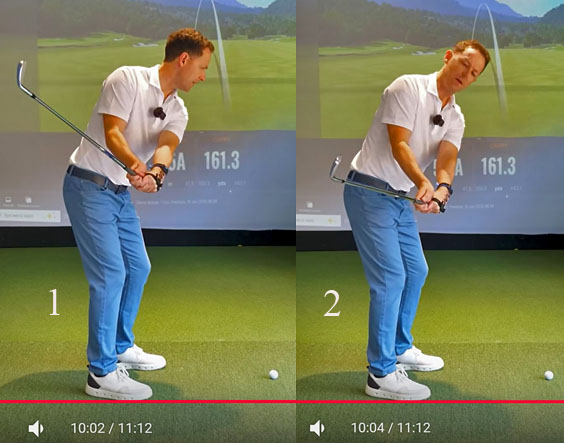
Image 1 shows how he performs a shortened backswing action where he does not even get his lead arm to the P3 position where the lead arm is parallel to the ground. Note that his clubface is slightly closed relative to the back of his lead hand because he uses a non-weak lead hand grip. However, his clubface is still open relative to his clubhead path.
Image 2 shows how he closes the clubface by
another ~20 - 30 degrees, which he calls a "turning-the-clubface-down"
move, and which is really just the end-result of performing the reverse
motorcycle move which closes the clubface slightly more relative to the
clubhead path.
So, the question becomes - can a pro golfer
use the reverse motorcycle move as the major clubface-closing mechanism
needed to avoid an open clubface at impact (which is due to forward
shaft lean) and thereby avoid having to use a PA#3 release action
between P6.5 => P7?
The correct answer is that it is physically
impossible!!! It is obviously true that a pro golfer (who uses a
non-strong lead hand grip) can optionally perform the reverse motorcycle
move between P4 => P6, but it will not decrease the amount of lead
forearm supination needed to perform a PA#3 release action between P6.5
=> P7.
Here is the proof - using Jon Rahm, who adopts
a weak lead hand grip at address and who uses the bowed lead wrist swing
technique.
Here are DTL capture images of Jon Rahm.
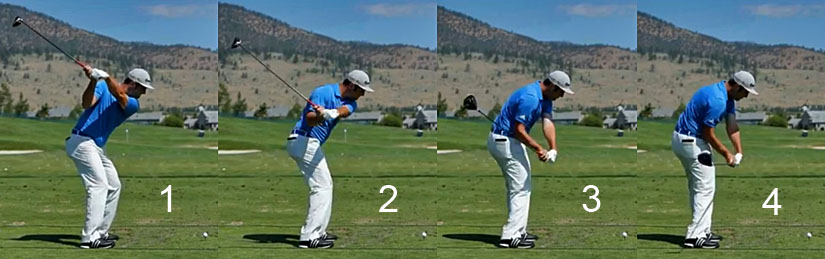
Image 1 is at P4, image 2 is at P5, image 3 is at P5.5 and image 4 is at P6.
Note that JR bows his lead wrist during
his backswing action so that it is already bowed by P4. However,
note that his clubface is straight-line-aligned relative to the back
of his lead hand at P4 and P5, which means that he is not performing
the reverse motorcycle move between P4 => P5.
However, he is obviously performing the
reverse motorcycle move in image 3 and image 4 and his clubface is
obviously much more closed relative to the back of his lead hand at
P6.
Now, consider what happens between P6.5 =>
P7.
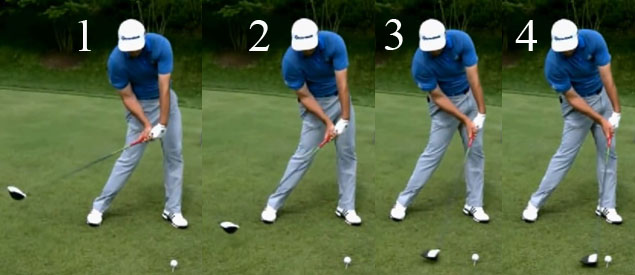
Image 1 is at P6.5, image 2 is at P6.65, image 3 is at P6.8 and image 4 is at impact.
Note that his clubface is minimally
closed relative to the back of his lead hand in image 1, but not
in images 2, 3 and 4, and that means that the clubface-closing
effect of his reverse motorcycle move is dissipating in his
later downswing and there is zero evidence of a reverse
motorcycle move causing a clubface-closing phenomenon at impact
- note that his clubface is straight-line-aligned with the back
of his lead hand at impact. Why does the clubface-closing effect
of a reverse motorcycle move dissipate in the later downswing? I
believe that it is due to the centrifugal forces existing during
the club release action (called the release of PA#2 in TGM
terminology) that stretch the finger flexor muscles. I have
never see any pro golfer who can keep the clubface closed
relative to the back of his lead hand at impact as a result of
performing the reverse motorcycle move technique during a full
golf swing action, and I will happily donate $100 to any person
who can provide any "evidence" that contradicts my claim!
So, how does JR square the clubface at
impact seeing that he has lot of forward shaft lean at impact?
Here are close-up views of his lead
forearm/lead hand during his PA#3 release action.
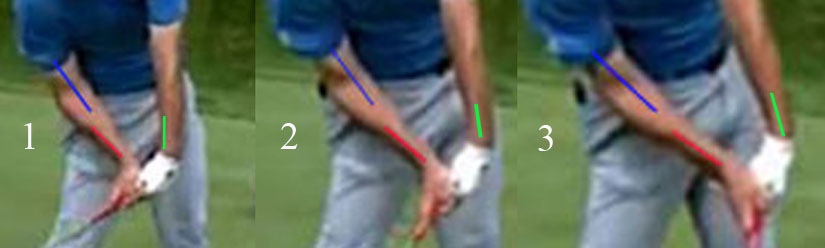
Image 1 is at P6.5, image 2 is at ~P6.7 and image 3 is at P7.
I have drawn a short green line
over his lead forearm's lower radial bone and one can
clearly see how much it is rotating counterclockwise between
P6.5 => P7 secondary to a lead forearm supinatory motion,
which is the biomechanical basis of the counterclockwise
rotation of the lead hand that happens during a PA#3 release
action. That is the only
biomechanical technique that pro golfers (who use a weak
or-neutral lead hand grip) use to square the clubface by
impact when they manifest forward shaft lean at impact
(which has a clubface-opening effect) - irrespective of
whether they use, or do not use, the reverse motorcycle move
during the earlier downswing between P4 => P6.
Danny Maude is free to teach the
reverse motorcycle move technique, but he is not correctly
demonstrating that the clubface-closing phenomenon that is
always needed to avoid an open clubface at impact (which is
due to the presence of forward shaft lean) in a golfer who
uses a non-strong lead hand grip must be due to a PA#3
release action (which is biomechanically secondary to a lead
forearm supinatory motion that rotates the clubshaft
counterclockwise during the later downswing) and it is not
due to the reverse motorcycle move.
Jeffrey Mann.
https://newtongolfinstitute.proboards.com/thread/1206/analysing-danny-maudes-swing-video