Analysing Danny Maude's recommended golf swing action
I have been studying golf swing biomechanics for ~18 years now in an attempt to better understand how pro golfers perform the golf swing action so efficiently. Most pro golfers use a pivot-induced TGM swinging action (lead arm swinging action). However, there are many amateur golfers who cannot perform a pivot-induced TGM swinging action because of a number of reasons - i) a lack of hula hula flexibility; ii) overall spinal stiffness and iii) a history of lumbar herniated disc disease that produces low back pain/sciatica, which is exacerbated by any attempt to actively rotate the pelvis/lumbar spine. I think that those golfers are obliged to perform a non-pivot induced golf swing action - which can be called an "arm swinging action" using a reactive/passive pivot motion. I do not know of a "fixed" definition of an "arm swinging action", and my personal opinion is that it must be primarily based on a lead arm swinging action where the golfer powers the golf swing by sequentially releasing PA#4 => PA#2 using an arm action. It is theoretically possible to power the golf swing with the trail arm, representing a trail arm swinging action, but I personally think that it is a sub-optimum technique, which I personally would not recommend for a golfer who has two arms.
I have never previously described how best to perform an "arm swinging" action, and I will now express my opinions on this topic in this post.
I am going to use Danny Maude's golf swing action - as demonstrated/described in the following swing video - as a template and I will add many comments where I disagree with his "arm swinging" approach.
The main topic of this DM-video
is actually how to optimally use the trail arm, but what really attracted me was
how DM performed the golf swing action in the video using a non-pivot induced
"arm swinging" action. DM did not discuss how he powers the golf swing, other
than to imply that it is not pivot-induced. I strongly believe that his "arm
swinging" action is really a lead arm swinging action using a reactive/passive
pivot motion. What I really like about his approach is that he envisions
swinging his lead arm/club in a curved arc around his body where the clubshaft
is roughly on the same plane during the backswing and downswing.
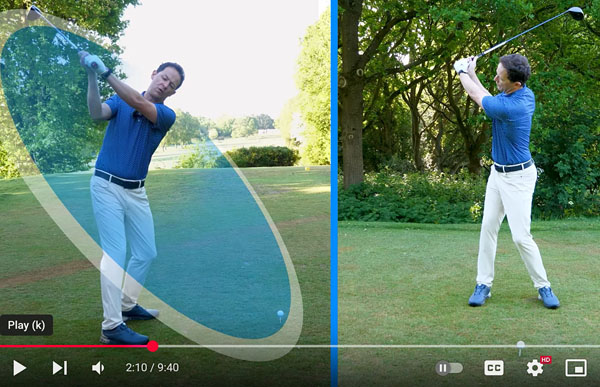
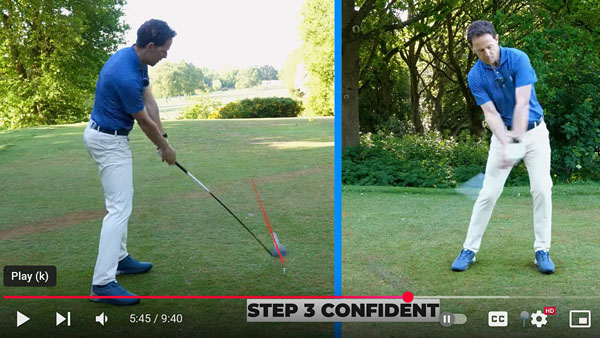
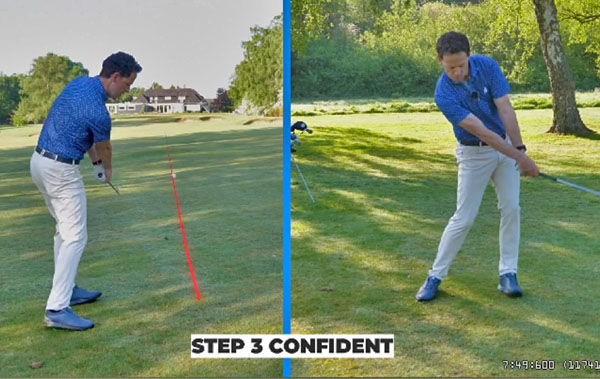
Here is a capture image from the video.
Note that DM wants the clubshaft/clubhead arc to swing on a consistent plane during both the backswing and the downswing, and he does not want to deliberately shallow the clubshaft during the downswing. I strongly favor that approach of minimising plane shifts during a golf swing action and where the clubshaft is continuously "on-plane" (= defined as the scenario where an imaginary line extended outwards from the club end that is nearest the ground always points at the ball-target line) between P1 => P4 and also between P4 => P7.
DM describes how to position the trail arm at address, which is very conducive to easily/optimally folding the trail arm during the backswing action. DM's trail arm folding technique between P1 => P4 is identical to the "Right Forearm Takeaway (RFT) technique that I have described.
Consider its evolution.
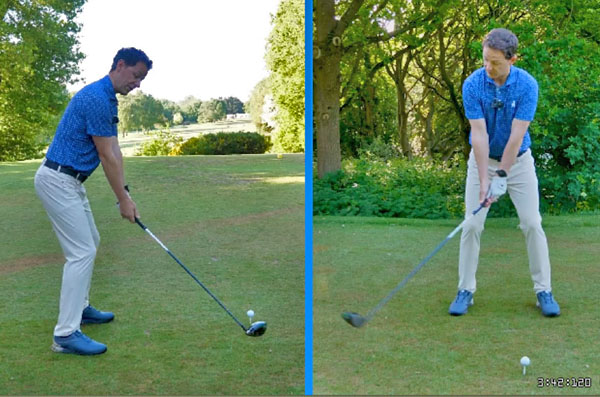
DM uses a neutral lead hand grip and a neutral trail hand grip.
DM starts the takeaway
by simply moving the clubshaft back away from the target while keeping
the clubshaft on its original shaft plane (= hand plane). Note that the
lead forearm is pronating slightly.

This capture image shows DM at the P2 position. Note that the clubshaft is parallel to the ground and parallel to the ball-target line and just in front of his toe line.
Note that his clubface is minimally closed relative to the back of his lead hand, and that is because he uses a neutral lead hand grip. If he used a weak lead hand grip it would be less closed and if he used a moderately strong lead hand grip, it would be more closed.
Note that he allows
his pelvis and thorax to rotate clockwise to a small degree between
P1 => P2
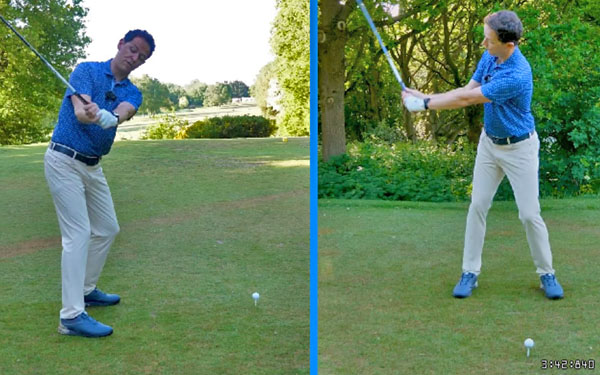
This capture image show DM at his P3 position.
Note that he is already upcocking his lead wrist to a large degree and allowing his trail arm to fold to a significant degree that makes it biomechanically easier (= more comfortable) to upcock the lead wrist.
Note that his hands are roughly opposite his mid-chest and at a level that is slightly higher than the elbow plane.
Note that he is rotating his pelvis/thorax very well so that he can keep his hands in front of his rotating torso.
Between P1 => P4, he is keeping the clubshaft continuously "on-plane".
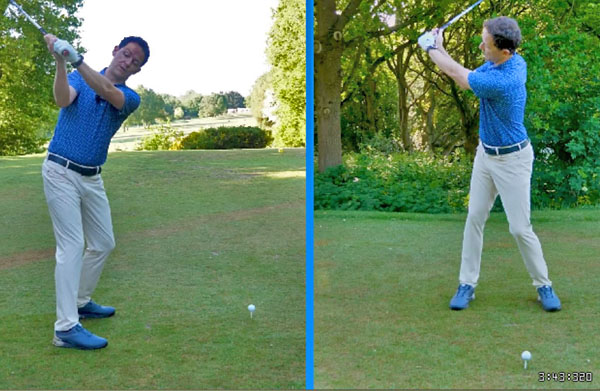
This capture image shows DM at the P4 position where the clubshaft is pointing left of the target and where it is still "on-plane".
Note that his trail arm has bent to a ~90 degree angle. His trail forearm looks slightly supinated rather than being neutral, but it would likely/naturally become more neutral if he decided to get his clubshaft to become parallel to the ball-target line at P4.
When performing this RFT technique like DM, the "average" amount of pelvic rotation will be ~45 degrees and the shoulders will rotate ~90 degrees creating a static X-factor measurement of ~45 degrees. However, the amount should depend on one's flexibility and the shoulders can rotate between ~70 - 100 degrees for the "average" amateur golfer.
When performing this RFT technique, it is permissible to use a rightwards-centered upper torso loading technique, or a vertical-centralised upper torso loading technique, or a leftwards-centralised upper torso loading technique.
DM describes how to perform the downswing action between the 3:45 - 5:00 minute time point of his video. He specifically states that a golfer should avoid rotating the pelvis/torso and that one should simply think of moving the arms downwards - and he vaguely talks of using gravity or a throw motion to move the arms downwards. He also talks about unfolding the trail arm from the very start of the downswing, which is an opinion that I totally reject.
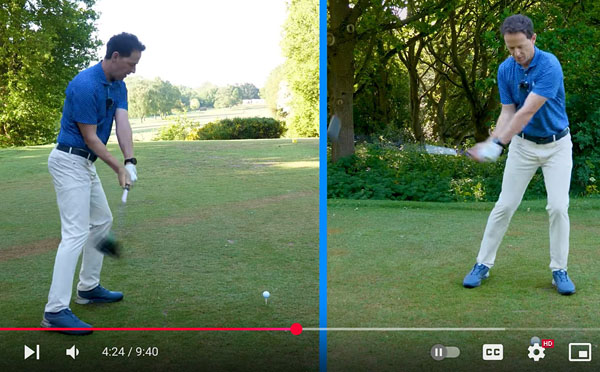
Here is a capture image
showing DM demonstrating his trail arm unfolding action.
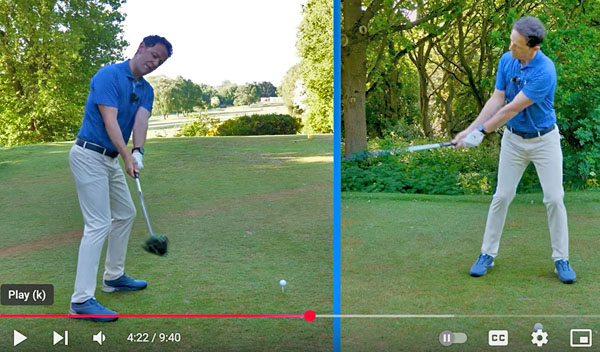
This image is from the 4:22 minute time point of the video.
Note that his hands have reached waist level and that he has lost a lot of his clubhead lag angle because he has straightened (unfolded) his trail arm prematurely and by too much.
That excessive unfolding action of his trail arm does not really happen in his "real life" golf swing action.
Here is a capture image from his driver golf swing action where he is at his P5.5 position.
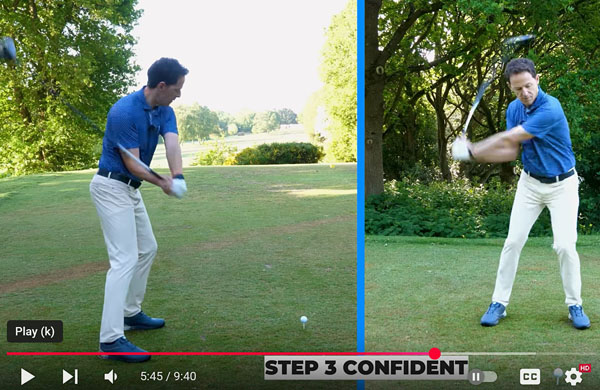
Note that his trail arm has only straightened/unfolded to a small degree (eg. from a ~90 degree angle at P4 to a ~100 angle at P5.5) and that allows him to retain a clubhead lag angle (= angle between the lead arm and clubshaft) of ~90 degrees. To achieve that goal when performing an "arm swinging" technique, I think that a golfer should be pulling the club handle down to the P5.5 position with a lead arm pulling action (secondary to an arm-induced release of PA#4 using the lead shoulder girdle muscles) and he should simultaneously be actively adducting the trail upper arm using a pitch elbow motion of the trail arm, with the intention of getting the trail elbow to nearly be reaching a position close to the front of the trail hip area by P5.5/P6. It is permissible when actively adducting the trail upper arm between P4 => P5.5, that its active motion can cause the trail hand's thenar area to be applying a "feel" of positive push-pressure over the base of the lead thumb at PP#1, but the amount should be small - signifying that the trail hand is just keeping up with the lead hand (which is causally responsible for powering the release of PA#4). The trail wrist should also remain extended, and not straighten, as that can predispose to casting.
Note that the trail forearm must be supinating by the exact amount necessary to allow the trail palm to remain continuously parallel to the swingplane on which the clubshaft is positioned between P4 => P5.5. There is no need to think of deliberately shallowing the clubshaft to lower than the elbow plane by P5.5, but it is permissible if a golfer has the requisite flexibility to get a lot of secondary axis tilt and right lateral bend in a biomechanically comfortable manner.
Although DM stated that one should not rotate the torso at the start of the downswing, that recommendation is impossible to achieve. Note that DM's pelvis has rotated ~45 degrees to become square by P5.5 and his thorax has rotated by >45 degrees. My personal recommendation is to allow the pelvis to reactively/passively square by P5.5 while ensuring that the thorax also rotates reactively/passively. However, it is critically important for the upper torso to be slightly closed at P5.5 so that one can generate an in-to-out clubhead path between P5.5 => P7. If one passively/reactively allows the upper torso to over-rotate to an open position by P5.5/P6, then it will likely result in an undesirable out-to-in clubhead path during the later downswing.
Here are capture
images of his iron swing action (when he used a 6-iron to hit the
ball ~200 yards).

This image is his P4 position.
Note that he has only rotated his upper torso by ~80 degrees and he has a slightly shortened backswing action.
Note that his
trail elbow is marginally below his lead elbow at P4.
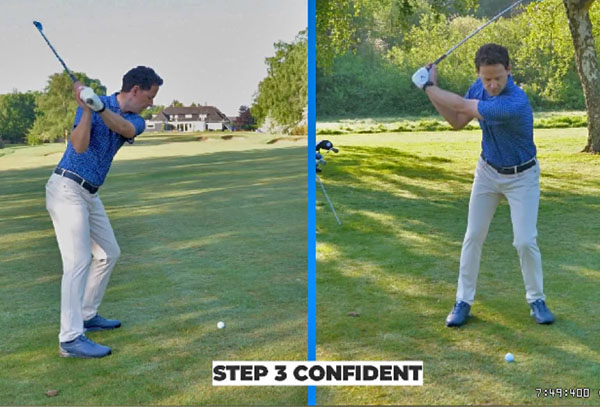
This image is at the transition to the downswing and at the ~P4.5 position.
Note that
his trail elbow is dropping below his lead elbow and that
his trail arm is very slightly more folded due to his active
trail upper arm adduction maneuver. That is permissible if
it is not excessive - if one does not deliberately choose to
use a "float-loading" swing technique.
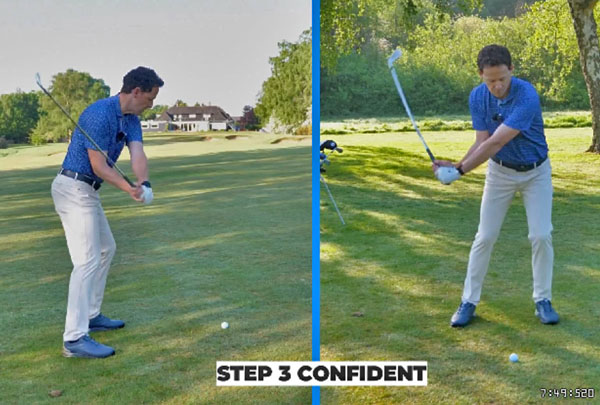
This image is at his P5.5 position.
Note that he is retaining a clubhead lag angle of ~90 degrees, which would not be possible if one unfolded the trail arm too early.
Note that his trail elbow is slightly ahead of his trail shirt seam at P5.5. This is important because his pelvis is not going to be opening further between P5.5 => P7 as seen in most pro golfers who a use a pivot-induced TGM swinging action - and in an "arm swinging" action the trail elbow must move across the front of the upper upper torso between P5.5 => P7.
Here is a capture image of DM's driver swing.
Note that both his pelvis and chest are facing the ball-target line at impact. This is a common biomechanical feature if a golfer uses an "arm swinging action" with a reactive/passive pivot motion. Note how his trail arm is angled towards the target at impact where the trail elbow is moving across the front of his torso between P6 => P7.
If the chest is parallel to the ball-target line at impact, that means that the trail shoulder socket is going to further back at impact (compared to a pro golfer - like Scottie Scheffler - who uses an active pivot-induced TGM swinging action) and the trail arm must therefore move further across the front of the body during the later downswing.
Capture image of Scottie Scheffler's late downswing
action.
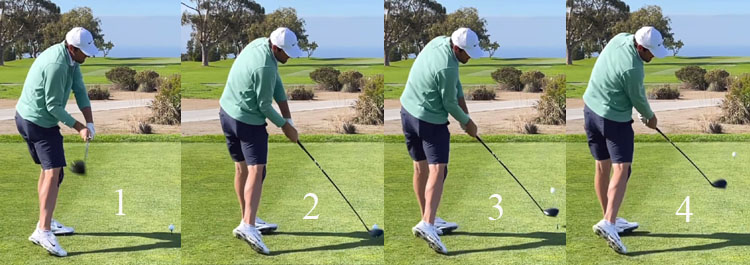
Image 2 shows SS at impact where he still has a slightly bent trail arm and a slightly extended trail wrist - even though his trail elbow has not bypassed his trail shirt seam. That is possible because his trail pelvis/mid-torso is rotated open at impact and also because his trail shoulder socket has moved further downplane by P7.
Here is a capture
image of DM at his P6 position when swinging a
driver.
Note that his hands are outside his trail thigh at P6. That allows him to create a more U-shaped hand arc path when hitting a driver, which is necessary if one wants to optimize the release of PA#2
In other words, whether one uses a pivot-induced TGM swinging action or an "arm swinging" action with a reactive/passive pivot motion, one still needs to shape one's hand arc path in order to optimally time the release of PA#2 - being more U-shaped when swinging longer clubs and being more V-shaped when swinging shorter clubs.
Another important point to note is that his trail forearm is supinated at P6, which positions his trail palm under the club handle. It is important for the trail forearm to be supinating between P5.5 => P6.5 to allow the clubshaft to release onto the functional swingplane without any chance of the clubshaft "tumbling" in an over-the-plane manner during that time period.
DM does not discuss how to perform a hand release action in his video.
Here is a capture
image of his followthrough action.
Note how much his clubshaft is bypass-flipping passed his stalled lead arm and how he is performing a hand cross-over release action during his early followthrough action.
I personally recommended a puck release action through impact and a non-DH hand release action (flipping subtype), where the degree of flipping is far less during the early followthrough between P7 => P7.2+.
I also prefer to not allow the trail forearm to pronate too early during the early followthrough.
Here is a
capture image of Rory McIlroy's hand
release action.
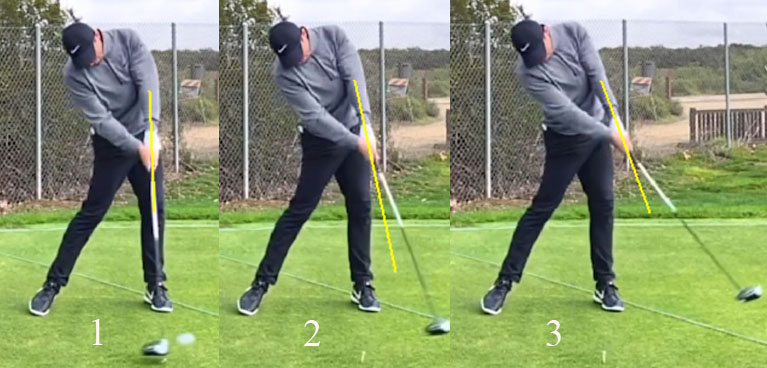
Note that his clubshaft is bypassing his lead arm to a small degree during his early followthrough because he is using a flipping subtype of non-DH hand release action. However, note that his trail forearm is still supinated during his early followthrough and his trail palm is not yet rotating over a supinating lead hand secondary to a trail forearm pronatory motion, and that his hand cross- over phenomenon only happens well after P7.4.
I personally recommend the same type of hand release action for an "arm swinger" and I do not recommend an early hand cross-over release action happening earlier than P7.2/P7.3.
---------------------------------------------------------------------------------------------------------------------------------------------------------------------------------------------------------------
In this post,
I am going to address the question as to
where does DM get his swing power.
Consider this
video.
In this video,
DM hits his 8-iron 166 yards and his
driver 290 yards with a shorter
backswing action. That's an impressive
distance. So, the question arises - does
he derive his swing power from a
pivot-induced release of PA#4 or from an
arm-induced release of PA#4 using his
shoulder girdle muscles?
Here are
capture images from his video.
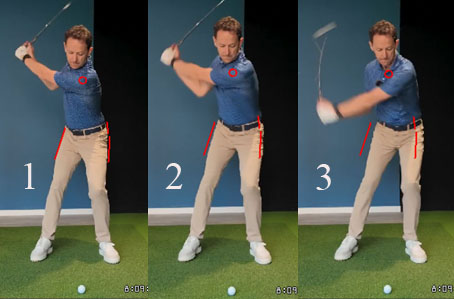
8-Iron swing
Driver swing
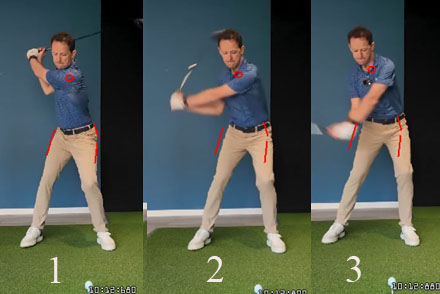
I have drawn a small red circular marker over his lead humeral head at P4 and red lines alongside his pelvis.
Let's presume that he releases PA#4 between P4 => P5.5/P6 where his lead arm speed reaches its maximum speed. What is causally responsible for providing his swing power to release PA#4?
Note that he does not have an active pelvic rotary motion at the start of his downswing and his pelvis only moves a few inches targetwards between P4 => P6. Note that his lead shoulder socket moves about 6" targetwards between P4 => P6 and it can be contributing to the release of PA#4. However, the motion of his lead shoulder socket is mainly in a horizontal direction, while his lead arm is mainly moving downwards and I therefore suspect that his very efficient release of PA#4 is mainly due to the muscular activation of his shoulder girdle muscles. What I cannot answer is whether his trail shoulder girdle muscles play a significant role. Note that he has a very efficient trail upper arm adduction maneuver during his early downswing while keeping his trail arm bent and I wonder whether his trail hand is applying some push-pressure against the base of his lead thumb to help him speed up his lead arm's PA#4 release action.
The more I
study Danny Maude's golf swing
action/advice - the more I like it.
Here is
another DM-video.
In this
video, DM talks about how he thinks
of swinging his arms across the
front of his body, while bracing his
lead leg/pelvis/mid-torso thereby
allowing the arms/club to more
freely release at a faster speed
during the later downswing and
through impact.
Here are
capture images from the video where
he drives the ball 290 yards using
an "arm-driven" golf swing action
with a passive pelvic rotation.
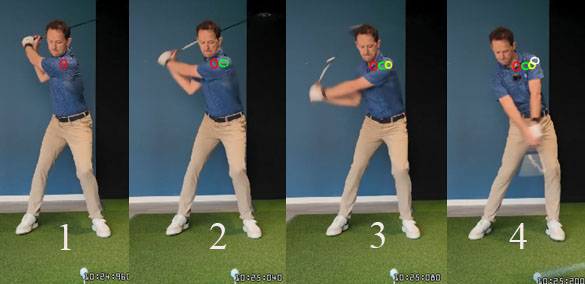
I have drawn small colored circular markers over his lead shoulder socket at P4 (image 1), P5 (image 2), P5.5 (image 3) and at P7 (image 4).
Note that he rotates his pelvis ~45 degrees clockwise by P4 and then rotates them back to square by impact. When looking at his counterclockwise pelvic rotation, it appears to be passive rather than active (as seen in many pro golfers).
Note how he seems to be powering his golf swing action by pulling his lead arm downwards-and-forwards. However, there must be some pivot-driven contribution from the motion of his lead shoulder socket, which moves actively about 4 - 6" targetwards between P4 => P5.5. How much of his swing power causing the release of his lead arm (= release of PA#4) is derived from the targetwards motion of his lead shoulder socket and how much is derived from his lead shoulder girdle muscles is unknown. Note how he keeps his upper torso closed between P4 => P5.5 and note how his lead arm moves mainly downwards between P4 => P5.5. What he does very well is that he is simultaneously adducting his trail upper arm very fast towards the trail side of his torso between P4 => P5.5 while keeping his trail elbow bend angle relatively unchanged and that allows him to maintain a clubhead lag angle of ~90 degrees until P5.5 (image 3). Then, he releases his club (= PA#2 release) very fluidly and very fast between P5.5 => P7+. I would agree with his claim that the bracing of his lead side (lead leg/pelvis) increases the speed of his release and also helps him to better control his clubshaft during his later downswing and early followthrough.
I
increasingly think that his
"arm-driven" golf swing action
is better suited for many
amateur golfers (especially
spinal-inflexible senior golfers
who lack hula hula flexibility)
and that it will work better in
"real life" for those golfers
than the standard pivot-driven
golf swing action that I
describe in my website (and
which is also taught by the AMG
instructors) or the alternative
pivot-driven golf swing action
prescribed by Milo Lines.
Jeffrey Mann.
https://newtongolfinstitute.proboards.com/thread/1189/analysing-danny-maudes-recommended-action