Rory McIlroy's favorite drill
Here is a video where Rory McIlroy describes his favorite drill.
I normally never recommend drills, but I think that this split-hand grip
drill is the most important drill that every golfer should perform,
especially if they are beginner golfers. I cannot recommend this drill highly
enough because it potentially teaches a golfer a number of optimal ways to move
the clubshaft in space.
I suspect that Rory learned this drill from Pete Cowen, who calls it the Chinese
fighting stick drill. Rory emphasizes certain advantages to performing this
drill in his video - i) getting the takeaway to move the clubshaft onto the
correct swingplane by P2.5; ii) getting the trail elbow optimally positioned in
front of the trail side of the body by P4; ii) getting the clubshaft parallel to
the ball-target line by P6 with the trail elbow still in front of the torso, and
not trapped behind the trail hip area. I agree with all those points, but
neither Rory McIlroy or Pete Cowen talk about the most important golf
instructional benefits of this drill, which I will now discuss.
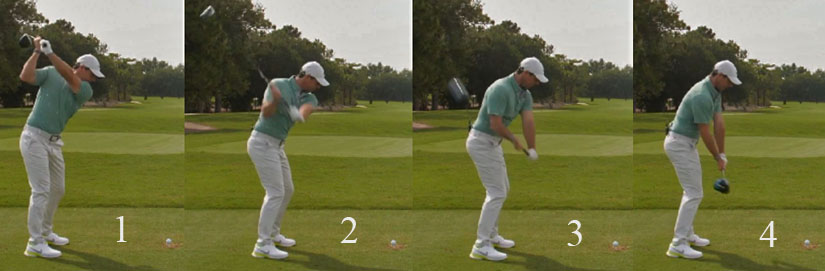
Capture images of Rory McIlroy performing this drill.
Image 1 is at P4, image 2 is at P5, image 3 is at P5.5 and image 4 is at P6.
The most important element of this drill
that is absolutely critical
is the positioning of the trail hand under the club handle. All the
benefits of this drill will not exist if the trail hand is not correctly
positioned under the clubshaft at address and also at every moment
during the performance of the simulated golf swing action between P4 => P7.
Image 1 is at P4. Note that Rory's trail upper arm/elbow is positioned in
front of his right upper torso even though he can rotate his upper
torso/shoulders ~110 degrees by P4. It is important to not allow the trail
elbow to get trapped behind the upper torso at P4. Note that his trail palm
is under the clubshaft at P4.
Note that Rory has squared his pelvis by P5, but his upper torso is still
closed. In fact, the AMG instructors have demonstrated that Rory has no
independent upper thoracic spine rotary
motion between P4 => P5 and
that any rotary motion of the two shoulder sockets is passively due to the
active pelvic rotation happening between P4 => P5. Note how Rory is using
his lead-and-trail shoulder girdle muscles to pull the club handle down to
the P5 position. The amount of clubshaft shallowing that will happen between
P4 => P5 is optional and it will be greater if the trail upper arm adductory
motion is very active and if the trail elbow drops below the lead elbow by
P5. However, what is really important is that the clubshaft should be
on-plane at P5 (where an imaginary line extending out from the butt end of
the club should point at the ball-target line). Note that the trail palm is
under the clubshaft and parallel to the swingplane.
Image 3 is at P5.5. Note that Rory's upper torso is still closed to a small
degree. Note that his trail elbow is positioned alongside his right hip
joint area, and not trapped behind his trail hip area. Note that his
clubshaft is still on-plane. Note that his trail palm is
under the
club handle and parallel to his shallowing swingplane.
Note the three-dimensional motion of the clubhead between P4 => P6. Note
that the clubhead has zero tendency to move in a "tumbling manner" which is
often seen in developing amateur golfers who have a strong tendency to
perform an OTT move. To prevent that happening during this drill, a golfer
must keep the trail shoulder back and keep the upper torso closed to a
variable degree while he performs his arm motion in the correct manner. The
most critical biomechanical element that allows the clubhead to follow the
optimum path between P4 => P6 is the position of the trail palm under the
clubshaft at all times between P4 => P6 while performing an
active
trail upper arm adductory move. Note that the trail elbow remains
significantly bent in the early downswing, which allows a golfer to maintain
clubhead lag and that it straightens to a variable degree in the
mid-downswing. The degree that the trail palm will become more horizontal
relative to the ground between P4 => P6 is optional/variable and it will be
greater if a golfer shallows the clubshaft a lot and if one uses a low track
stone-skipping trail arm motion between P4 => P6.
When practicing this split-grip drill, it is very important to move the
trail arm in the correct manner and to ensure that the trail palm is
constantly under the clubshaft and constantly parallel to the
swingplane between P4 => P5.5. It is also important to ensure that the upper
torso is closed to a variable/optional degree so that one can "feel" that
one is pulling the club downwards/groundwards in front of the upper torso.
Watch Rory repeating the drill multiple times between the 1:10 - 1:20 minute
time point of the video and note how consistently his can bring the
clubshaft down from P4 => P6 with no tendency to "tumble" the clubshaft
over-the-plane. Try and mimic Rory's drill action about 100x so that you can
ingrain the "feel" of how the clubshaft moves in space during the drill, and
how it should also move in one's "real life" golf swing action. Try to
ingrain the "feel" of the lead hand pulling the club handle down to the P6
position while the correct motion of the trail palm is mainly used to keep
the clubshaft on-plane and to avoid any tendency to "tumble" the clubshaft
over-the-plane in an OTT manner.
Now, I will discuss the critical biomechanical elements that must happen
between P6 => P7.
Capture images of Rory performing the drill as he approaches the P6
position.
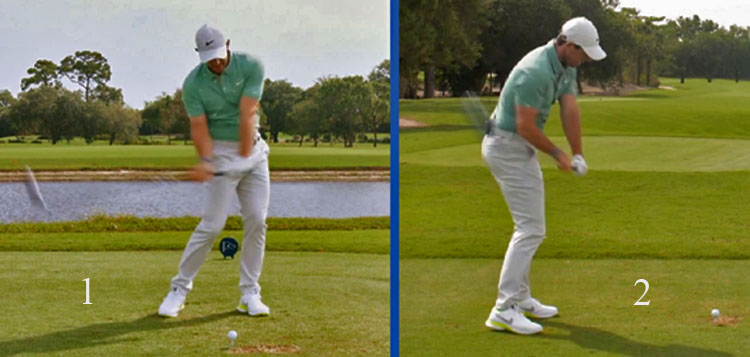
Image 1 shows Rory just bypassing the P6 position and image 2 shows Rory approaching the P6 position.
What has to happen between P6 => P7 (during the club release phase =
release of PA#2 action) is that the clubshaft must remain continuously
parallel to the functional swingplane. In image 2, Rory's clubhead is
behind his hands (= further away from the ball-target line than his lead
hand) and it will subsequently get in front of his hands (= closer to
the ball-target line than his lead hand) after P6. During that critical
time period between P5.5 => P6.5, it is important that the clubhead move
either across the hands or below the hands (when viewed from a DTL
viewing perspective) and never "tumble" over-the-hands. What makes that
clubhead motion biomechanically possible is keeping the trail palm
continuously under the club handle between P5.5 => P6.5 and that
also requires that the trail forearm be continuously supinated between
P5.5 => P6.5.
Here is a capture image of Rory at P6.5 in his "real life" driver golf
swing action.
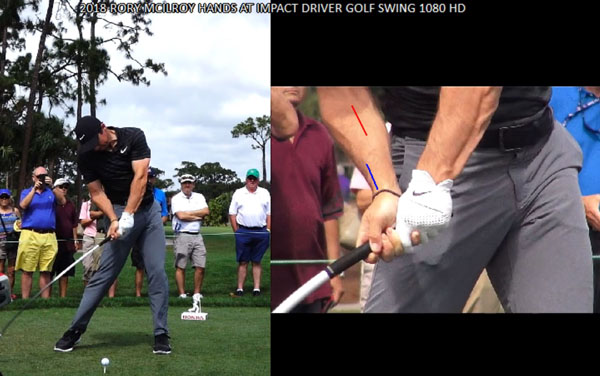
I have drawn a red line down the middle of his trail antecubital fossa and a blue line along his trail lower forearm's radial bone, and one can clearly see that his trail forearm is very supinated at P6.5. Note how his trail palm is positioned partly under the club handle, and partly behind the club handle - but it should never face the ground. When performing Rory's favorite drill one should monitor the motion of one's trail forearm/trail palm between P6 => P6.5+ to ensure that the trail palm never faces the ground (as wrongheadedly recommended by Pete Cowen).
Now, consider what should also be happening in the later downswing when
performing Rory's favorite drill.
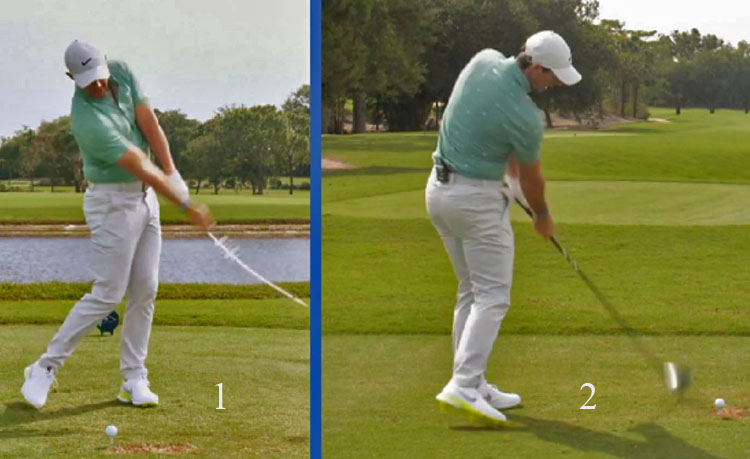
Note that Rory's trail palm is still partly under the club handle through impact and that his trail forearm is still supinated to a small degree.
How should one learn to perform that correct trail forearm/trail
palm action?
It is very important to understand that one can only avoid a
"running-out-of-trail arm" scenario through impact if one opens the
pelvis/upper torso through impact while the lead shoulder socket is
simultaneously moving up-and-inside left due to the lead leg
straightening action that is combined with a stretching-out of the
lead mid-upper torso, which will pull the club handle slightly
upwards as the lead hand simultaneously moves inside-left to a
variable degree. Note how the correct pivot motion allows the trail
shoulder socket to move under the chin through impact. Note that
Rory has a steep shoulder turn angle through impact, which requires
a finite amount of secondary axis tilt due to moving the pelvis
targetwards while keeping the head (and upper swing center) back
behind the ball that is simultaneously combined with a finite amount
of right lateral bend.
The most interesting part of the Rory McIlroy video from my personal
perspective is when Martin Hall asked Rory how often he does his
favorite drill. Rory stated that he does it every day and during
every golf round. I strongly recommend that every student-golfer
should adopt Rory's approach and I also recommend that he should
perform this split-hand drill every day.
Here is another video featuring the golf instructor Alex Elliot - teaching
golfers how to perform Pete Cowen's Chinese fighting stick drill.
I just want to make one point about what should really be happening between
P6 => P7+.
Watch the video between the 4:00 - 4:20 minute time point of the video. Note
how Alex talks of pushing the clubshaft into-and-through impact by applying
a push force with the trail hand and that echoes Pete Cowen's advice about
applying push-pressure with the trail hand against the back of the
clubshaft.
However, consider what he is really doing.
Capture image from the 4:15 minute time point of the video.
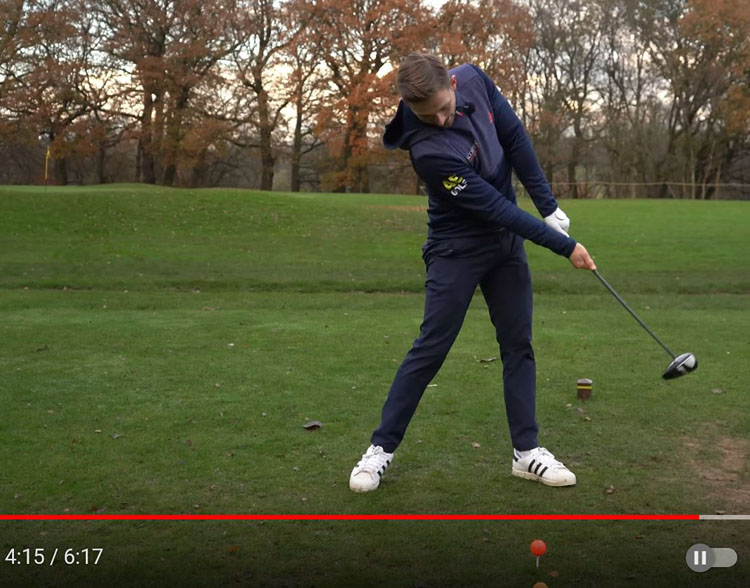
Note that he is at the P7.4 position and that the clubshaft is still straight-line-aligned with his lead arm as seen in a DH-hand release action. Note that his trail arm is still slightly bent and that his trail wrist is still extended as seen in a DH-hand release action.
So, why is the push-force that he claims that he is applying with the trail
hand during his later downswing after P6 not causing a clubshaft flipping
motion through impact?
The correct answer is that
he is moving his lead arm/hand so fast
between P6 => P7.4 that any push-force being applied by the trail hand
cannot possibly induce a flipping phenomenon. What makes that
biomechanically possible is his excellent pivot action - note how i) he
opens his pelvis/upper torso through impact, ii) how he elevates his lead
shoulder in an inside-left direction and iii) how he gets his trail shoulder
far enough downplane to avoid a "running-out-of-trail arm" scenario.
Here is a video of Pete Cowen performing his drill in a gym.
Here is a capture image of his post-impact position.
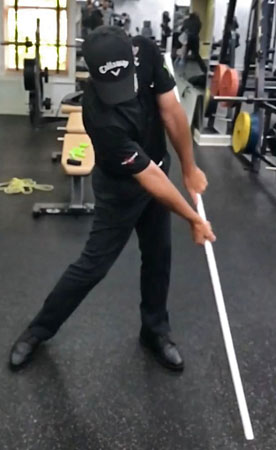
Note that he is actually performing a DH-hand release action through impact. Note that his trail forearm is still supinated and that his trail palm is still under the shaft.
In this post I am going to explain how one can possibly be applying
push-force with the trail hand between P6 => P7+ in the split-hand grip drill
(and also in a "real life" DH-hand release action).
Alex Elliot demonstrates this split-hand grip drill better than any other golf
instructor that I have watched - here again is his video.
Watch the video between the 4:00 - 4:10 minute time point of the video where
he demonstrates how he is pushing the club with the trail hand between P6 =>
P7+.
Here are capture images showing his body-arm motion during the P5.5 => P7.4 time
period.
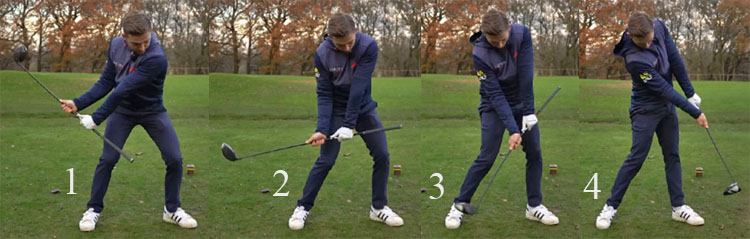
Image 1 is at P5.5, image 2 is just bypassing P6, image 3 is at P6.6 and image 4 is at P7.4.
AE states that he is pushing the club with his trail hand during the P6 =>
P7.4 time period. But, consider what is really happening from a
biomechanical perspective.
Note that his trail forearm is supinated at all moments between P5.5 => P7.4
and that his trail palm is always partly under the clubshaft.
At no time
is it ever on top of the clubshaft - facing groundwards. The only part
of his trail hand that can be perceived to be facing groundwards is the
thenar area of his trail hand, but that area only represents the thumb
metacarpal area and it does not represent the hypothenar/interdigital area
(= "true" palmar area) as seen in the following image.
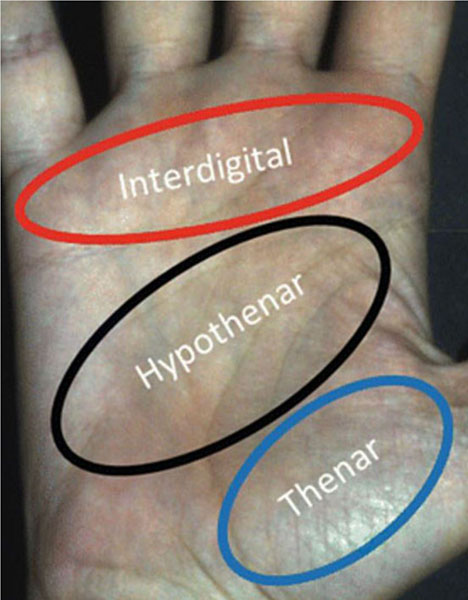
If AE got the hypothenar/interdigital area of his trail palm to face groundwards during the split-hand grip drill, then he would necessarily have to be pronating his trail forearm and thereby pushing the clubshaft off the functional swingplane. So, the trail forearm has to remain continuously supinated and the trail hand's "true" palm area cannot be facing the ground between P6 => P7.4 in those capture images if the club is being kept continuously parallel to the functional swingplane.
Secondly, imagine that AE is
actively applying a positive
push-force with the thenar area of his trail palm in a groundwards
direction between P6 => P7+. What effect does it have on the club's
motion?
Note that AE's trail hand is further away from the target than his lead
hand at P6, but it is closer to the target at P7.4. Does the fact that
his trail hand bypasses his lead hand soon after impact imply that he
must be flipping through impact?
The answer is obviously negative! Look at what is happening to the
clubshaft between P6 => P7.4. Note that the butt end of the clubshaft is
pointing at the target at P6, then it is pointing left of the target at
P6.5 and then it is pointing directly away from the ball-target line at
P7.4 (as the butt end of the clubshaftt wraps around his body after
impact). What causes the proximal end of his clubshaft to manifest that
specific pattern of motion? It is obviously due to the effect of his
pivot motion and lead hand motion. In other words, one can push very
actively with the trail hand between P6 => P7.4 without ever causing a
clubshaft flipping phenomenon either pre-impact, or immediately
post-impact, if one performs the pivot motion and lead arm/hand motion
in the optimum manner that is characteristic of a prototypical DHer eg.
Cameron Champ.
Here are capture images of Cameron Champ performing a DH-hand release
action.
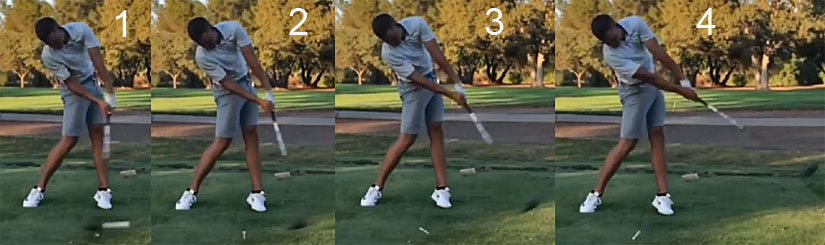
Note that Cameron Champ in image 2 looks identical to Alex Elliot in
image 4 of his set of capture images - note that i) the pelvis and upper
torso is very open to the target, ii) the lead shoulder socket is
markedly elevated as it moves inside-left and iii) the lead arm is not
stalling and it is maintaining a high degree of forwards/targetwards
motion. Note how his trail wrist is kept extended through impact, which
means that any push-force that is possibly being applied by the
trail hand is most likely being applied by the thenar area of the trail
palm against PP#1 on the lead hand (which is located
above the
coupling point). If any push-force is being applied by the trail hand
above the coupling point (midpoint between the hands) it can help to
ensure that the lead hand maintains an optimised speed in a targetwards
direction, but it will not predispose to the clubshaft flipping through
impact.
-----------------------------------------------------------------------------------------------------------
In this post, I am going to discuss Pete Cowen's concept of "trail
arm/forearm spinning" and his belief that the trail palm must be
directed groundwards/downwards in the later downswing in order to square
the clubface by impact and in order to push-pressure-load the clubshaft
into impact/through impact.
I do not clearly understand what PC means by using the term "trail
arm/forearm spinning", and I will be analysing his opinions expressed in
the following video.
I will also analyse the opinions of two Cowen-influenced golf
instructors (Danny Maude and Andy Carter).
Before I analyse PC's opinions, let's consider whether the split-hand
grip drill has anything to do with the "idea" of clubface closure. I
have stated in a previous post that learning how to perform the
split-hand grip drill is useful because it gives one insight into the
biomechanical actions needed to keep the clubshaft on-plane, especially
during the downswing. An additional question is whether it has any
direct influence on the clubface closing phenomenon (relative to the
path) that routinely happens in the later downswing of pro golfers,
especially if they adopt a weak-or-neutral lead hand grip at address.
Here is a link to the video where PC demonstrates the split-hand grip
drill in a gym.
Here are capture images of PC performing the drill between the P6 =>
P7.2 positions.
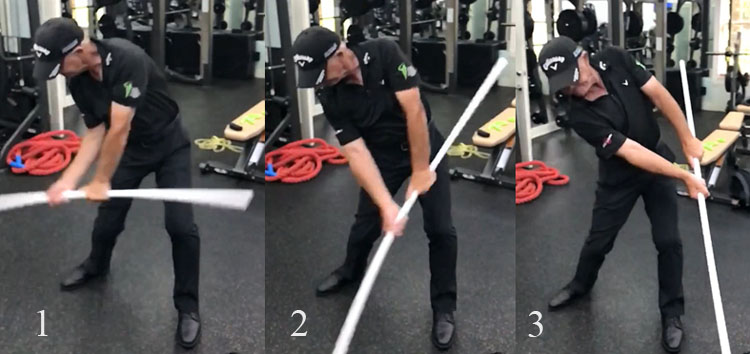
Image 1 is at P6 position, image 2 is at the P7 position and image 3 is
at the P7.2 position.
When PC performs the drill he positions his lead hand on-top of that
shaft at address and that represents a very strong lead hand grip
alignment. Then, when he performs an on-plane backswing action between
P1 => P4 the back of his lead hand remains continuously parallel to the
swingplane and it does not rotate clockwise in a clubface-opening
direction. Then, when he performs the downswing action between P4 => P6,
he keeps the back of his lead hand parallel to the swingplane, so no
clubface-closing (relative to the clubhead path) would he happening
between P4 => P6. Then, note how he moves that shaft between P6 => P7 in
such a manner that the shaft will move parallel to the functional
swingplane (mimcking the on-plane club release phenomenon that happens
in a full golf swing action). During the P6 => P7 time period, he is
basically keeping the back of his lead hand parallel to the functional
swingplane and roughly parallel to the ball-target line, and there is no
counterclockwise rotation of the back of his lead hand in a
clubface-closing manner. If PC performed the same split-hand grip drill
with a golf club (as seen in the Alex Elliot video which I analysed in a
previous post) the clubface would not be closing relative to the
clubhead path between P6 => P7 although it would automatically/naturally
be closing relative to the ball-target line because the clubhead path
would be arced in shape and the clubhead would be moving along the
in-to-square arced clubhead path as seen in the following diagram.

The thin curved black line represents the clubhead path. The curved red
arrow shows the club release phase that naturally happens pre-impact.
The short black line represents the clubface's orientation, which
remains continuously square/perpendicular to the clubhead path. The
small red dot represents the ball position. Although the clubface is not
closing relative to the clubhead path between P6 => P7 it is obviously
closing relative to the ball simply due to the fact that the clubhead
path is in-to-square between P6 => P7.
Note what happens with respect to PC's trail palm during his split-hand
grip drill. PC placed his trail palm under the club handle at
address, which is equivalent to a very strong trail hand grip alignment.
Note that his trail palm always remains
continuously under the
shaft between P1 => P4 and also between P4 => P6. Note that PC's trail
palm is still under the shaft at P6 in image 1 of those capture images.
Then, note that his trail palm remains partly under the shaft between P6
=> P7 but it becomes increasingly behind the shaft as it approaches
impact where it is still partly under the shaft and simultaneously
partly behind the shaft at impact (image 2). The change in orientation
of PC's trail palm is not due to changing his trail hand grip relative
to the shaft and it is solely due to the fact that the shaft is moving
from being parallel to the ball-target line at P6 to becoming roughly
perpendicular to the ball-target line by P7. During that time period,
the clubface (if he was was using a golf club instead of that white
shaft) would not be closing relative to the clubhead path, but it would
be closing relative to the ball-target line (as explained in that
previous diagram).
What biomechanical actions are happening with respect to his trail
arm/forearm/wrist between P6 (image 1) and P7 (image 2)?
Note that his trail elbow is in a pitch location at P6 and his trail
antecubital fossa is facing the ball-target because his trail humerus
(upper arm) is in a neutral position.
Then, note how he internally rotates his trail humerus between P6 => P7
while he partially straightens his trail elbow and that angles his trail
forearm in a more targetwards direction. Note that his trail forearm is
markedly supinated at P6 and slightly less supinated at P7. Note that he
is not straightening his trail wrist between P6 => P7.
Now, if the two biomechanical phenomena of i) a small degree of internal
rotation of the trail humerus that angles the trail forearm increasingly
towards the ball as the trail elbow partly straightens between P6 => P7
and as ii) the trail forearm becomes slightly less supinated between P6
=> P7 represents the PC-concept of "trail forearm spinning" then I can
readily understand that PC-concept. However, note that the trail palm
never faces the ground at any moment between P6 => P7 in those capture
images. When PC and the Cowen-influenced golf instructors (eg. Danny
Maude and Andy Carter) talk about the "spinning of the trail forearm"
phenomenon they always wrongheadedly claim that the trail palm must be
facing groundwards between P6 => P7.
Before I analyse their wrongheaded claims in greater detail, let's
consider what biomechanical actions happen in "real life" pro golfers
during the P6 => P7 time period.
I will first start off by analysing the P6 => P7 time period of the pro
golfer - Matthew Fitzpatrick, who uses a very strong trail hand grip
combined with a weak trail hand grip.
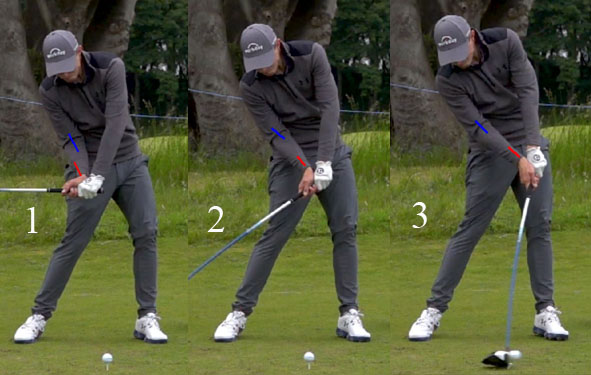
Image 1 is at P6, image 2 is at P6.5 and image 3 is at impact/P7.
Note that the back of MF's lead hand is parallel to the functional
swingplane, and roughly parallel to the ball-target line, between P6
=> P7 and that means that his clubface is not closing (relative to
the clubhead path) to any significant degree because it is basically
square to his clubhead path during that entire late downswing time
period (as a result of him adopting a very strong lead hand grip at
address).
I have drawn a blue line down the middle of his trail elbow
antecubital fossa (elbow pit) that shows that it is facing the
ball-target line at P6 and that his trail humerus is close to being
neutrally aligned. I have drawn a red line along his trail lower
forearm's radial bone, and it is rotated clockwise relative to the
blue line, which means that his trail forearm is supinated.
Note how MF internally rotates his trail humerus between P6 => P7
while he partly straightens his trail elbow and that angles his
trail forearm targetwards so that he can get his trail hand closer
to its impact location. Note that his trail forearm is still
supinated at impact, but slightly less than it was at P6. Note his
trail wrist's degree of extension remains unchanged between P6 =>
P7.
Now, let's examine what is happening with respect to his trail palm
between P6 => P7.
When I talk about his trail palm I am referring to his "true" palm
area.
Here is an image showing the trail palm's designated areas.
The "true" palm area is the area over the 2nd, 3rd, 4th and 5th
metacarpal bones (combination of the hypothenar area and the
interdigital area).
The thenar area only represents the palm area overlying the
thumb's metacarpal bone.
If you look at MF at his P6 position, note that his trail palm
(= "true" palm area) is under his club handle and that it
remains partly under, and then increasingly behind, his club
handle as his clubshaft moves towards P6.5 and then eventually
towards P7. However, his trail palm never faces groundwards.
The only part of his trail hand that faces groundwards between
P6 => P7 is his trail thumb and his trail thumb's thenar area,
and that is only because he adopts a very weak trail hand grip
at address where he wraps the thenar area of his trail hand over
the top of the club handle.
What will happen if a pro golfer adopts a weak lead hand grip,
instead of a very strong lead hand grip (like Matthew
Fitzpatrick), with respect to the clubface closing phenomenon?
Here is a diagram showing what will happen in the late downswing
(red arrow phase).
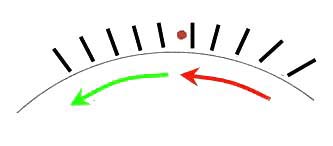
Note that the clubface is open relative to the clubhead path at the
P6.5 position and it steadily closes to become square by impact.
Why is the clubface open at P6.5?
The correct answer is that a golfer, who adopts a weak lead hand
grip at address, will have to pronate his lead forearm a lot during
his backswing action to get the back of his lead wrist/hand parallel
to his swingplane by P4. Then, to get his clubface to become square
by impact he has to reverse the process during his downswing by
performing a lead forearm supinatory motion. That lead forearm
supination phenomenon cannot happen before P6 because it would cause
the clubshaft to steepen and move off-plane (often referred to as a
"tumble action" when the clubshaft moves over-the-plane). Therefore,
the left forearm supination phenomenon usually happens after P5.5
with most of it happening between P6.5 => P7.
As an example, let's consider the clubface-closing action of a pro
golfer who uses a weak trail hand grip and a weak lead hand grip -
Scottie Schefller.
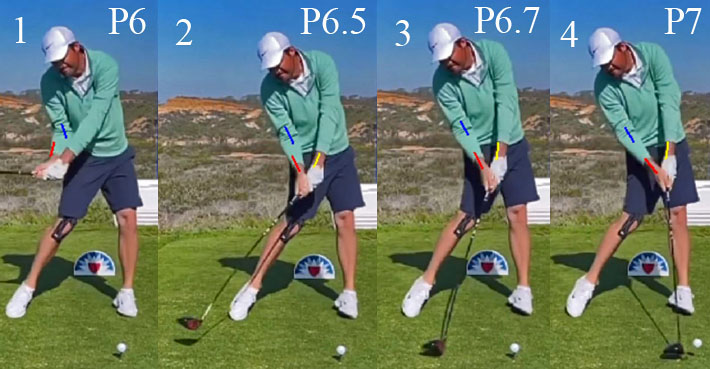
I have drawn a blue line down the middle of his trail
antecubital fossa and a red line over his trail lower forearm's
radial bone and if the red line is rotated clockwise (away from
the target) relative to the blue line, then that means that the
trail forearm is supinated.
SS uses a TGM swinging action (lead arm swinging action)
involving an intact LFFW/GFLW swing technique and that means
that his clubface is straight-line-aligned relative to the back
of his GFLW (geometrically flat lead wrist) all the way between
P4 => P7. Therefore, his rate of clubface closure during the
late downswing after P6 directly correlates with how much the
back of his lead wrist/hand and his lead forearm's lower radial
bone (short yellow line) rotates counterclockwise during the P6
=> P7 time period - mainly due to a lead forearm supinatory
phenomenon. Note that the back of his lead wrist/hand rotates
very little counterclockwise between P6 => P6.5, and most of his
lead forearm supinatory motion needed to rotate the back of his
lead wrist/hand counterclockwise so that it faces the target by
impact happens between P6.5 => P7.
It is this lead forearm
supinatory motion that is causally responsible for the clubface
closing phenomenon (relative to the clubhead path) that happens
in his late downswing, and it is called a PA#3 release action
(in TGM terminology). One does not need a trail arm to be
present to perform an efficient PA#3 release action and lead
arm-only golfers, who lack a trail arm, can easily learn how to
square their clubface by impact by using a lead forearm
supinatory motion.
What has to happen with respect to the trail arm/forearm/wrist
during the PA#3 release action (which is causally due to a lead
forearm supination phenomenon)? Because SS uses a weak trail
hand grip and a weak lead hand grip where the two palms
continuously face each other throughout the entire
downswing, the trail palm must rotate counterclockwise at the
same rotational speed as the lead palm between P6.5 => P7. What
biomechanical phenomenon allows SS's trail palm to rotate
counterclockwise between P6.5 => P7 so that it rotates at the
same rotational speed as his lead hand? There are two
biomechanical phenomena in play that allows his trail palm to
rotate in a clubface-closing (counterclockwise) direction - i) a
decreasing amount of trail forearm supination that allows the
trail lower forearm's radial bone to rotate counterclockwise by
a small amount and ii) partial straightening of the trail wrist
that is associated with a circumductory roll motion of the lead
wrist in a counterclockwise direction. Note that the trail
humerus internally rotates between P6 => P7 and that angles the
lead forearm in a targetwards direction so that the trail palm
can keep up with the lead hand. However, note that the ventral
aspect of his trail upper forearm (the 4-6" long area just below
his trail elbow) constantly faces the sky during the P6 => P7
time period and a counterclockwise rotation of the
proximal
trail forearm does not play any significant role in the
counterclockwise rotation of his trail palm that happens during
the P6.5 => P7 time period.
If you look at SS at his P6 position, note that his trail palm
(= "true" palm area) is under his club handle and that it
remains partly under, and then increasingly behind, his club
handle as his clubshaft moves towards P6.5 and then eventually
towards P7. However, his trail palm never faces groundwards.
The only part of his trail hand that faces groundwards between
P6 => P7 is his trail thumb and his trail thumb's thenar area,
and that is only because he adopts a very weak trail hand grip
at address where he wraps the thenar area of his trail hand over
the top of the club handle.
Here is Jon Sinclair's lead/trail forearm supination graph
representing the "average" lead and trail forearm
pronation/supination measurements of >100 pro golfers.
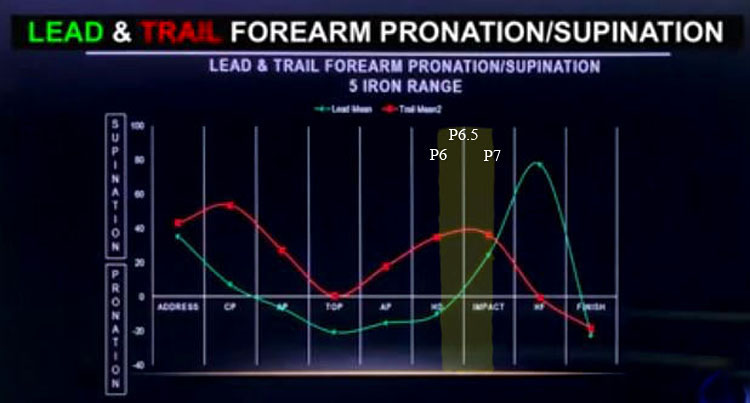
The green graph is the lead forearm supination graph that shows
how the lead forearm starts to supinate at P6 and that it
supinates much faster after P6.5 - and it is causally
responsible for the clubface-closing phenomenon seen in all pro
golfers (with the amount of lead forearm supination being
inversely proportional to the strength of the lead hand grip).
The red graph is the trail forearm supination graph that shows
that the trail forearm is still supinating between P6 => P6.5
and that it only moves in a pronatory direction (= lesser degree
of supination) between P6.5 => P7. The amount of
counterclockwise rotation of the lower forearm happening is very
small and it cannot be deemed to be causing the large amount of
clubface-closing seen between P6.5 => P7 in pro golfers who use
a weak-or-neutral lead hand grip (like Scottie Scheffler) and
the simultaneous large amount of counterclockwise rotation of
the trail palm that is happening at the same time. It is frankly
obvious to me that part of the counterclockwise rotation of the
trail palm seen in pro golfers who use a weak-or-neutral lead
hand grip must involve the biomechanical mechanism of "partial
straightening of the trail wrist combined with a simultaneous
counterclockwise wrist circumductory roll motion".
I will now analyse a few you-tube videos produced by Danny Maude
and Andy Carter to demonstrate that many of their opinions
regarding the topic of clubface closure and push-pressure
loading of the clubshaft by the trail arm/forearm/wrist/palm are
wrongheaded.
Danny Maude video number 1:
DM discusses how to move the trail elbow in the backswing in the
first 4 minutes of the video and I agree with his opinions. I
agree that the split-hand grip drill and the cack-handed grip
drill are very useful to help one improve one's trail arm/elbow
motion during the backswing.
Starting at the 4 minute time point, he starts to explain how to
perform Pete Cowen's trail arm/forearm spinning technique. He
talks about getting the trail elbow down to a pitch location by
~P5.5 and he then states that the trail arm must then
progressively straighten between P5.5 => P7 so that the trail
palm can reach its correct impact position by P7 - and I can
readily agree with his opinions.
However, listen to what he states, and demonstrates, between the
6:09 - 6:39 minutes of the video where he shows how the trail
arm/forearm spinning technique closes the clubface.
Here are capture images of his demonstration.
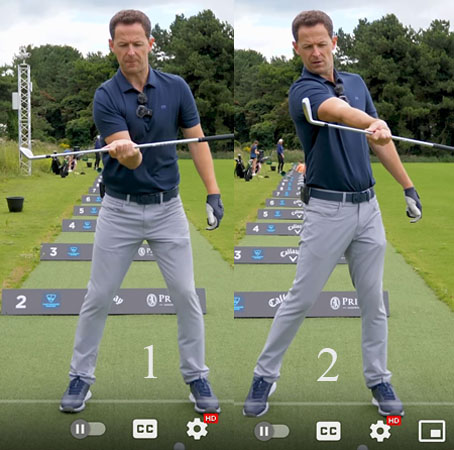
Image 1 - note that he is holding the clubshaft with his trail
hand where the clubface is parallel to the ventral aspect of his
upper trail forearm. Note that his trail elbow is in a pitch
location and that his trail humerus is in a neutral alignment.
Note that his trail forearm is supinated and that allows his
trail palm to be positioned under the clubshaft. Note that his
trail wrist is very extended.
Image 2 - note that he is supposedly demonstrating the trail
forearm spinning technique, which causes the clubface to close
by >45 degrees. What is causing the clubface-closure seen in his
demonstration where he maintains a supinated trail forearm and a
very extended trail wrist. It is obviously due to the fact that
he is internally rotating his trail humerus so that his trail
antecubital fossa and trail proximal forearm are rotated
counterclockwise by a large amount. He is also therefore
seemingly implying that it is causally responsible for the
clubface closing seen in the late downswing!!!
Here is a capture image from his video showing how he envisions
how he wants to be positioned at impact when he performs the
trail arm/forearm spinning technique using a flexible alignment
stick.
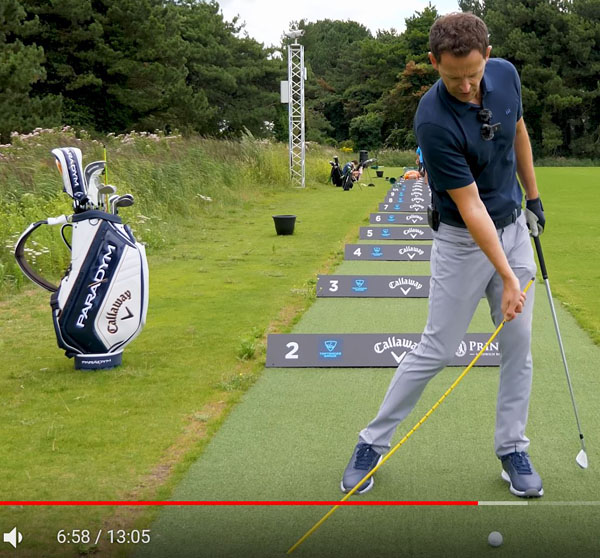
1) Note that his trail humerus is significantly rotated internally
so that his trail antecubital fossa and his proximal trail forearm
(just below elbow level) is facing the target and he believes that
the counterclockwise rotation of his trail humerus/proximal forearm
is causally responsible for the clubface closure needed to square
the clubface by impact.
2) Note that his trail lower forearm is supinated. Note that his
trail wrist remains very extended and he imagines that he is
applying a positive push-pressure against the aft side of that
alignment stick and that it will cause the peripheral shaft to be
bent backwards at simulated impact. He also imagines that he will be
driving the club handle through impact while maintaining a very
extended trail wrist as he continues to drive his spinning trail
forearm through impact.
3) Note how open his pelvis and upper torso are at simulated impact.
The true "real life" reality is that he is not really performing
those described biomechanical actions in his "real life" golf swing
action.
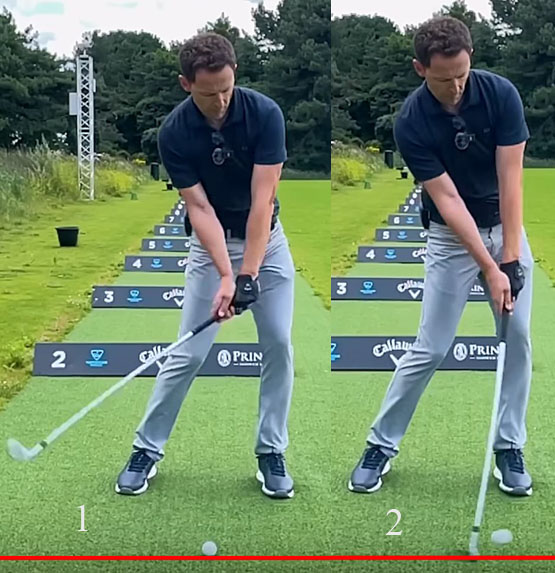
Image 1 is at the P6.5 position where his clubface is still
significantly open relative to his clubhead path.
Image 2 is at impact where his clubface is now square to his
clubhead path and the target.
So, how did he square his clubface between P6.5 and P7?
Note how much the back of his lead hand is rotating counterclockwise
between P6.5 => P7 due to a lead forearm supinatory motion.
Note how much his trail palm (which is partially under the club
handle at P6.5 and more behind the club handle at impact) has
rotated counterclockwise between P6.5 => P7. What is causing the
counterclockwise rotation of his trail palm between P6.5 => P7? It
is obviously due to a decreasing amount of trail forearm supination
where his trail forearm is less supinated at P7 compared to P6.5 and
partly due to his straightening trail wrist which is simultaneously
rolling more closed secondary to a trail wrist circumductory roll
motion.
Note that his trail antecubital fossa is still facing the
ball-target line at P6.5 and at P7 and that there has been very
little counterclockwise rotation of his trail humerus happening (as
seen in his simulated "trail forearm spinning" capture images
above).
Note that his pelvis and upper torso are only open to a small degree
at impact.
Note that all these described biomechanical features are also seen
in those capture images of Scottie Scheffler at impact and he looks
very similar to Scottie Scheffler at impact.
It is a fallacy to believe that DM is squaring his clubface in his
later downswing by using the "trail arm/forearm spinning" technique
(that he describes and demonstrates in his video) and his trail palm
is rotating counterclockwise between P6.5 => P7 secondary to i) his
trail forearm rotating counterclockwise in a pronatory direction so
that it is less supinated at P7 compared to P6.5 and also due to ii)
a straightening trail wrist that is simultaneously rotating
counterclockwise due to a trail wrist circumductory roll motion.
I think that DM's opinions are irrational, but far less irrational
than the opinions expressed by another Cowen-influenced golf
instructor - Andy Carter - in the following video.
In this video AC, who worked for >5 years at the Pete Cowen Academy
in Dubia, expresses his opinions on how the trail arm/forearm
spinning technique should be performed. Amazingly, he claims that it
should start at the transition to the downswing so that the clubface
can already become closed by P6. Watch the video between the 1:23 -
3:25 minute time point where he demonstrates a drill using his open
trail hand. Note that he starts with the trail palm facing the
ground and he wants it again to be facing the ground when it reaches
the delivery position (P6 position).
Here is a capture image of his trail palm's orientation when his
trail hand gets to the P6 position as it moves along a hand arc path
towards impact where he wants the trail palm to be facing the target
at impact.
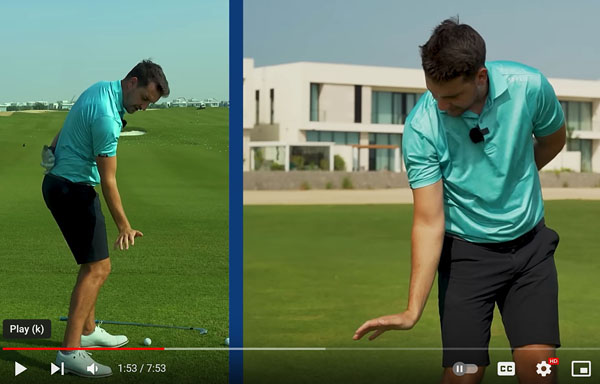
This capture image is from the 1:53 minute time point of the
video and it shows that the trail palm is facing groundwards. As
I have previously demonstrated that does not happen in the "real
life" full golf swing action of pro golfers (like Scottie
Schefller) and it is only the thenar area of the trail palm that
faces the ground at P6 (especially if the golfer adopts a weak
trail hand grip) and the "true" trail palm area is parallel to
the swingplane at P5.5 and approaching vertical at P6.
Here are capture images of Scottie Scheffler's early/mid
downswing action.
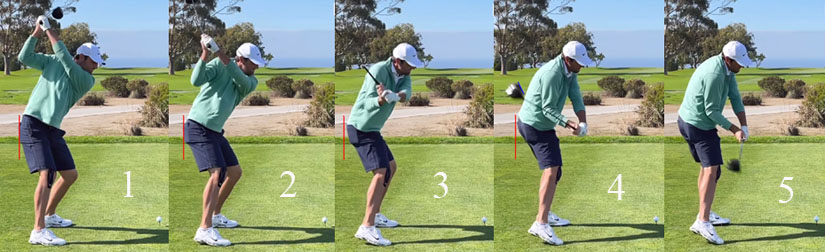
Note that SS's "true" trail palm area is under the club
handle at P4 (image 1), and at P4.5 (image 2), and at P5
(image 3), and at P5.5 (image 4). By P6 (image 5) his "true"
palm area is still under the club handle, but now also
partly behind the club handle. His "true" palm area never
faces the ground between P4 => P6 and the only part of his
trail palm that can be deemed to be facing the ground is his
trail palm's thenar area (which only represents the
alignment of the trail thumb's metacarpal bone).
Note that his lead wrist is flat at P6 and parallel to the
ball-target line, and it is not overtly bowed due to the use
of a reverse motorcycle maneuver, and that his clubface is
not facing the ground and the toe of his club is facing
straight upwards.
By contrast, here is a capture image of Andy Carter showing
how the clubface must be facing grounwards at the delivery
position (P6 position).
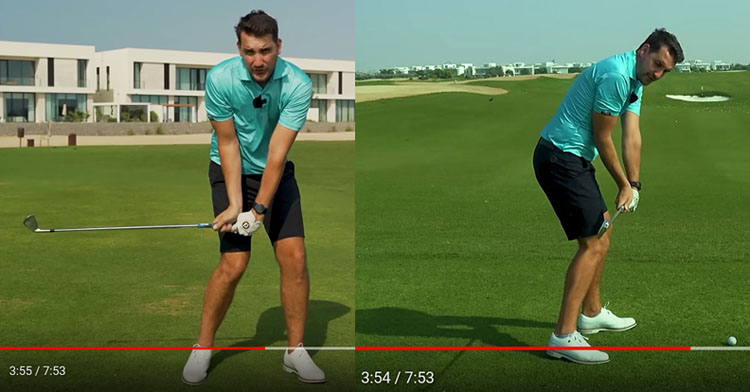
What biomechanical mechanism is he using to get the clubface
to be facing groundwards at the P6 position?
Note that i) his trail humerus is neutral at P6 and that his
trail proximal forearm is facing the ball-target line and it
has not rotated too much counterclockwise in a
clubface-closing manner and note that ii) his trail forearm
is very supinated at P6 so the combination of those two
biomechanical elements means that he is not performing any
trail arm/forearm spinning motion in a counterclockwise
direction. The real reason why his clubface is slightly
closed at his P6 position is the fact that he is performing
the reverse motorcycle maneuver (which involves lead wrist
palmar flexion while the lead wrist is radially-deviated
combined with a greater degree of trail wrist extension).
However, the reverse motorcycle maneuver - which is an
idiosyncratic/fetish maneuver taught by some golf
instructors - is not routinely used by most pro golfers
(like Scottie Scheffler and Rory McIlroy) and it is not an
inherent biomechanical element that is fundamental to the
execution of a counterclockwise trail arm/forearm spinning
motion.
Finally, I will discuss the issue of the trail palm applying
push-pressure against the aft side of the club handle during
the later downswing and early followthrough.
Peter Cowen and the Cowen-influenced golf instructors (Danny
Maude and Andy Carter) state that the trail palm must be
facing groundwards after P6 so that it can produce forward
shaft lean at impact and also pressure-load the shaft at
impact and through impact. I do not object to the "idea"
that coming into impact with an extended trail wrist can
help a golfer more easily get a desirable amount of forward
shaft lean at impact (especially when hitting irons), but I
do not believe that pro golfers are push-pressure loading
the clubshaft with the trail palm during the P6 => P7.2+
time period when performing a full golf swing action.
Here are capture images of Rory McIlroy's driver swing
action.
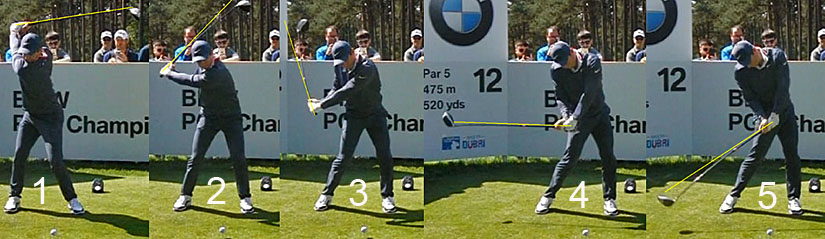
Image 1 is at P4, image 2 is at P5, image 3 is at P5.5, image 4
is at P6 and image 5 is at P6.5.
I have drawn a yellow line along the length of his club handle
and proximal clubshaft.
Note that his peripheral clubshaft is bent backwards during his
P4 => P5.5 time period, which is compatible with a positive hand
couple scenario involving the trail hand. However, note that
after P5.5 his peripheral clubshaft is bent in a forwards
direction and that implies a negative hand couple
scenario involving the trail hand. All pro golfers manifest this
same pattern and they all have their peripheral clubshaft bent
forwards near impact, or at impact, when performing a full golf
swing action with a driver or iron. I have never seen a pro
golfer with the peripheral clubshaft bent backwards as their
clubshaft approaches impact.
Both Sasho MacKenzie and Dr.Young-Hoo Kwon have independently
performed inverse dynamics measurements regarding the
forces/torques being applied to the club handle by the lead and
trail hands in pro golfers and they have come to the same
conclusion that the trail hand's hand couple force is negative
between P6 => P7. I have discussed this issue in mind-blowing
detail in different subsections of my downswing chapter and
interested readers can read the following subtopics i)
perfectgolfswingreview.net/downswing.htm#topic5 and ii)
perfectgolfswingreview.net/downswing.htm#topic8a if they are
interested in learning more about this issue.
Although I do not believe that any pro golfer is applying a
positive hand couple force with the trail hand in the later
downswing just before impact, or at impact, or immediately
post-impact when performing a full driver golf swing action, I
can readily agree that it may be advantageous to have the trail
wrist being biomechanically extended between P6.5 => P7.4 as
this biomechanical phenomenon is often seen in pro golfers who
use a drive-hold hand release action and I refer to those pro
golfers as DHers.
Here are capture images of Cameron Champ performing a DH-hand
release action through impact.
Image 1 is at P7, image 2 is at P7.2 and image 3 is at P7.4.
Note that the clubshaft does not bypass his lead arm (from an
angular rotational perspective) between P7 => P7.4 which means
that he is using a DH-hand release action through impact into
his early followthrough phase. The major biomechanical mechanism
that makes that possible is that he is perfectly matching the
forward angular velocity of his lead arm relative to the forward
angular velocity of his released clubshaft, and it is not due to
any biomechanical action involving the trail arm/hand.
Note that his trail wrist remains markedly extended throughout
the P7 => P7.4 time period. The potential advantage of having a
significantly extended trail wrist during the execution of a
DH-hand release action is that it potentially allows the trail
hand couple force to be negative through impact. A negative
trail hand couple force through impact can potentially stabilise
the lead wrist and decrease the possibility of flipping through
impact. To perform a DH-hand release action as efficiently as
Cameron Champ, one has to avoid a "running-out-of trail arm"
scenario and one has to ensure that the trail shoulder moves far
enough downplane so that one can keep the trail arm partially
bent and the trail wrist partially extended all the way to
P7.4+. That is only biomechanically possible if one opens the
pelvis and the upper torso very efficiently between P7 => P7.4+
as seen in those Cameron Champ capture images.
Consider this Danny Maude video where he discusses the topic of
driving the clubshaft through impact with an extended trail
wrist.
Danny Maude video number 2:
DM discusses a
golf swing motion where he swings his arms/club around in an arc
from the 9 o'clock position to the 3 o'clock position as seen in
the following capture image.
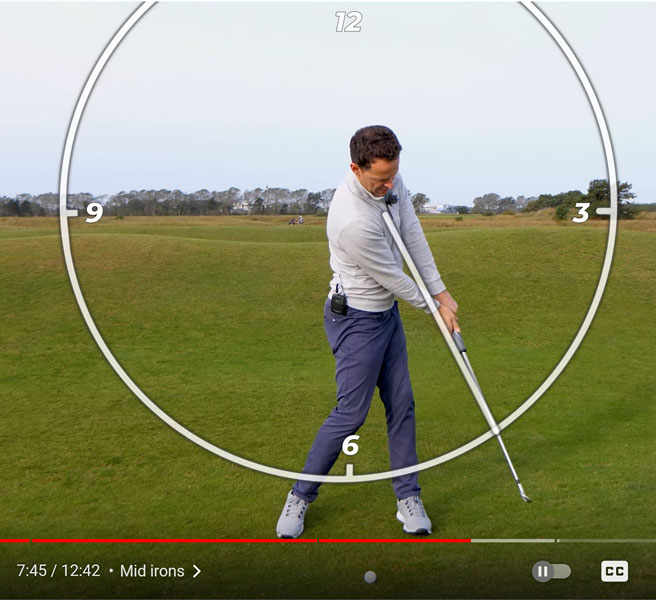
Note what
he looks like at his P7.4 position. Note that he has rotated
his pelvis and upper torso very open (similar to Cameron
Champ). Note that he has got his trail shoulder far enough
downplane that he can still have a slightly bent trail arm
and a significantly bent trail wrist at his P7.4 position
(similar to Cameron Champ). Note that his clubhaft has not
bypassed his lead arm from an angular rotational
perspective, which means that he is performing a DH-hand
release action between P7 => P7.4. I think that his
slow-motion-demonstrated golf swing action is superb and it
is nearly identical to the "real life" driver golf swing
action performed by Cameron Champ who performs a superb
DH-hand release action between P7 => P7.4 - although DM
prefers to perform a CP-arm release action where the hands
move inside-left soon after impact while Cameron Champ
actually performed a CF-arm release action in those capture
images of his DH-hand release action that I previously
presented.
DM claims that he is driving his
golf swing action through impact via positive push-pressure
being applied by the trail palm against the aft side of his
club. That may apply to this slow motion-demonstrated golf
swing action, but it does not likely apply to his "real
life" driver golf swing action, which he performed at the
end of his video.
Here are capture images of his
"real life" driver's late downswing action.

Image 1 is at P5.5 and image 2 is
at P7.
Note that his "true" trail palm
area is under
the club handle at P5.5 and it is not facing groundwards.
Image 2 is just before impact -
note that his peripheral clubshaft is bent forwards, which
means that his trail hand couple must be negative, and not
positive, in his later downswing as he approaches impact. DM
may possibly be applying a positive push-pressure at impact
with his trail hand, but then it must be happening above the
coupling point (mid-point between the hands) and he must
then be applying push-pressure against his lead thumb. That
push-pressure (if it exists) against the lead thumb could be
advantageous if it helps to prevent stalling of the lead arm
between P7 => P7.4, which is incompatible with a DH-hand
release action because the lead arm must travel forward at
the same angular velocity as the released club if the
clubshaft does not bypass the lead arm (from an angular
rotational perspective) during a DH-hand release action.
So, what type of hand release
action did DM perform during his "real life" golf swing
action in that video?
Here is a capture image of his
post-impact followthrough action.
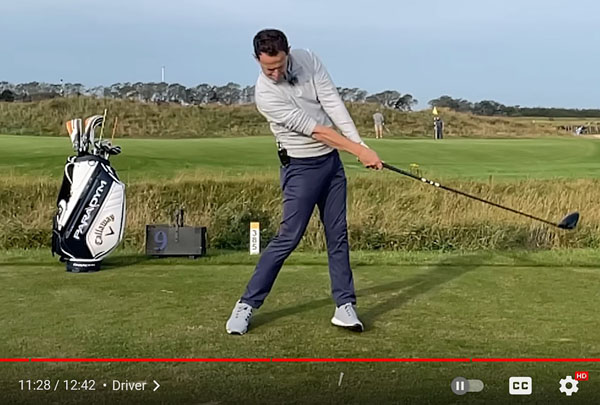
Note that the clubshaft has
bypassed his lead arm from an angular rotational
perspective, which means that he is performing a non-DH hand
release action.
Note that his trail arm and trail
wrist have fully straightened due to a "running-out-of-trail
arm" phenomenon, which is secondary to the fact that his
trail shoulder socket is not far enough downplane - compare
this image to the Cameron Champ capture images. In other
words, DM is not really doing what he teaches in the video.
That does not mean that his driver golf swing action, where
he performs a non-DH hand release action, is suboptimal.
Both Scottie Scheffler and Rory McIlroy use a non-DH hand
release action and DM looks very similar to those two
skilled pro golfers at P7 and also at P7.4. Performing a
DH-hand release action efficiently (like Cameron Champ) is
an optional choice, but it requires a lot of flexibility and
athleticism to do it sufficiently well.
Jeffrey Mann.
https://newtongolfinstitute.proboards.com/thread/1102/rory-mcilroys-favorite-drill