Analysing the Milo Lines "secret move" video
Watch this latest video by Milo
Lines where he describes the "secret move".
I have actually referred to this "secret move" as the "Anti-Malaska Move" in my
previous writings.
Milo talks in his video about why Moe Norman and Ben Hogan performed this move
and he then talks about the "feels" that he experiences in order to execute this
"secret move".
Milo describes the main feature of this move between the 0:57 - 1:18 minute time
of his video as a deliberate intention to get the trail arm to become lower than
the lead arm by ~P6 (as seen from DTL). Milo implies that both MN and BH
performed this "secret move" to avoid pull-hooking the ball left. I disagree and
I personally believe that their main intention was to avoid an OTT move, which
would predispose to an out-to-in clubhead path between P4 => P7; and that they
both also wanted the clubshaft to shallow between P4 => P6 and that they both
also wanted to generate an in-to-out clubhead path between P6 => P7. Milo
wrongheadedly implies that BH developed this "secret move" to avoid over-drawing
the ball to the left side of the course. I believe that's not true and BH's true
"secret move" (which he described in a Life Magazine article), and which he
developed to prevent over-drawing the ball leftwards, was to intentionally cup
his lead wrist at his P4 position and to keep it cupped between P4 => P6. In the
video clip of BH that Milo features at the beginning of his video, BH was
describing how to avoid an OTT move by starting the downswing with a pelvic
shift-rotation move, and not an upper body rotational move. Between the 1:50 -
2:05 minute of the video, Milo also implies that BH developed this "secret move"
to avoid flipping the club over through the ball strike. I believe that Milo's
assertion is not true because the "secret move" move is mainly a biomechanical
action intended to avoid an OTT move and to perform a clubshaft
shallowing
action during the early-mid downswing that is combined with an in-to-out
clubhead path coming into impact - and it is not a move designed to avoid
flipping the club over through impact.
Milo then describes the "feels" that he personally experiences when performing
his "secret move".
Between the 2:17 - 3:18 minute time point of the video, Milo uses a hockey stick
to describe the "secret move". He states that some people think of the "secret
move" as being due to driving the trail elbow forward using a pitch elbow motion
of the trail arm and that other people believe that it is mainly due toa
shift-rotation motion of the pelvis. Milo disagrees with those two opinions and
he states that he thinks of the "secret move" as being due to the golfer
squatting as he starts the downswing, which is then combined with compression of
the right-sided rib cage and depression of the trail scapula, and also with the
"lead arm moving upwards while the trail arm moves back".
Regarding that bold-highlighted Milo-assertion, Milo expands on that "arm feel"
between the 4:17 - 4:40 minute time points of his video when he talks of the
trail arm pushing-and-elevating the hands/club upwards-and-away from the
ball-target line and target.
Milo then describes between the
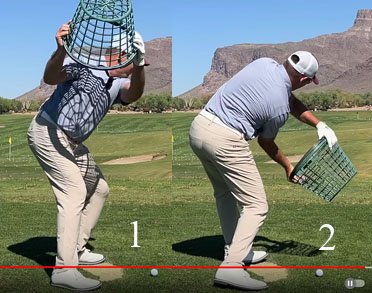
4:10 - 4:50 minute time points of his video a drill (using a large ball basket)
that he uses to acquire the "feel" of the trail arm dropping below the lead arm.
Here are capture images of Milo performing that drill.
Image 1 is at a simulated P4 position and image 2 is at a simulated P7
position.
When Milo grasps the rim of the basket, he talks of it "feeling" like a
steering wheel that he is going to rotate clockwise during his downswing
action when he pulls the basket down to P7. That clockwise rotation of the
basket's rim causes his trail forearm to end up below his lead arm in image
2.
I personally disagree with some of Milo's "feel" descriptions and I will now
describe the two core biomechanical actions that I personally believe should
be used to perform the "Anti-Malaska Move" (= anti-OTT move).
The first core biomechanical move involves the body pivot motion. I believe
that the most important feature of the correct body pivot motion that must
be performed is to get the kinematic sequence correct so that one first
starts the pivot motion with a pelvic shift-rotation motion, which is then
followed (with a variable degree of torso-pelvic separation) by a
counterclockwise rotation of the upper torso. The shift-rotation motion of
the pelvis creates secondary axis tilt that allows the trail shoulder to
drop more groundwards while the upper torso is rotating counterclockwise. It
is also useful to develop right lateral bend after P5, where the thoracic
spine bends rightwards relative to the lumbar spine, as that allows the
right shoulder to drop even more groundwards. I do not believe that it is
necessary to perform an exaggerated squat move or any compression of the
right side of the rib cage in order to get the right shoulder to move
downplane in an optimum manner.
The second biomechanical move needed to optimally perform the "Anti-Malaska
Move" involves the arm motion. I believe that the major arm motion needed is
an active trial upper arm adductory motion that is combined with a
pitch elbow motion of the trail arm that allows the trail elbow to be driven
to its pitch location alongside the trail hip joint area by P5.5. If the
trail upper arm adduction is active it will drop the trail elbow below the
level of the lead elbow during the early downswing and that will cause the
two arms to rotate clockwise - as seen in Milo's basket drill.
Here are capture images of Viktor Hovland performing the "Anti-Malaska
Move".
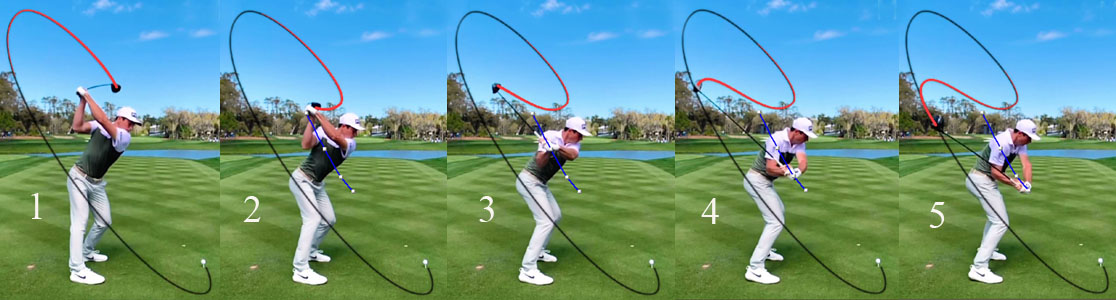
The black path shows his clubhead path during the backswing, the red path
represents his clubhead path during the early-mid downswing and the blue
path represents his hand arc path.
Image 1 is at P4 and image 3 is at P5. Note how VH actively adducts his
trail upper arm between P4 => P5 and that drops his trail elbow to a level
that is well below his lead elbow by P5. It is that active trail upper arm
adductory motion that causes the two arms to
passively
rotate clockwise during the arm lowering phase - where the back of the lead
hand, and the trail palm, passively become more horizontal relative to the ground. For
the back of the lead hand to become horizontal, the lead humerus must
internally rotate more and/or the lead forearm must pronate more. For the
trail palm to become more horizontal, the trail forearm must supinate more
and the trail humerus must avoid internally rotating more. Note that the two
arms/two hands are both dropping groundwards between P4 => P5 and that there
should be no "feel" of the trail arm pushing the hands upwards-and-away (as
described by Milo). Note that VH continues to shallow his clubshaft between
P5 (image 3) and P5.5 (image 5) and that requires a greater degree of
clockwise rotation of the two arms during the early phase of the
mid-downswing - where the the back of the lead hand becomes more horizontal
relative to the ground and where the trail palm becomes more horizontal
relative to the ground.
Jeffrey Mann.
https://newtongolfinstitute.proboards.com/thread/1057/analysing-milo-lines-secret-video