Pressuring the clubshaft at impact
In this post, I am going to analyse two recent videos produced by Bertie
Cordle.
Video 1: "How to pressure the shaft".
Video 2: "The best golf video ever".
The first video is labelled "How to pressure the shaft." Watch the first 1:28
minutes of the video. BC has placed his clubhead against the base of the
alignment stick at ground level and he generates forward shaft lean by pushing
against the resistance of the ground and he then describes the "feel" that he
experiences in his lead hand and trail hand when he is in a condition of forward
shaft lean - he states that he "feels" the lead hand's hypothenar area pushing
against the club handle in an away from the target direction and he "feels" like
his trail hand's 2nd finger is applying a positive push-pressure against the aft
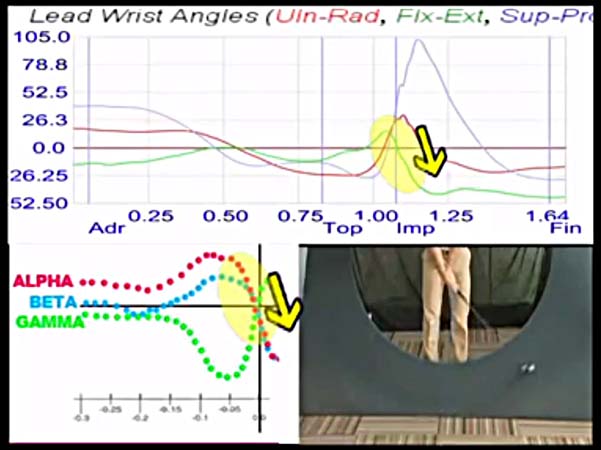
side of the club handle at the PP#3 area. Note that it produces a
counterclockwise torque about the coupling point (mid-hands point) - note the
yellow-colored arrow rotating counterclockwise. BC believes that this creates a
clubface-stabilising phenomenon at impact. I cannot agree with that opinion
because if a golfer comes into impact while applying those lead hand/trail hand
forces (as described by BC) at impact, which will result in a counterclockwise
torque about the coupling point, I think that it will more likely promote a
rotation-about-the-coupling point hand release action that is taught by Brian
Manzella and his acolytes.
Here is a capture image showing the rotation-about-the-coupling point hand
release phenomenon taught by Brian Manzella and his acolytes.
The alpha torque graph measures the torque being applied to the club handle by
the hands in the direction of the target (= parallel to the functional
swingplane direction) - note that it is positive during the later downswing all
the way to impact and that it only becomes negative after impact when the lead
wrist bends allowing the clubshaft to flip passed the lead forearm. Most
importantly, if the trail hand's 2nd finger is applying a positive push-pressure
at impact against the aft side of the club handle (as suggested by BC), then
that represents a positive trail hand couple scenario.
I agree with BC that is is advantageous to have forward shaft lean at impact,
where the clubshaft is angled away from the target relative to the lead forearm,
but I think that the best way to ensure a clubshaft-stabilising force at impact
that promotes forward shaft lean (and that will act to resist/impede any
clubshaft flipping phenomenon) is to have the lead/trail hand forces working in
the opposite direction, which will promote a
clockwise rotary
torque about the coupling point that will better promote a
continued
condition of forward shaft lean continuously existing through impact and
into the early followthrough time period. In other words, the lead hand must be
pulling the club handle towards the lead hand's hypothenar area at impact - by
maintaining a bowed lead wrist while allowing the lead hand's 3rd, 4th and 5th
fingers to be continuously pulling against the aft side of the club handle in a
targetwards direction. By contrast, the trail hand needs to be applying a
negative trail hand couple force at impact - by ensuring that the trail wrist
remains continuously extended through impact thereby resisting any tendency for
it to straighten - and that negative trail wrist torque scenario will be the
exact opposite of applying a positive "pressuring shaft force" with the trail
hand to the club handle below the coupling point at impact (as described by BC).
Consider Cameron Champ's DH-hand release action through impact.
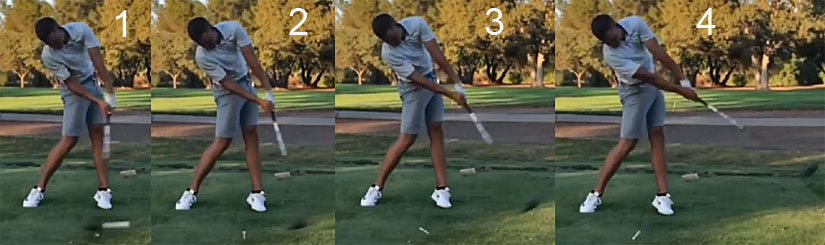
Image 1 is at P7, image 2 is at P7.2 and image 3 is at P7.4.
Note that his clubshaft is angled back relative to his lead forearm at P7
and to a slightly lesser degree at P7.2. What are the likely
clubshaft-stabilising forces that CC could potentially be applying between
P7 => P7.2 with his lead/trail hands to prevent a clubshaft flipping
phenomenon. Surely, it must be the forces that I described in the last
paragraph, which particularly involves the use of a negative trail hand
couple force, which is the exact opposite of a "pressuring the shaft" force
being applied below the coupling point. I cannot understand why a pro golfer
would want to be applying a positive trail hand push-force against the club
handle below the coupling point ( = "pressuring the shaft" below the
coupling point) at impact-and-through impact if he specifically desires to
ensure that he has forward shaft lean at impact-and-through impact!!!
Listen to what BC states-and-demonstrates starting at the 3:30 minute time
point of his video. He talks about having the correct impact geometry at
impact where the clubshaft is angled back relative to the lead forearm, but
where the amount is different for a driver compared to a short iron mainly
because of ball position. Note that he does not like the term "lean angle"
and he prefers to use the term "lag tension". That's a major golf
instructional difference between BC and me because I want a golfer to
manifest the same impact geometry (same lean angle) recommended by BC and
the same low point characteristics where the deepest part of the divot
happens a few inches ahead of the ball when hitting a short iron, but I have
zero sympathy for BC's "idea" of lag tension.
Watch the video starting at the 5:54 minute time point where Jonathan
Yarwood demonstrates a drill intended to foster the "feel" that should exist
at impact. Note that he places the clubhead against one of the table's feet
and he then "positively stresses" the clubshaft by applying a positive
push-force with a body rotation/motion in order to "artificially" create a
bowed lead wrist and forward shaft lean at simulated impact. However, that
demonstrated drill has no relevance with respect to a full golf swing action
where a pro golfer uses a pivot-induced TGM swinging action (lead arm
swinging action) and where there is a sequential release of PA#4 => PA#2 -
as seen in the following capture images of Rory McIlroy's driver swing.
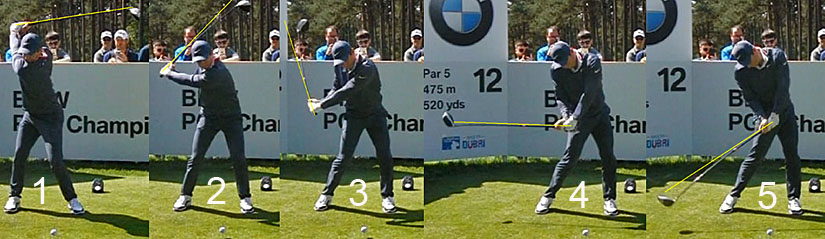
Image 1 is at P4, image 2 is at P5.2, image 3 is at P5.5, image 4 is at
P6, image 5 is at P6.3 and image 6 is at P6.8.
I have drawn a yellow line along his proximal clubshaft.
Note that his entire clubshaft forms a straight line with that yellow
line at his P4 position, which means that no positive alpha torque is
being exerted at this time point.
Note that he must be applying a positive alpha torque at P5.3 and P5.5
because his peripheral clubshaft is bent back relative to the proximal
clubshaft. However, note that he must be experiencing a negative alpha
torque (negative hand couple) phenomenon in his later downswing between
P6 and impact because his peripheral clubshaft is bent forward at all
time points between P6 and impact relative to the proximal clubshaft. In
other words, his clubshaft is not being positively stressed at impact
(in the "artificial" manner demonstrated by Jonathan Yarwood where the
peripheral shaft is bent backwards relative to the proximal clubshaft),
and there is therefore no reason to believe that Rory is applying a
positive trail hand couple torque force in his late downswing or at
impact.
According to Dr. Kwon, Sasho MacKenzie and David Tutelman, no pro golfer
has a positive trail hand couple force existing between P6 => P7 and
they all agree that the trail hand's couple force is negative - as shown
in the following image.
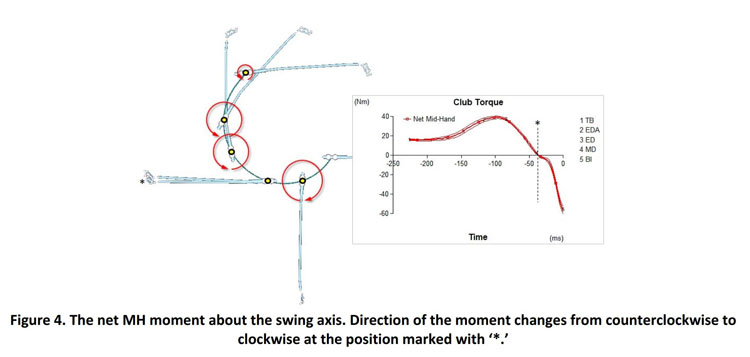
The red graph is a measure of the club torque being generated about
the mid-hands point (coupling point) by the hand couple during the
downswing. Note that it becomes increasingly negative after P6 and
it is very negative at impact (position 5 on the graph which is
vertically below the zero time line on the horizontal axis).
Watch the BC-video between the 7:15 - 7:50 time point where he
features Pete Cowen. PC talks about applying a positive pressure
against the shaft with the trail hand during the later downswing and
he refers to Ben Hogan's statement about "wishing he had three trail
hands" that PC seemingly believes would enable him to better
compress the golf ball. How is that possible? What could a pro
golfer do with the trail hand via a "pressuring the shaft"
phenomenon to ensure a better compression of the ball at impact? BC
seemingly implies that "three right hands" could apply a greater
degree of "pressure against the shaft" below the coupling point, but
that claim directly contradicts the scientific evidence presented by
Dr. Kwon, Sasho MacKenzie and David Tuteleman, who all claim that
the trail hand's hand couple torque is negative during the later
downswing and at impact. So, this issue needs more clarification
(which I will provide later in this post).
Watch the BC-video between the 7:50 - 8:17 minute time points where
he features Justin Rose. JR states that he wants to have forward
shaft lean at impact when hitting an iron, and I 100% agree with JR
that it is very desirable. That's how golf club irons are designed =
when the sole of an iron club is placed correctly on the ground you
will note that the club handle is ahead of the clubhead indicating
the physical condition of forward shaft lean. I therefore fully
agree with BC's opinion that forward shaft lean should exist at
impact, and I only disagree with his junk science opinions about lag
tension and a pre-stressed clubshaft.
Consider the following image that BC features in the 2nd video
called "Best Golf Video Ever".
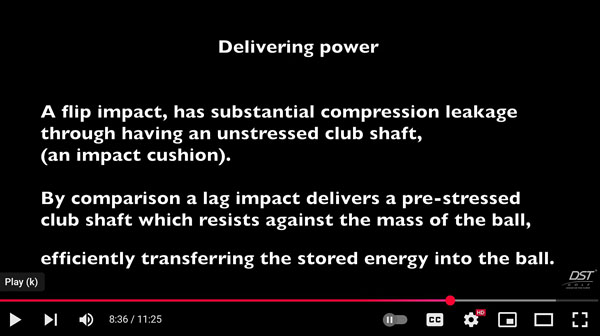
BC refers to a lag impact scenario where coming into impact with
forward shaft lean "delivers a pre-stressed clubshaft which
resists against the mass of the ball efficiently transferring
the stored energy into the ball". Where is the scientific
evidence that a clubshaft is positively pre-stressed when being
delivered into impact by a pro golfer and where is the
scientific evidence that there is "stored energy" that is being
delivered to the ball at impact in a pro golfer's driver golf
swing action? What is BC actually talking about? I am very open
to considering alternative/contrary opinions that support BC's
claim about a "pre-stressed shaft" and "stored energy" even
though I presently believe that it makes no sense! Any
suggestions?
In that 2nd video, Ben Doyle states that the "secret of golf" is
"sustaining the line of compression" through impact. I think
that it is an outdated TGM concept, which has no scientific
validity when referring to a full golf swing action (as
demonstrated by Rory McIlroy's driver golf swing action)! Ben
Doyle talks of the "feel" of "dragging a wet mop" into impact
and through impact where there is a "feel" of lag pressure being
felt (+/- being positively applied) by the trail hand's 2nd
finger at PP#3, which is below the coupling point. I can
certainly agree that it could exist when he demonstrates his
handle-dragging release technique when performing a chip shot,
or a punch shot, or a shortened pitch shot. However, I don't
believe that is applies to a full golf swing action - like Rory
McIlroy's driver swing action.
What happens in a driver golf swing action, and in a full long
iron golf swing action, is that a skilled pro golfer (who
performs a pivot-induced TGM swinging action) can theoretically
use the trail hand's 2nd finger's PP#3 point to sense lag
pressure, but not produce lag pressure,
if the trail hand
moves continuously at the same speed as the lead hand throughout
the downswing action. Under those conditions, a skilled
golfer could theoretically sense a lot of lag pressure via his
trail hand's 2nd finger at PP#3 during the P4 => P6 time period
(when the peripheral clubshaft is bent backwards relative to the
proximal clubshaft) and then theoretically sense a significant
decrease in his lag pressure sensation between P6 => P7 (when
the peripheral clubshaft is bent forward relative to the
proximal clubshaft). What I cannot understand is how trying to
monitor the "feel" sensation of the degree of lag pressure via
PP#3 can causally result in a golfer obtaining the exactly
desirable amount of forward shaft lean at impact. I can readily
agree that virtually all pro golfers come into impact with
forward shaft lean, but I believe that this essential skill is
based on optimising the timing of the release of PA#2, and not
based on sensing, and responding to, the degree of lag tension
during a full golf swing action (where a handle-dragging
technique is not being used).
BC quotes Jack Nicklaus at the 11:00 minute time point of the
video as follows-: "Striking the ball with your hands
slightly ahead of the ball is fundamental to solid shotmaking".
I agree with Jack Nicklaus and I can even agree that using one
of BC's custom-made golf clubs, that have an impact line drawn
near the hosel, can help a golfer learn how to better achieve
the desirable amount of forward shaft lean at impact. However,
what I cannot understand is how
"pressuring the shaft" below
the coupling point with the trail hand's index finger can be
desirable/useful in a full golf swing action (where a
handle-dragging technique is not being used).
It is amazing to me how many golf instructors are susceptible to
the "idea" that it is useful to
"pressure the shaft" below
the coupling point without explaining how it can be
advantageous if a golfer uses a pivot-induced TGM swinging
action technique.
Consider the following video by the golf instructor, Alex
Elliot.
In that video, AE analyses a drill that Ludwig Aberg performs
where he places his flat trail hand with fingers fully extended
against the aft side of the club handle below the coupling
point, and he then performs a full golf swing action using a
pivot-induced TGM swinging action (lead arm swinging action).
What is the purpose of the drill? I have never seen LA provide a
personal explanation of why he does that drill. However, AE
automatically presumes that the purpose of the drill is to
engrain the "feel" of pressuring the clubshaft with the trail
hand. Note that he performs the drill a few times and he then
finally hits a very solid shot holding the club with both hands
gripping the club handle in his usual manner. AE concludes that
the "feel" of pressuring the clubshaft below the coupling point
while performing the drill helped him to strike the ball more
solidly in his final golf swing action. I think that his
conclusion is irrational and wrongheaded. Why?
Consider how AE normally grips the club with his two hands by
viewing these capture images that I have created from his video.
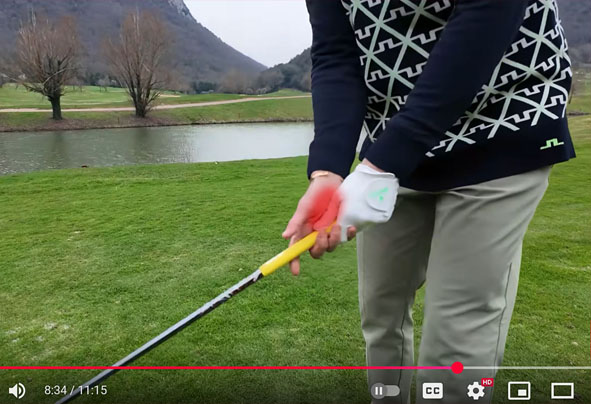
AE uses a strong lead hand grip that positions the lead thumb on
the aft side of the club handle. He then uses a neutral trail
hand grip using the interlocking fingers method. Note that most
of his trail palm abuts against the lead thumb area (called
pressure point #1 in TGM terminology) - see the red-colored area
that I have drawn over the image - which is above the coupling
point. That means that any push-pressure being applied by the
trail palm is most likely being applied above the coupling
point, and not below the coupling point. This is a critical
point that I will discuss later with respect to the "idea" as to
whether it could be advantageous in terms of enhancing a
golfer's ability to stike the golf ball more solidly. If I am
correct, then there could be another explanation as to why LA
performs the drill that is not related to the "idea" of
"pressuring the shaft below the coupling point".
I think that there could be a far more rational explanation as
to why LA performs the drill, which could be as follows-: LA
uses a strong lead hand grip, which means that he rotates his
lead hand >60 degrees clockwise over-the-top of the grip so that
the lead thumb is placed at the 2 - 3 o'clock position (when
viewed from above). A great advantage of adopting a very strong
lead hand grip is that it allows one to automatically/naturally
acquire forward shaft lean at address - if the club handle is
placed along the lifeline crease of the lead hand. That makes it
much easier from a biomechanical perspective to get into a
desirable condition of forward shaft lean at impact - without
having to bow the lead wrist. Another advantage of adopting a
very strong lead hand grip is that there is minimal need to
perform a lead forearm supinatory motion between P6.5 => P7
(during a PA#3 release action) because the back of the lead hand
will always be traveling roughly parallel to the functional
swingplane, and ball-target line, between P6 => P7, and there is
no added need to rotate the back of the lead hand
counterclockwise so that it faces the target at impact. In fact,
a golfer, who uses a very strong lead hand grip (like LA), must
come into impact with the ulnar border of the lead hand facing
the target, while the back of the lead hand must still be facing
the ball-target line. If the golfer allows the lead hand to
rotate counterclockwise between P6.5 => P7 that will cause the
clubface to be too closed at impact, so the golfer must
deliberately avoid that possibility! I think that the
"correct" use of the trail hand can help a golfer avoid that
possibility. Note that LA uses a neutral trail hand grip which
means that his trail palm must be traveling perpendicular to the
ball-target line between P6.5 => P7 and the trail palm must face
the target at impact. If you understand this point, then it
provides a rational explanation as to why LA performs that drill
- he places the trail palm parallel to his clubshaft so that he
can ingrain the "feel" of the trail palm coming into impact
facing the target, and not rolling too much counterclockwise as
his hands reach impact. In other words, LA is powering his golf
swing action with a pivot-induced lead arm swinging technique,
and he does not need the trail hand to apply more swing power.
The trail hand is mainly used to help guide the motion of the
lead hand/club handle into impact and help to avoid the
possibility of non-intentionally over-rotating the lead hand
during the later downswing as the hands reach closer to impact
by ensuring that the trail palm is facing the target as it
reaches impact.
Now, I want to expand on this complicated issue of how a golfer
can more fruitfully use the trail arm/hand when performing a
pivot-induced TGM swinging action (lead arm swinging action)
technique by more thoroughly analysing this Danny Maude video
featuring Pete Cowen.
The main topic of that video is how to optimally use the
trail arm/hand in a full golf swing action. BC extracted a
small section of that video where PC talked about
"pressuring the shaft" to better compress the ball at
impact. However, what does PC really demonstrate in the
Danny Maude video about how to use the trail arm/hand in the
downswing? Watch the DM-video between the 4:11 - 5:40 time
point of the video where PC explains what he wants the trail
arm to do during the downswing - he talks about "spinning"
the right forearm downwards while maintaining a bent
(extended) trail wrist into impact. What does he mean when
using the term "spinning"? PC does a very poor job using
biomechanical terminology when describing the right forearm
"spinning" motion, but I can mentally grasp what he is
implying.
Keep watching the video and particularly watch the video
very carefully starting at the 9:50 time point when DM
states that he does not know what to do next. PC provides
his answer between the 9:50 - 10:06 minute time point of the
video when he talks about "spinning" the trail forearm down
while maintaining a fully extended trail wrist.
Look at this capture image from the DM-video - captured at
the 9:58 minute time point.

Note that DM is using a cack-handed grip when performing this
right forearm "spinning" motion between P6 => P7. Note that it
results in forward shaft lean at impact if the trail wrist is
kept in an extended position. Note that it also causes the trail
forearm to "spin" in a clockwise (supinating) direction, and not
a counterclockwise (pronating) direction, between P6 => P7.
Finally, note that the trail palm is applying push-pressure
against the club handle above the coupling point, and not
below the coupling point, at impact.
Also, note where PC's fingers are pointing when he talks about
the "feel" of muscular tension in the right forearm. He is
pointing at the lateral half of the trail forearm where the
right wrist's extensor muscles and right forearm's supinator
muscles are located. In other words, I believe that PC
definitely wants the trail forearm to be supinated at impact,
and not pronated at impact, when he talks about the "spinning"
motion of the trail forearm.
Where specifically does PC want the trail hand to be applying
push-pressure at impact if a golfer uses a standard grip, and
not a cack-handed grip.
Keep watching the video when DM performs a right forearm
"spinning" motion using his standard two-handed grip and pay
very careful attention to what PC says between the 11:12 - 11:23
minute time point of the video when he talks about applying
pressure with the trail hand at impact.
Here is a capture image from the 11:23 minute time point of the
video.
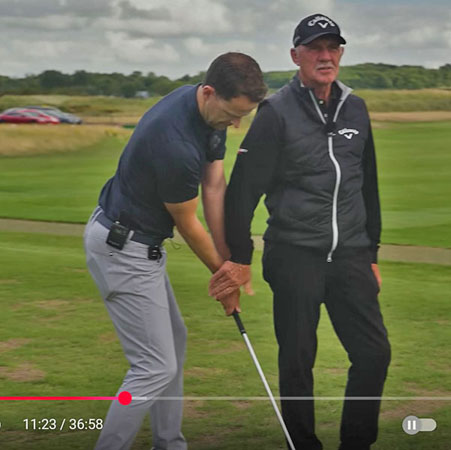
Note that PC is patting the back of DM's upper trail hand, which is well extended at impact, while he states that this why "Hogan wished that he had three right hands". PC is presumably implying that any push-pressure being exerted by the trail hand is being exerted against the club handle above the coupling point (in the region of PP#1 which is located over the lead thumb), and not below the coupling point by the trail index finger alone. Why does PC specifically emphasize the golf instructional point that the trail wrist must be well extended at impact and that it must remain extended immediately post-impact? I suspect that it helps to ensure that the trail palm's push-pressure is not being exerted below the coupling point via the right index finger. What are the potential advantages of the trail palm applying push-pressure to the lead thumb and the club handle above the coupling point if the golfer uses a pivot-induced lead arm swinging action (like Rory McIlroy and Ludwig Aberg and Ben Hogan)? It can first of all help to ensure that the lead arm does not stall its targetward motion during the later downswing and through impact. Secondly, it can ensure that if any rotary torque is being applied about the coupling point during impact that it will be in a clockwise direction (which can help to stabilise the club handle's forward angled alignment through impact) rather than being in a counterclockwise direction (which will more likely promote a flipping motion of the club handle through impact). If the trail wrist is kept well extended during the impact interval, it can potentially help to maintain the anatomical structural alignment of a "bowed lead wrist and forward shaft lean" at impact and it also allows the trail hand couple to work as a negative trail hand couple at impact (which is potentially beneficial in creating a clockwise torque - and not a counterclockwise torque - about the coupling point).
What about the "idea" of having "three right hands at
impact"? How can it be beneficial? I can perceive that it
can potentially be beneficial if a golfer uses a right
arm-powered golf swing action and not a pivot-induced TGM
swinging action, which is used by most PGA tour golfers. I
do not know of any pro golfer who powers his golf swing
solely via a trail arm swinging-or-hitting motion.
It is obvious that a skilled pro golfer can perform a
pivot-induced lead arm swinging action very efficiently
without applying any push-pressure against the aft side of
the club handle above the coupling point at impact - and a
good example of a pro golfer who has this skill is VJ Singh.
Here is a swing video of VJ Singh's full golf swing action.
Watch
the 1:21 - 1:23 minute time point of video - note that
VJ's trail hand separates away from the club handle just
prior to impact so he cannot possibly be applying any
positive push-pressure with his trail palm against the
club handle at impact. Nonetheless, he can easily ensure
that he has acquired his desirable amount of forward
shaft lean at impact, and he can obviously strike the
ball very solidly.
It is therefore optional as to
whether a pro golfer, who uses a pivot-induced lead arm
swinging action, should apply a positive push-pressure
with his trail hand at impact in a "pressurising the
shaft" manner. However, and most importantly, if he does
want to apply a positive push-pressure with his trail
hand in a "pressurising" manner at impact, then I very
strongly believe that it should be applied above the
coupling point, and not below the coupling point (as
recommended by Bertie Cordle).
Jeffrey Mann.
https://newtongolfinstitute.proboards.com/thread/1170/pressuring-clubshaft-impact