Most importantly, I did not
clearly realize that the direction of "pull"
must continuously
be along the Fz axis (= axis drawn outwards from
the butt end of the club) and that a negligible pull-force must be exerted
along the Fx axis. Even more importantly, I did not clearly realize that the
amount of pull-force must get much greater after P5.5. I previously believed
that most of the pull force (mainly due to a lead arm/hand pulling action)
is exerted between P4 => P5.5 due to the release of PA#4 and I correctly
believed that lead hand speed reaches its maximum speed at ~P5.5. I knew
that lead hand speed decreases by 25% between P5.5 => P7 while PA#2 is being
released and I knew that the "force" needed to complete the release of PA#2
is due to the centripetal component of the MoF - as shown in the following
Kwon graph.
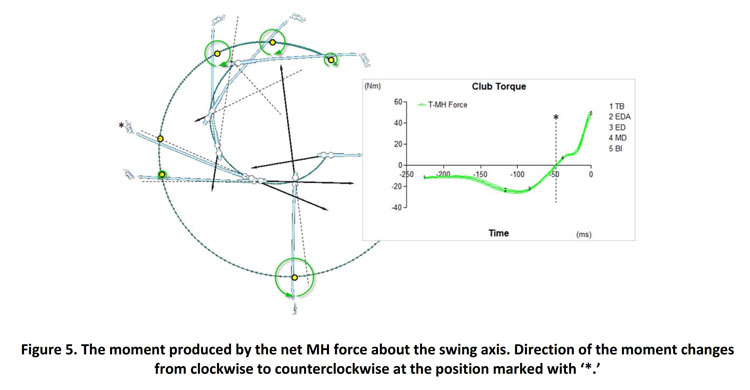
Note that curved green arrow rotates counterclockwise after P5.5 and that causes the release of PA#2.
I realized that the straight black arrows represents the net MH force and I noted that the black arrow becomes directed more centripetally at impact.
However, I did not fully realize that the length of the black arrow represents the magnitude of the lead hand pulling force, which becomes much greater after P5.5 and I did not fully realize that the pulling force must be directed in the Fz axis (outwards from the butt end of the club).
If you study SMK's video, it shows the forces as referenced to the grip end of the club (grip reference frame), and not relative to the swingplane.
So, consider what is happening during the downswing.
Image 1 at P5.2.
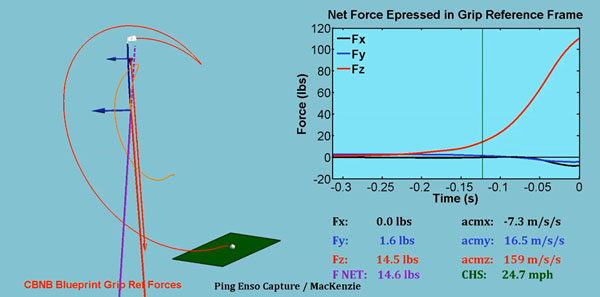
The total force = 14.6 lbs and most of it (14.5 lbs) is happening in the Fz direction - see red arrow which is pointing groundwards because the club is vertical at ~P5.2.
Image 2 is at P5.5.
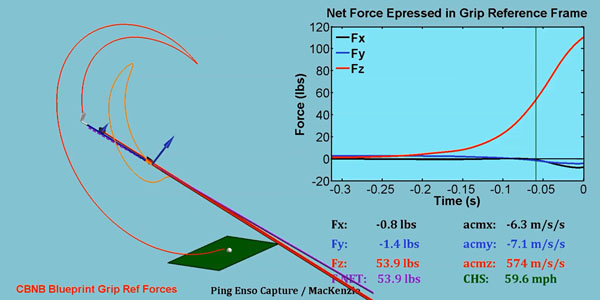
At P5.5, lead hand speed has reached its maximum speed and the lead hand pulling force is 53.9 lbs and it is entirely in the Fz direction.
Note that a lot of additional force is
still needed to complete the golf swing action between P5.5 =>
P7 (see curved red graph in the top right hand corner).
Image 3 is at P6.5.
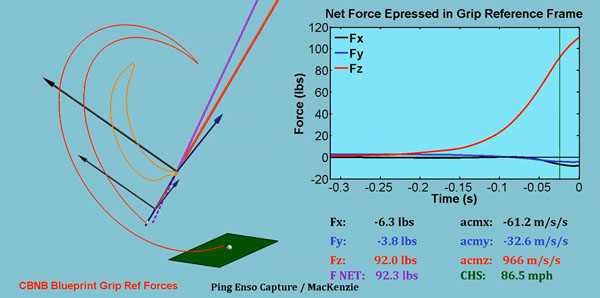
Note that the lead pulling force must now be 92.3 lbs in magnitude and it is almost 100% due to pulling the club handle in the Fz direction.
Image 4 is at P7.

Note that the lead hand pulling force is now 110lbs and virtually all of it is in the Fz direction.
In other words, the lead hand must be pulling with much more force (and continuously in the Fz direction) between P5.5 => P7 than it was pulling at P5.5 (when lead hand speed reached its maximum speed due to the release of PA#4).
I never clearly realized
how important it was to be pulling the club handle in
the Fz direction between P5.5 => P7 and that the
direction of pull must become more
centripetally-directed as the club gets closer to
impact.
How is it physically possible for a golfer to be pulling upwards with a lead hand pulling force of such a great magnitude of ~80 - 110 lbs between ~P6 => P7?
I think that it is mainly due to a body motion (= elevation of the lead shoulder socket) and not due the fact that the lead hand is still swinging at a great speed in a slightly uptilted-targetward direction between P6 => P7.
Consider Dustin Johnson's lead shoulder motion.
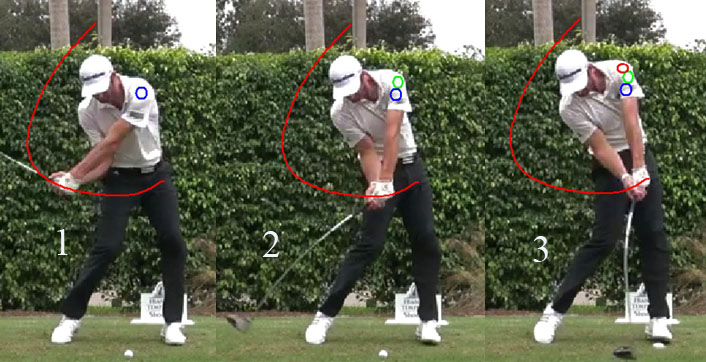
Image 1 is at P5.5, image 2 is at P6.5 and image 3 is at P7.
The red splined path is his hand arc path.
I have drawn a small blue circular marker over his lead shoulder socket at P5.5, and I have drawn a small green circular marker over his lead shoulder socket at P6.5 and a small red circular marker over his lead shoulder socket at P7.
Note that his lead shoulder socket is moving
vertically upwards between P5.5 => P7. I have for
many years known that this "lead shoulder elevation"
phenomenon is an important biomechanical feature of
a good quality golf swing action, but I never
clearly realized how important it is from a "lead
hand pulling force" perspective. I now believe that
it is the optimum way to provide the 80 - 100 lbs of
pulling force (directed along the Fz axis) that is
required in the later downswing. Another important
insight is realizing that the direction of the "lead
hand pulling force" must
continuously
be directed along the Fz axis - which means it is
continuously
directed away from the butt end of the club. So, if
you look at where DJs butt end of the club is
pointing at P5.5, P6.5 and P7, one needs to imagine
a "lead hand pulling force path" that is mainly
directed at the target at P5.5,
but increasingly directed
towards the lead shoulder socket as the lead hand
moves along the hand arc path between P5.5 => P7 and
that the magnitude of that "lead hand pulling force"
must be getting progressively larger the closer the
lead hand gets to impact.
I previously under-emphasized the importance of the "lead shoulder socket elevation" phenomenon which is secondary to a lead leg straightening action combined with an extending phenomenon of the lead side of the mid-upper torso, and which is not due to alternative sub-optimum biomechanical motions eg. "standing-up" phenomenon through impact or a "chicken-winging" action of the lead arm.
-----------------------------------------------------------------------------------------------------------------------------------------------------
Consider Kyle Berkshire's driver
golf swing action
https://youtu.be/KA3MfuWn83M
There is a slow motion sub-video
featured at the 1:54 - 1:60 minute time point of the video
that allowed me to create capture images.
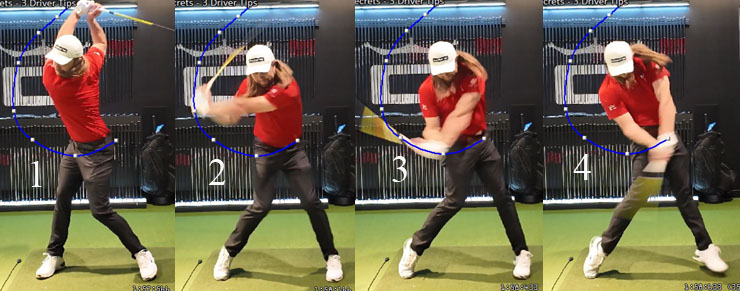
Image 1 is at P4, image 2 is at P5, image 3 is at P5.5 and image 4 is at P6.7+.
Note that KB can get his lead arm to beyond the 12 o'clock position at P4. He also has a huge amount of torso-pelvic separation at P4.
Note the long length of his hand arc path between P4 => P5.5 where his lead arm speed probably peaks.
According to SMK, linear work energy is a product of the "average hand speed" multiplied by the length of the hand arc path and one can imagine that KB is producing a huge amount of linear energy during his PA#4 release phase between P4 => P5.5.
Then, note how his hand arc path is uplifting between P5.5 => P6.7 and that allows him to maximise his speed of release of PA#2.
Here are capture images showing his lead shoulder motion.
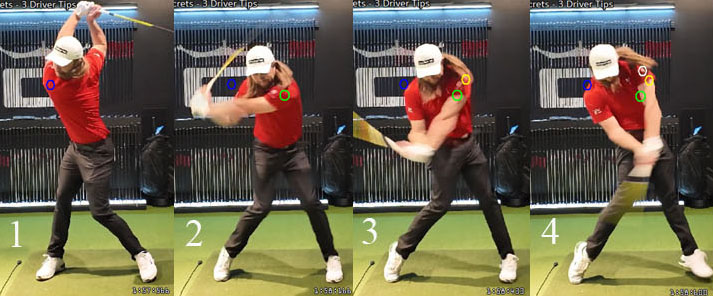
Image 1 is at P4, image 2 is at P5, image 3 is at P5.5 and image 4 is at P6.7+.
I have drawn a small blue circular marker over his lead shoulder socket at P4.
I have drawn a small green circular marker over his lead shoulder socket at P5.
I have drawn a small yellow circular marker over his lead shoulder socket at P5.5.
I have drawn a small white circular marker over his lead shoulder socket at P6.7+.
KB starts elevating his
lead shoulder socket earlier than most pro golfers and it happens
between P5 => P5.5. He also has lot of lead shoulder socket elevation
happening between P5 => P6.7+ that potentially allows him to release
PA#2 more efficiently.
So, KB presumably gets a huge amount of swing power by optimising his speed of release of PA#4 and by also optimising his speed of release of PA#2 - according to the principles that can be derived from SMK's journal article and video.
Jeffrey Mann.
https://newtongolfinstitute.proboards.com/thread/1171/radical-change