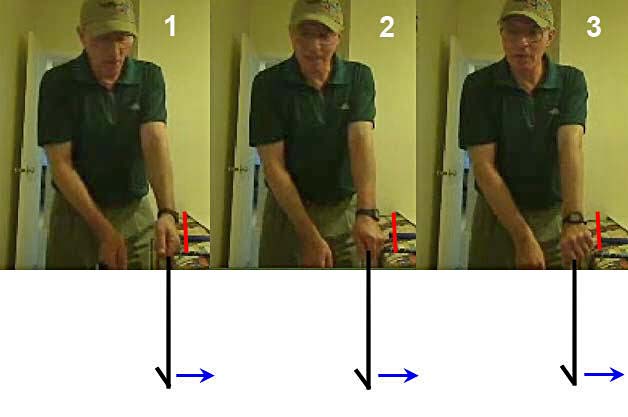
Re-visiting the intact LFFW concept
A forum member posed the
following question-: "I still have a slight
issue understanding how a non-neutral grip can still have an intact LAFW.
For example , do all these images below show an intact
LAFW with a GFLW for the varying grip strengths? I am assuming that in all the
images the clubface is square to the target line.?
Good questions!
My thinking on the intact LAFW concept has evolved
since I produced that image showing an imaginary clubshaft straight-in-line with
the left arm - supposedly representing an intact LAFW.
At present, I think that the intact LAFW/GFLW concept
only usefully applies to a golfer who adopts a neutral-or-weak left hand grip
and that it does not apply if the golfer adopts a very strong left hand grip.
If a golfer adopts a neutral-weak left hand grip, then
the intact LAFW/GFLW concept is very useful because it allows a golfer to avoid
wobbly left wrists during the late downswing when PA#3 is released, and it also
allows a golfer to efficiently perform a DH-hand release action through impact
to P7.2+ and thereby avoid a flip-or-rolling problem.
You also asked-: "Example 1: Image 1 (weak 1 knuckle grip). If the golfer grips using mid-palmar grip pattern (blue line) won't the clubshaft be slightly angulated towards the target at address? And won't it become even more angulated towards target if he gripped using 'low palmar' and 'finger grip' pattern?"
No.
Changing from a mid-palmar => low palmar => finger
grip only varies the accumulator #3 in the plane of radial => ulnar
deviation and it does not disrupt an intact LAFW alignment if a golfer
adopts a neutral-weak left hand grip (presuming that the intact LAFW is
perpendicular to the swingplane).
I now think that the intact LFFW/LAFW concept has
no useful value if a golfer adopts a very strong left hand grip. At address,
the left palm (and back of the left hand) are parallel to the swingplane,
and not perpendicular to the swingplane. Also, it would therefore naturally
cause forward shaft lean if the left wrist is neutral in the plane of radial
=> ulnar deviation, with the degree of forward shaft lean becoming greater
as one moves from a midpalmar => low palmar => finger grip pattern. The only
way to get the clubshaft to become straight-line-aligned with the left arm
at address (as depicted in that image) would be to ulnar-deviate the left
wrist. When I produced my video project series of 7-videos, I suggested that
it is better to think of the LAFW lying parallel to the swingplane at
address if the golfer adopts a very strong left hand grip, which means that
the clubshaft would be straight-line-aligned with the left arm
as perceived from a DTL viewing perspective
(where one views the scenario from a viewing angle that is parallel to the
swingplane). That "LAFW modification" alignment suggestion has some utility
if the golfer keeps the same degree of left wrist dorsiflexion throughout
the downswing - as seen in Jamie Sadlowski's golf swing action.
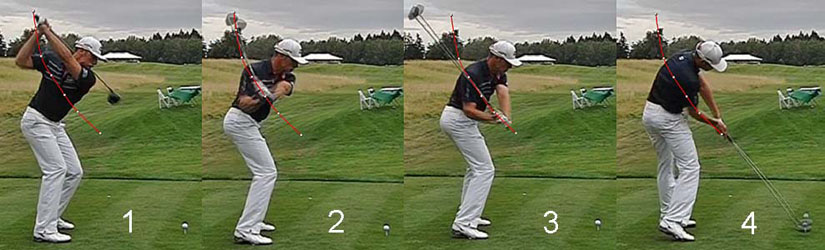
Note that JS has his left radial bone approximately inline with his left antecubital fossa throughout his downswing and that he also has his clubshaft more-or-less inline with his left arm/forearm between P4 and impact.
However, that "intact LAFW modification" alignment
(where one thinks of the intact LAFW lying parallel to the swingplane
throughout the downswing and early followthrough) would only apply if the i)
golfer did not shallow the clubshaft to below the TSP during the downswing
and if the ii) golfer comes into impact with an outstretched left arm and a
iii) very small accumulator #3 angle. The "real life" reality is that some
pro golfers (who adopt a very strong left hand grip) shallow the clubshaft
during the early-mid downswing and come into impact with a more vertical
left arm and a larger accumulator #3 angle (due to increased left wrist
dorsiflexion that is combined with a more vertical left arm) and that means
that an "intact LAFW modification" alignment would not exist in their
downswing action.
Another problem with the modified definition of an
intact LAFW (where the intact LAFW is perceived to be
continuously
parallel to the swingplane) is the fact that maintaining an "intact LAFW
modification" alignment would not prevent flipping through impact because
flipping would be caused by excessive left wrist ulnar deviation (which does
not disrupt an intact LAFW that is aligned parallel to the swingplane). I
therefore now question the utility of the intact LAFW concept in a golfers
who adopt a very strong left hand grip, and I do not think that it has
practical value.
Jeffrey Mann.
https://newtongolfinstitute.proboards.com/thread/758/revisit-gflw-intact-lafw