If you follow that link, you will find a 2:29 minute Terry Rowles video,
where he talks about the golf swing biomechanics that must happen as a
result of adopting an on-top (weak) trail hand grip. I mainly disagree with
3 claims made by TR in that video and his 1st claim happens at the 0.26 -
0.32 minute time point of the video when TR states "that the trail hand
grip has the biggest effect on what the clubface does during the golf swing".
The 2nd claim that TR makes happens between the 1:32 - 1:50 minute time
point of the video when TR claims that an on-top trail hand grip is a
face-opener grip and that means that the golfer will have to perform a
clubface-closing mechanism during the downswing to counter that
clubface-opening effect that is due to adopting an on-top trail hand grip.
The 3rd claim that TR makes happens between the 1:50 - 2:00 minute time
point of the video when TR describes the clubface-closing phenomenon that he
believes is needed to provide the clubface-closing mechanism - when he
states that when the trail arm extends (= straightens at the elbow joint)
during the later downswing ( = roughly between P5.5 => P7) that it will
cause the trail forearm to pronate, and that when the trail forearm is
pronating during the later downswing that the counterclockwise rotating
trail forearm will cause the clubshaft to rotate counterclockwise about its
longitudinal axis and that will cause the clubface to close more relative to
the clubhead path so that the clubface can become square relative to the
clubhead path by impact.
It is very important to note that when I talk about the topic of "clubface
control" I am mainly talking about how the clubface must close during the
later downswing (between ~P5.5 => P7) relative to the clubhead path so that
the clubface can become square relative to the clubhead path by impact and I
am not talking about "clubshaft/clubhead control" which mainly affects the
clubhead path and swing direction. It also important to understand that in
this post I am only talking about the golf swing action performed by pro
golfers (eg. PGA tour golfers) and not the golf swing action performed by
amateur hackers.
I strongly disagree with TR's assertion that the trail hand grip strength
has the biggest effect on the clubface-closing phenomenon routinely seen in
the later downswing of pro golfers and I believe that it is the lead hand
grip strength that is the main factor that affects the "amount of clubface
closing relative to the clubhead path" phenomenon that
always happens
during the later downswing after ~P5.5.
I will first analyse those 3 claims made by TR before I start to explain why
I believe that it is the lead hand grip strength that is the biggest
determining factor involved in the amount of clubface-closing that happens
in the later downswing in all pro golfers.
I will start off this analysis by analysing what TR seemingly means when he
talks about an on-top trail hand grip being a face-opener grip.
Here are capture images from the TR video.
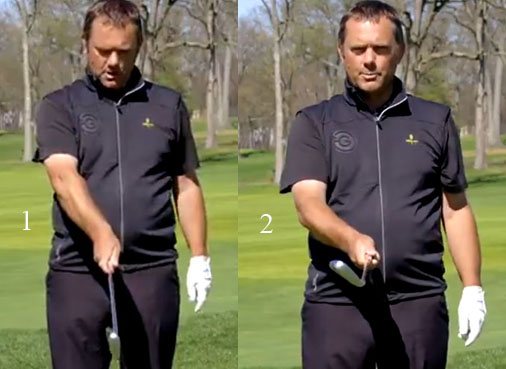
Image 1 shows TR holding a golf club handle using an on-top (weak trail
hand grip) where the clubface is facing the target, which means that it
is neither open-or-closed.
Image 2 shows what happens when TR rotates his trail hand clockwise
(when viewed from his perspective) so that the back of his trail hand
becomes more vertical and that causes the clubface to open.
What does this mean to you?
What it means to me that if a golfer adopts an on-top (weak) trail hand
grip - as seen in image 1 where the clubface is neutral (square) to the
clubhead path (presuming that the clubhead path is directed towards the
target) - that if the golfer swings his trail arm towards the target (as
seen in the P6 => P7 time period of a pro golfer's swing) that the
clubface will remain square to the clubhead path if the grip does not
rotate clockwise (as seen in image 2 where it is rotating clockwise to
an open clubface alignment) or rotate counterclockwise (where it will
rotate to a closed clubface alignment).
That phenomenon of the clubface remaining square (neutral to the
clubhead path) is what happens in the grip verification test performed
by Mike Adams (MA).
Here is a link to MA's grip verification test video.
In this grip verification test video, Mike Adams explains how you know
that you have "dialed-in" the correct trail hand grip strength. Note
that he starts with a strong trail hand grip and he then swings the club
from waist-high-to-waist-high using only his trail arm. He states that
if you "feel" the clubface closing during the clubshaft's travel passage
from waist high-to-waist high, then the trail hand grip strength is too
strong. He then suggests that you weaken the trail hand grip until the
clubshaft remains quietly stable with no tendency to roll closed during
the trail arm-only swinging action. MA seems to be suggesting that if
the clubface does not roll when using an on-top trail hand grip that the
trail hand grip is correct (= stable) for that particular golfer. That
claim suggests to me that MA believes that if there is no tendency for
the clubface to roll either open-or-closed during that the grip
verification test when using an on-top trail hand grip, then that means
that the on-top trail hand grip allows the clubshaft to swing across the
front of the body without being subjected to any face-opening force or
face-closing force.
However, TR seems to be implying that there is naturally a "face-opening
force" in play during the late downswing if a golfer adopts an on-top
trail hand grip that mandatorily requires a corrective
clubface-closing phenomenon to be actuated to counter that "face-opening
effect". I have no idea what's the nature/cause of that
"clubface-opening force" that TR must have in mind if he believes that
an on-top trail hand golfer must mandatorily provide a
clubface-closing force to counter any tendency of the clubface to be too
open during the P6 => P7 time period.
Seeing that I have no clear idea why TR believes that a corrective
clubface-closing force is needed if a golfer adopts an on-top trail hand
grip, I will move onto the next topic by discussing what I perceive TR
is claiming regarding the biomechanical mechanism of performing that
corrective clubface-closing action.
TR uses the analogy of a straightening trail arm when performing a
boxing punch action to help explain the rationale for his proposed
clubface-closing mechanism.
Here are capture images of his boxing punch demonstration.
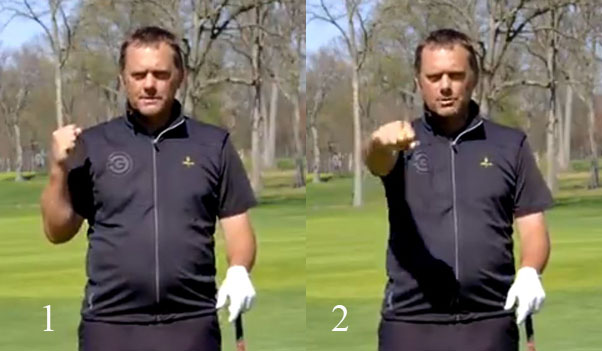
In image 1, note that TR has flexed his right elbow while holding
his closed fist in a vertical alignment where his finger knuckles
are vertically aligned.
In image 2, he fully straightens/extends his right arm and you can
see that his fist rotates ~90 degrees counterclockwise (as viewed
from his viewing perspective). What explains why his fist rotates
counterclockwise? TR seemingly suggests that it is a
natural/automatic biomechanical phenomenon that is due to a passive
pronatory motion of his right forearm.
When I perform his test maneuver, I find that I can easily
straighten my right arm fully without any tendency of my fist to
rotate if I keep my right humerus vertically aligned alongside the
right side of my torso with the right humerus in a neutral rotary
position. However, if you look at image 2, note that his trail upper
arm is slightly abducted away from the side of his torso. When I
mimic that abducted right upper arm alignment, then I also note that
my fist will automatically rotate counterclockwise by ~90 degrees
during my right arm straightening action. What I perceive is
happening biomechanically is that the right humerus starts to rotate
internally during the arm straightening action and that secondarily
causes the right forearm to pronate as the right arm straightening
action proceeds further.
That forearm pronatory motion is what
theoretically happens
in a punch elbow motion of the trail elbow during the later
downswing - according to TR's reasoning. Homer Kelley in his "The
Golfing Machine" book described a pitch elbow motion of the trail
arm during the P4 => P6 time period and also a punch elbow motion,
but he never defined the difference clearly. I also have never heard
TR clearly define the difference between a pitch elbow motion versus
a punch elbow motion between P4 => P6 other than to infer that the
trail elbow leads the trail hand all the way down to P6 without the
trail hand bypassing the trail elbow when performing a pitch elbow
motion, while in a punch elbow motion he infers that the trail
humerus will start to internally rotate when the trail arm
straightens and that it will cause the trail hand to bypass the
trail elbow before P6. It is my experience that pro golfers only
start their trail arm straightening action between P5.2 - P5.5 and
never in the early downswing and that it mainly happens to a greater
degree after P5.5 - P6. Then, I perceive that TR seemingly believes
that when the trail arm continues to straighten much more between P6
=> P7 while the trail humerus continues to internally rotate, that
it will induce the trail forearm to passively pronate during the
later phase of the trail arm straightening action, which mainly
happens between P6.5 => P7. If the trail forerarm pronates, it will
obviously produce a clubface-closing phenomenon that TR believes is
mandatorily required if a pro golfer adopts an on-top/weak trail
hand grip (face-opener grip). By contrast, TR seemingly believes
that if a pro golfer adopts an under/strong trail hand grip
(face-closer grip) that he must definitely avoid performing a punch
elbow motion and that he must mandatorily use a pitch elbow motion
of the trail arm.
Consider this image of Rory McIlroy and Dustin Johnson that TR
featured in one of his Ultimate Golf Lesson webinar videos.
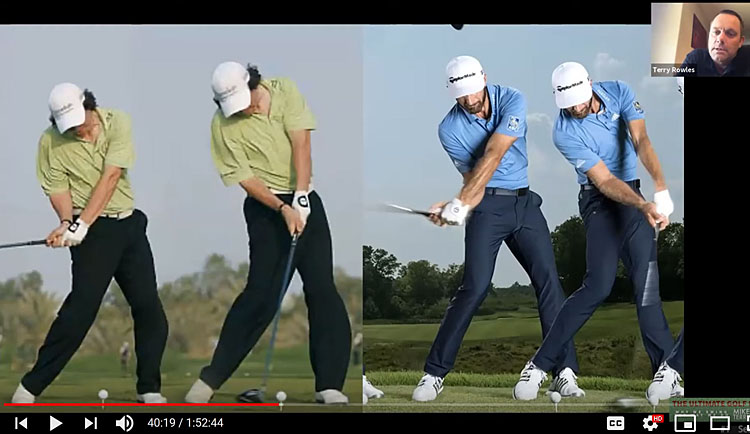
Rory McIlroy is on the left side. Note that his trail elbow is
positioned in a rear linkage position above-and-behind his trail
hip joint area at P6 and TR states that he is using a punch
elbow motion because his trail hand is closer to the target than
his trail elbow and that his trail humerus is internally
rotated. Then note how Rory is straightening his trail arm
between P6 => P7 while manifesting an internally rotated trail
humerus. According to TR's reasoning that earlier trail arm
straightening action using a punch elbow motion will cause the
trail forearm to passively pronate in the later downswing, which
TR asserts is a mandatory requirement because Rory uses a
face-opener trail hand grip that TR believes necessitates a
clubface-closing phenomenon that will be provided by the trail
forearm's pronatory motion.
Dustin Johnson is on the right side. Note that his trail elbow
is in a pitch location above-and-forward of his trail hip joint
area at P6 and that he is using a pitch elbow motion because his
trail elbow is closer to the target than his trail hand. That
results in a later trail arm straightening action and it also
helps to avoid a clubface-closing phenomenon due to trail
forearm pronation that Dustin must avoid because he uses an
under/strong (face-closing) trail hand grip.
TR's reasoning seems to be logical if one follows the sequential
path of his line of reasoning, and it therefore seems reasonable
to infer that if a golfer adopts an on-top trail hand grip
(face-opener grip) that he must use a punch elbow motion of his
trail arm earlier that will secondarily result in a passive
trail forearm pronatory motion between ~P6.5 => P7, which will
consequently provide the clubface-closing phenomenon that TR
believes is a mandatory requirement if one wants to square the
clubface relative to the clubhead path by impact using the trail
arm/forearm's clubface-closing action.
There is one major problem with TR's theory about how the trail
arm's punch elbow motion, that is naturally/automatically
combined with a later passive trail forearm pronatory motion, is
causally responsible for the clubface-closing phenomenon
(relative to the clubhead path) that routinely happens during
the P6.5 => P7 time period in all pro golfers - and
that is
the indisputable fact that the trail forearm does not normally
pronate between P6.5 => P7 in any pro golfer irrespective of
whether they use a weak-or-strong trail hand grip.
I am now going to present substantial evidence that shows that
there is no significant counterclockwise rotation of the trail
forearm during the P6 => P7 time period in pro golfers who
use an on-top trail hand grip.
I will start off by examining Rory McIlroy's later downswing
action.
Here is a link to a Rory McIlroy driver golf swing video.
Capture image of Rory McIlroy at his P6 position.
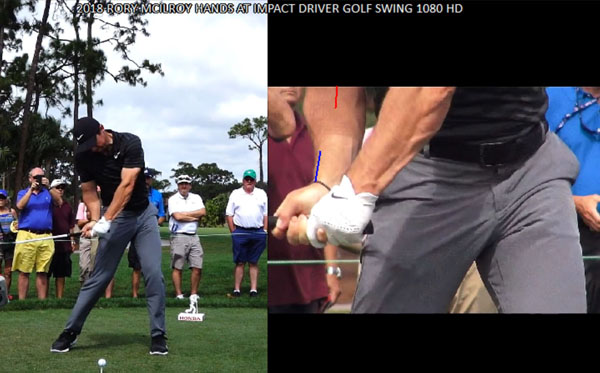
Note that his trail elbow is located
in a rear linkage position and that his trail hand is marginally
closer to the target than his trail elbow, which indicates that
he is performing a punch elbow motion.
I have drawn a red line down the
middle of his trail arm's antecubital fossa and a blue line over
his lower radial bone in his lower trail forearm. Note that the
blue line is rotated clockwise relative to the red line, which
means that his trail forearm is supinated at his P6 position.
How can the back of Rory's trail hand be facing the ground at P6
if his trail forearm is markedly supinated? I think that it is
only the thenar eminence area of his trail palm that is actually
facing groundwards because his thumb metacarpal is held in
closer opposition to his trail palm by ~45+ degrees. If you look
at his true trail palm area (= palm area just proximal to the
base of his 3rd - 5th fingers) it is facing partly skywards and
partly facing the aft side of the club handle.
Capture image of Rory McIlroy at his
P6.5 position.
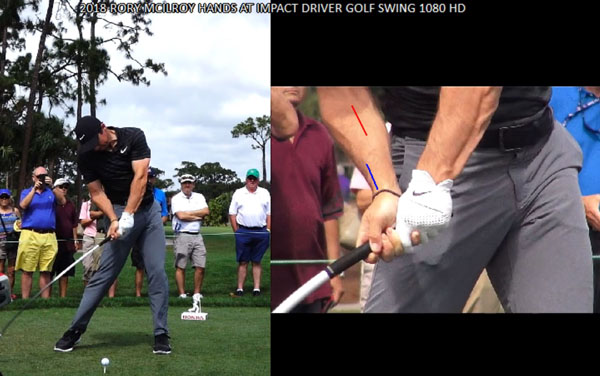
Note that the blue line seems to
possibly be rotated minimally more clockwise relative to the red
line, which suggests that Rory's trail forearm is rotating in a
clockwise (more supinatory direction) and not in a pronatory
direction (counterclockwise direction).
Capture image of Rory McIlroy at
impact.
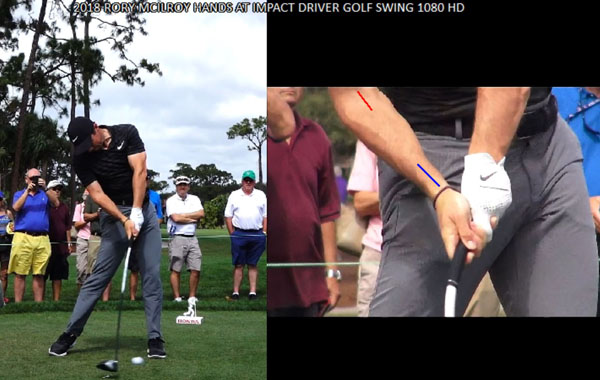
Note that the back of his lead
hand has rotated counterclockwise to a small degree between P6.5
=> P7 secondary to a lead forearm supinatory motion. The amount
of lead forearm supination required to square his clubface
relative to his clubhead arc between P6.5 => P7 is very small
because Rory McIlroy uses a moderately strong lead hand grip.
Note that Rory's trail forearm is
still supinated at impact, and there is no evidence that he is
pronating his trail forearm during his late downswing between
P6.5 => P7. There has been a small amount of counterclockwise
rotation of his trail forearm in a pronatory direction, but the
amount is very small. Note that Rory still has an incompletely
straightened trail arm and a significantly bent trail wrist at
impact. In fact, if Rory released his trail arm "early and hard"
using TR's recommended punch elbow motion that action could
potentially produce an excessive amount of trail arm extension
and secondary trail forearm pronation between P6 => P7, which
would likely close his clubface too much. I think that Rory
cannot afford to close his clubface too much between P6 => P7
because he uses a moderately strong lead hand grip, and I
believe that he must reach impact with the back of his lead hand
exactly angled as seen in this capture image if he wants to have
a square clubface at impact.
Now, let's consider the late downswing
action of another on-top pro golfer - Patrick Reed
Capture image of Patrick Reed's late
downswing action.
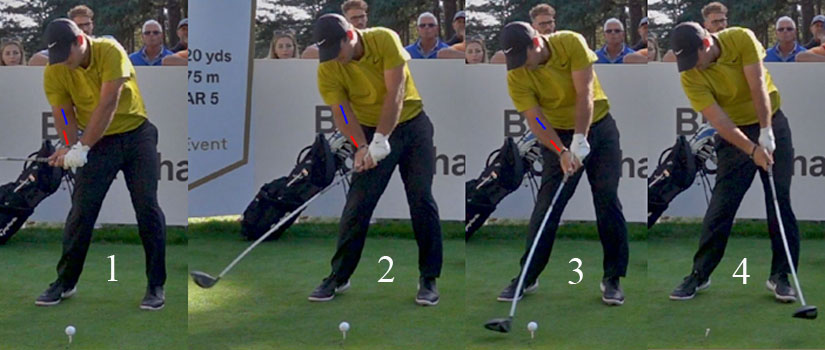
Image 1 is
at P6, image 2 is at P6.5, image 3 is at impact and image 4
is at P7.2.
Note that I have drawn a blue line
down the middle of his trail antecubital fossa and a red
line over his trail lower forearm's radial bone.
Note that PR's trail elbow is
located in a rear linkage position at P6 (image 1). Note
that the red line is rotated clockwise relative to the blue
line, which means that his trail forearm is significantly
supinated. Note that the back of his lead wrist is facing
towards the ball-target line. How can the back of PR's trail
hand be facing the ground at P6 if his trail forearm is
significantly supinated? I think that it is only the thenar
eminence area of his trail palm that is actually facing
groundwards because his thumb metacarpal is held in closer
opposition to his trail palm by ~45+ degrees. If you look at
his true
trail palm area (= palm area just proximal to the base of
his 2nd - 5th fingers) it is facing partly skywards and
partly facing the aft side of the club handle.
At P6.5 (image 2) his trail
forearm is still supinated and there has been no
counterclockwise rotation of his trail forearm in a
pronatory direction. Note that the back of lead hand is
still facing towards the ball-target line to a large degree.
Note that his clubface is still open relative to his
clubhead path and he still has to perform a clubface-closing
phenomenon to square the clubface relative to his clubhead
path.
At impact (image 3), his trail
forearm is still supinated and the degree of
counterclockwise rotation of his trail forearm happening
between P6.5 => P7 in a pronatory direction is very small
and not enough to explain the degree of clubface-closing
that is actually happening during that late downswing time
period - look at how much the back of his lead hand is
rotating counterclockwise between P6.5 => P7. Note that he
still has a significantly bent trail arm and his trail wrist
is still extended.
Image 4 is at P7.2. Note that his
trail arm is now fully straightening and that his trail
forearm is now pronating (as recommended by TR) , but
it happens post-impact so the
pronatatory motion of his trail forearm cannot explain how
he performed a clubface-closing phenomenon pre-impact.
Now, let's consider the late
downswing action of another on-top pro golfer - Matthew
Fitpatrick
Capture images of Matthew
Fitzpatrick's late downswing action.
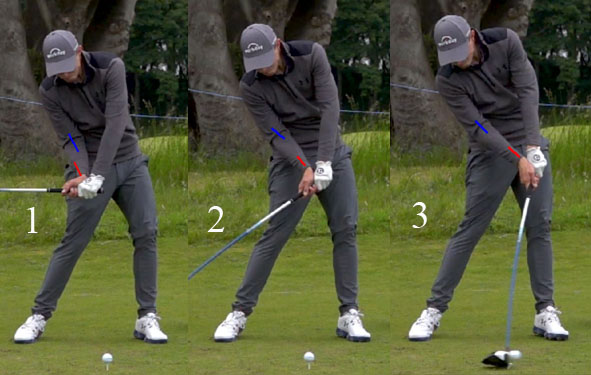
I have
drawn a blue line down the middle of his trail
antecubital fossa and a red line over his trail lower
forearm's radial bone.
Image 1 is at the P6 position
- note that the red line is rotated clockwise relative
to the blue line, which means that his trail forearm is
supinated at his P6 position. How can the back of
Matthew's trail hand be facing the ground at P6 if his
trail forearm is significantly supinated? I think that
it is only the thenar eminence area of his trail palm
that is actually facing groundwards because his thumb
metacarpal is held in closer opposition to his trail
palm by ~45+ degrees. If you look at his true trail palm
area (= palm area just proximal to the base of his 3rd -
5th fingers) it is facing partly skywards and partly
facing the aft side of the club handle.
Image 2 is at the P6.5
position - note that his trail forearm is still
supinated to roughly the same degree and note that there
has been no counterclockwise rotation of his trail
forearm in a pronatory direction between P6 => P6.5.
Image 3 is at his impact
position. Note that his trail forearm is now minimally
less supinated and closer to being neutral so there has
been a small amount of counterclockwise rotation of his
trail forearm happening in a pronatory direction between
P6.5 => P7. However, the amount is very small, which is
a good thing because MF uses an ultra-strong lead hand
grip and he cannot afford to have too much lead forearm
supination happening between P6.5 => P7, which would
cause his clubface to close too much by impact. Note
that the back of MF's lead hand is facing the
ball-target line at impact and it is only the ulnar
border of his lead hand that faces the target at impact
and that same alignment would need to happen even if he
used a side-on (neutral) or under (face-closer) trail
hand grip.
I have presented the golf
swing actions of 3 pro golfers who use an on-top
(face-opener) trail hand grip and none of them have any
frank pronation happening during their P6.5 => P7 time
period as suggested by TR. I can imagine that I could be
accused of confirmation bias by selecting only 3
examples that do not show the requisite evidence that
there is a large amount of counterclockwise trail
forearm rotation happening between P6 => P7 in on-top
pro golfers - so let's look at a larger sample of pro
golfers.
Here is a capture image of Jon
Sinclair's graphs of >100 pro golfers' trail forearm
supination/pronation rotary motion pattern - captured
using the TPI/AMM 3-D system used by Phil Cheetham.
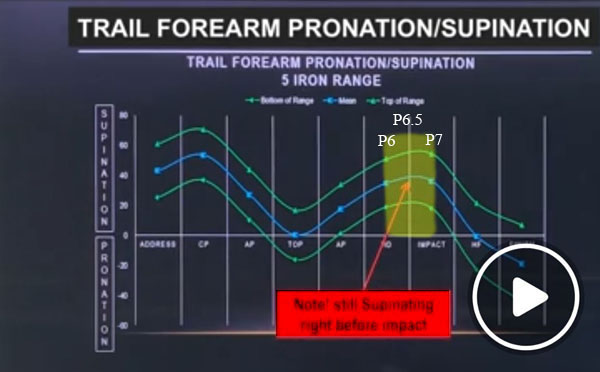
Supination is above the horizontal zero line, and
pronation is below that line. It is hard to read the
positions on that graph where "top" is the P4
position, "AP" is the P5 position, "MD" is the P6
position and impact is the P7 position. The vertical
white line midway between P6 and P7 is the P6.5
position.
Note that I have
yellow-highlighted the P6 to P7 time period.
The blue graph represents
the average value and the two green graphs represent
the one standard deviation limits, which means that
68% of the pro golfers in Jon Sinclair's collection
fall between those two green graphs.
Note that Jon Sinclair has
written a note in a red box, which states "Note!
Still supinating before impact" and his red arrow is
pointing at the P6.5 position.
His trail forearm
supination/pronation graph shows that the average
pro golfer is increasingly supinating his trail
forearm between P6 => P6.5 and that there is a
marginal decrease in the amount of supination that
is present at P7 compared to P6.5. There is no
evidence of a large amount of counterclockwise trail
forearm rotation happening between P6.5 => P7 and
there is no evidence of any overt trail forearm
pronation existing during the late downswing or in
the immediate post-impact time period in 68% of
those pro golfers.
If I would hazard a guess,
I would imagine that strong/under trail hand grip
(face-closer) pro golfers would be closer to the top
green line while the weak/on-top trail hand grip
(face-opener) golfers would be closer to the bottom
green line. Either way, the fact is indisputable
that most pro golfers do not have any significant
counterclockwise trail forearm rotation happening
between P6 => P7 (as predicted by TR for the on-top
subgroup of pro golfers).
I know that Phil Cheetham
must also have a large collection of these trail
forearm graphs in his collection of >100 pro
golfers' AMM-3D results. I would like to see him
publish his graphs to see whether they show the same
results as the Jon Sinclair graphs above. In fact, I
would like to see him and Jon Sinclair both publish
separate graphs for on-top (face-opener) trail hand
grip pro golfers versus under (face-closer) trail
hand grip pro golfers in order to determine if there
is a significant difference in their pattern of
trail forearm rotation happening between P6 => P7.
I will now provide yet
another reason that explains why I do not believe
that the trail hand's grip strength is the major
factor that is causally responsible for the degree
of clubface closure that happens to a variable
degree in all pro golfers between P6.5 => P7 - and
that is the indisputable fact that the lead hand's grip strength
is more likely to be the major factor that can be
causally correlated with the degree of clubface
closure that happens in the late downswing between
P6 => P7 in many pro golfers.
Here is a diagram showing
the usual pattern of clubface closure that happens
between P6 => P7 in a pro golfer who uses a
weak-or-neutral lead hand grip (irrespective of the
strength of the trail hand grip) and who wants to
generate a straight ball flight by zeroing-out both
the clubhead path and the clubface angle at impact.
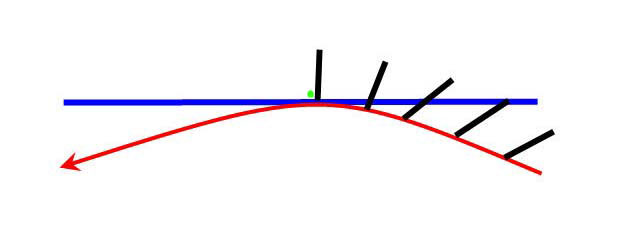
The blue line
represents the ball-target line and the desired
direction of the straight ball flight.
The curved red path
represents an in-to-square-to-in clubhead path
where the clubhead path is square to the
ball-target line at impact (green dot
representing the ball).
The short black line
represents the clubface angle which is steadily
closing during the P6.5 => P7 time period so
that the clubface can become square to the
clubhead path (and therefore also to the
ball-target line) by impact.
Why is this
clubface-closing pattern between P6.5 => P7 -
where the amount of clubface closure is
inversely proportional to the strength of the
lead hand grip - often seen in many pro golfers
who want to zero-out both the clubhead path and
clubface angle at impact (as seen in the above
diagram)?
Here is the obvious
answer.
Consider the swing of
a pro golfer who uses a weak-or-neutral lead
hand grip.
Tiger Woods driver
golf swing action - capture images from his Nike
commercial video.
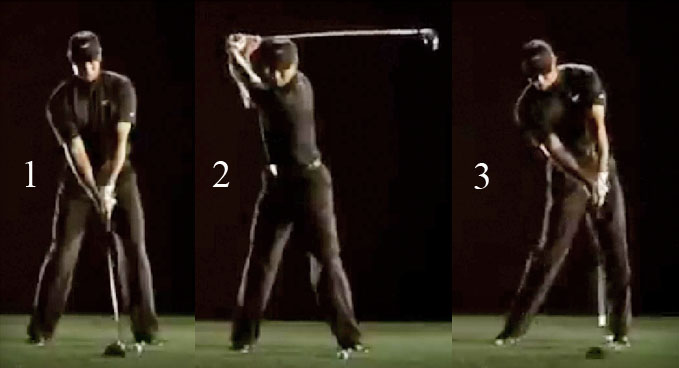
Image 1 is at P1,
image 2 is at P4, and image 3 is at impact.
Note that the logo on
Tiger's lead hand glove is facing the target at
address and that it is approximately
straight-line-aligned with his clubface
(although it is marginally off because Tiger
prefers to hold his hands midway between his
thighs at address, which causes his clubshaft to
be angled slightly backwards due to the fact
that his lead hand is slightly behind his ball
position at address). Note that the back of his
lead hand is facing the target at address and
that it is approximately perpendicular to his
hand arc path.
During his backswing's
P1 => P4 time period, the back of Tiger's lead
hand is going to rotate clockwise so that by the
time his lead hand reaches its P4 position it
will have rotated ~90 degrees clockwise so that
the back of his lead hand is roughly parallel
(and not perpendicular) to his hand arc path.
Because his clubface continuously stays roughly
parallel to the back of his lead hand during the
P1 => P4 time period, his clubface will also
rotate by the same amount so that it is roughly
parallel to his clubhead path at P4, which means
that it has rotated clockwise to a very open
position. The major biomechanical factor that
allows the back of his lead hand to rotate ~90
degrees clockwise between P1 => P4 is a lead
forearm pronatory motion, although a certain
amount of internal rotation of the lead humerus
can contribute to his lead hand's clockwise
rotary action.
To get his clubface to
become square to the target at impact, Tiger
Woods must reverse the process so that the back
of his lead hand, and therefore the clubface,
will again be square to the target at impact. To
reverse the process and rotate his lead hand in
a counterclockwise direction, Tiger must perform
a lead forearm supinatory motion +/- a certain
amount of lead humerus external rotary motion.
The necessary lead forearm supinatory motion
cannot happen between P4 => P5.5 when the back
of his lead hand and clubshaft are continuously
aligned parallel to his shallowing swingplane,
because that would steepen his clubshaft to an
over-the-plane (off-plane) position. So, all the
necessary lead forearm supination must happen
between P5.5 => P7, and mainly between P6.5 =>
P7 after the club has significantly completeted
most of its release action in the plane of lead
wrist radial => ulnar deviation (representing
the release of PA#2 in TGM terminology).
Here is a capture
image showing Tiger's lead forearm supinatory
action (which is called the release of Power
Accumulator #3 in TGM terminology).
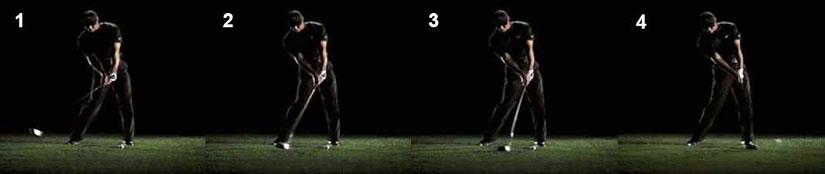
Image 1 is at P6.5,
image 2 is at P6.7, image 3 is at P6.8 and image
4 is at impact.
Note that Tiger's
clubface is still open relative to his clubhead
path at P6.5 and note that it steadily closes
more between P6.5 => P7 in direct proportion to
the angular speed of counterclockwise rotation
of the back of his lead hand, and note that his
clubface remains continuously parallel to the
back of his lead hand between P6.5 => P7. What
causes his lead hand to rotate counterclockwise
between P6.5 => P7? I believe that it is mainly
due to lead forearm supination (= PA#3 release
action) - look at the degree of rotation of his
lead lower forearm's radial bone (just above the
top level of his gloved hand) and note that it
rotates at the same rotational speed as the back
of his lead hand and clubface. I can see no
evidence that his trail forearm is rotating
counterclockwise by a large amount in a
pronatory direction between P6.5 => P7 that
would lead an unbiased observer to postulate
that it is the major casual factor causing the
clubface closing phenomenon (relative to the
clubhead path) that is obviously happening
between P6.5 => P7.
I think that the
biomechnically-induced pattern of clubface
closure seen in Tiger Woods driver swing action
is identical to the "average" pattern seen in
Jon Sinclair's collection of >100 pro golfers.
Consider these Jon
Sinclair graphs showing the "average" pattern of
lead forearm rotation (green graph) and trail
forearm rotation (red graph) seen in his
collection of >100 pro golfers.
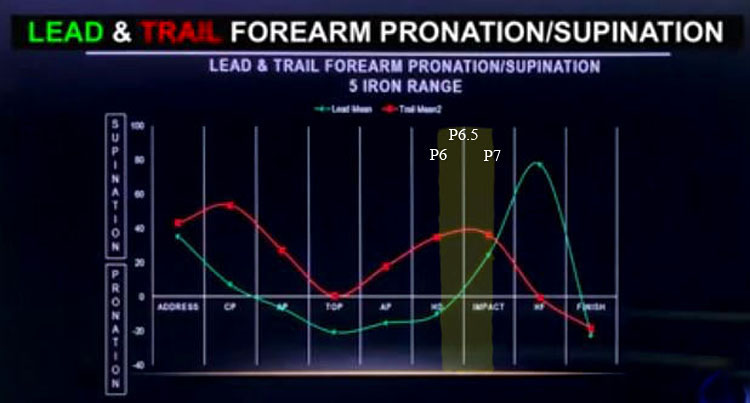
Address = P1, Top =
P4, AP = P5, MD = P6, and Impact =P7.
I have
yellow-highlighted the P6 => P7 time period.
Note that the green
graph shows that the lead forearm is supinated
at address (P1) and note that it rotates in a
pronatory direction between P1 => P4 to become
frankly pronated by P4 - as I demonstrated when
describing the backswing action of Tiger Woods.
Note that there is
very little change in the degree of lead forearm
pronation happening between P4 => P6. Note that
the slope of the green slope only starts to
steepen between P6 => P6.5 and that it becomes
even steeper between P6.5 => P7. Note the large
amount of lead forearm supination happening
between P6.5 => P7, which would cause the
clubface to close more rapidly relative to the
clubhead path during that time period - as seen
in Tiger Woods P6.5 => P7 time period. Note that
the trail forearm is not rotating significantly
in a pronatory direction between P6.5 => P7 so I
have no reason to believe that it could be the
major causal factor that would be producing the
significant amount of clubface-closure (relative
to the clubhead path) seen between P6.5 => P7 in
many pro golfers who use a weak-or-neutral lead
hand grip - and as seen in Tiger Woods driver
swing action.
I think that there are
many pro golfers who use a pivot-induced TGM
swinging action (lead arm swinging action) like
Tiger Woods (who uses a side-on/neutral trail
hand grip), but who personally choose to use an
on-top trail hand grip.
Consider an example
featuring Patrick Rogers.
Capture image of
Patrick Rodgers at address.
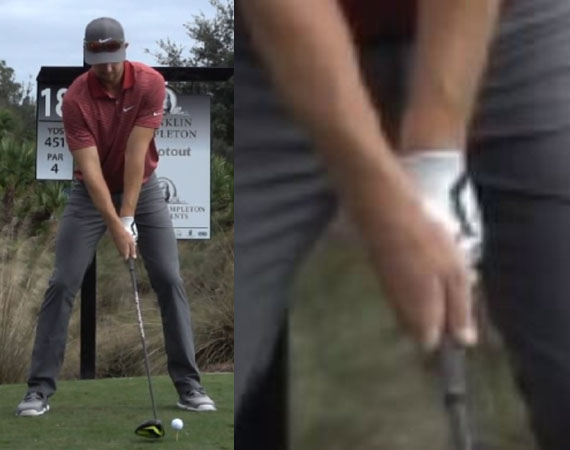
At address (image
1), his trail humerus is internally rotated
to a small degree so that his trail
antecubital fossa faces more towards the
target and it does not face the ball-target
line. Note that he has an on-top trail hand
grip and a neutral lead hand grip. Note that
the back of his lead hand faces the target
at address.
Now, consider the
clubface-closing phenomenon seen in his late
downswing between P6.5 => P7.
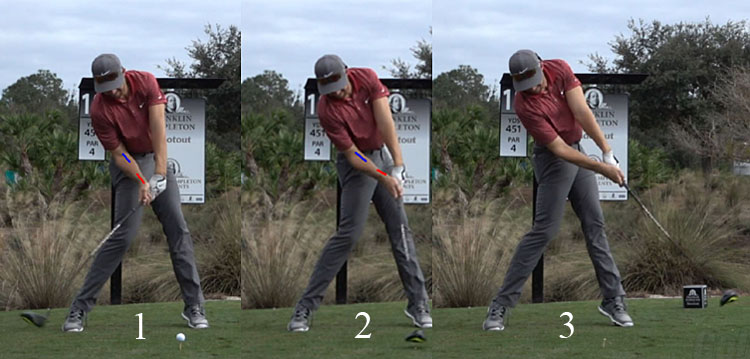
Image 1 is at
P6.5, image 2 is at P7 and image 3 is at
P7.4.
I have drawn a
blue line down the middle of his trail
antecubital fossa and a red line along
his trail lower forearm's radial bone.
Image 1 shows
that his trail forearm is significantly
supinated at P6.5 and that the back of
his lead wrist is facing more towards
the ball-target line, which means that
very little counterclockwise rotation of
his lead hand happened between P6 =>
P6.5. Note that his clubface is still
significantly open relative to his
clubhead path at P6.5.
Image 2 shows
that the back of his lead hand is facing
the target at impact due to a large
amount of lead forearm supination that
is happening between P6.5 => P7 - note
how much his lead lower forearm's radial
bone has rotated counterclockwise
between P6.5 => P7. Note that there is a
direct
proportional relationship between the
amount of counterclockwise rotation of
the back of his hand happening between
P6.5 => P7 and the amount of
counterclockwise rotation of the
clubface that is happening during the
same time period
- strongly suggesting a direct causal
relationship. Note that very little
counterclockwise rotation of his trail
forearm in a pronatory direction is
happening during the same time period,
which suggests that the counterclockwise
rotation of his trail forearm cannot be
the major causal factor responsible for
the clubface-closing phenomenon of the
clubface (relative to the clubhead path)
that is happening between P6.5 => P7.
Look at his trail hand's true palm area
(= area just proximal to the base of his
trail hand's 2nd - 5th fingers) at P6.5
and P7 - you will note that it rotates
at the same rotational speed as the back
of his lead hand in a counterclockwise
direction. How is that possible if there
is so little counterclockwise rotation
of his trail forearm happening during
that P6.5 => P7 time period? I believe
that the correct answer is that his
trail wrist is becoming significantly
less extended between P6.5 => P7 and
that allows the trail palm to roll in a
counterclockwise direction, especially
if a finite degree of counterclockwise
trail wrist circumductory roll motion
happens during his trail wrist's partial
straightening action.
Note that
Patrick Rodgers is performing a DH-hand
release action between P7 => P7.4 where
the clubshaft is not bypassing his lead
arm from an angular rotational
perspective, and that allows him to more
easily keep his clubface square to his
clubhead path between P7 => P7.4. He is
not using a handle-dragging "hold-off"
hand release action where the lead wrist
is held fixedly/rigidly in the same
degree of lead wrist flexion and he is
allowing his lead wrist to extend during
the early followthrough time period
between P7 => P7.4, but only by a small
amount that will not cause the clubshaft
to bypass his lead arm (from an angular
rotational perspective). Note how he is
able to retain a partly bent trail arm
and a partly extended trail wrist all
the way to P7.4, and that is only
biomechanically possible because he does
not "run-out-of-trail arm" - due to the
fact that he moves his trail shoulder
far enough downplane so that the
distance between his trail shoulder and
his trail hand does not get too large
(considering the additional fact that
there is a significant amount of
targetward motion of his lead hand
happening between P7 => P7.4). By
maintaining roughly the same degree of
bent trail arm and the same degree of
extended trail wrist through the impact
zone between P7 => P7.2 it potentially
allows his hand couple to work as a
negative hand couple through impact,
which could have a
mechanical-stabilising effect on his
lead wrist and make it less likley to
extend too much in the immediate
post-impact time period. Note that to
perform a DH-hand release action as
efficiently as Patrick Rodgers, that he
has to ensure that he rotates both his
pelvis and upper torso counterclockwise
by a sufficiently large amount between
P7 => P7.4.
Most
importantly, note that his use of an
on-top trail hand grip does not prevent
him from performing a DH-hand release
action in a very efficient manner.
Let's compare
Patrick Rodgers late downswing action to
the late downswing action of another pro
golfer who uses a weak-or-neutral lead
hand grip, but who uses a strong
(face-closer) trail hand grip - Justin
Thomas.
Capture images
of Justin Thomas's late downswing
action.
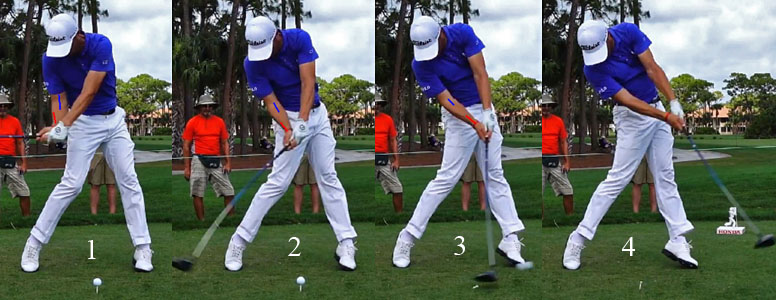
Image 1 is at P6,
image 2 is at P6.5, image 3 is at impact and
image 4 is at P7.4.
Note that I have
drawn a blue line down the middle of his
trail antecubital fossa and a red line along
his trail lower forearm's radial bone.
Note that JT's
trail forearm is markedly supinated at his
P6 position (image 1). Note that the back of
his trail hand is facing the ball-target
line. Note that his trail elbow is above-and
behind his trail hip joint area, and that it
is in a rear-linkage position.
Note that the back
of his trail hand is still facing the
ball-target line at P6.5 (image 2) and note
that there has been very little
counterclockwise rotation of his lead hand
happening between P6 => P6.5. Note that his
trail forearm is still supinated at P6.5 and
there has been no significant
counterclockwise rotation of his trail
forearm in a pronatory direction. Note that
his clubface is still open relative to his
clubhead path.
Note that the back
of his lead hand is facing the target at
impact (image 3) secondary to a lead forearm
supinatory motion (= release of PA#3) and
that a large amount of counterclockwise
rotation of his club handle is consequently
happening between P6.5 => P7 to ensure that
he squares his clubface relative to his
clubhead path by impact. However, note that
his trail forearm is still supinated at
impact and I therefore think that the very
small amount of trail forearm rotary motion
happening between P6.5 => P7 cannot be
deemed to be causally responsible for the
large amount of clubface-closing happening
between P6.5 => P7 relative to his clubhead
path. The amount of clubface-closing
happening relative to his clubhead path
between P6.5 => P7 better correlates with
the amount of lead forearm supination
happening during that time period.
If you compare the
amount of trail forearm rotation in a
counterclockwise direction happening between
P6.5 => P7 in Patrick Rodger's and Justin
Thomas' driver swings, note that there is a
negligible difference. In an email message
to another golf swing theory enthusiast
(DG), TR wrote the following regarding the
choice of a trail hand grip-: "We
test this until we arrive at a trail hand
that delivers the face squarely with the
least effort and conscious intervention.
Baddeley calls this a “quiet” face. A
mismatched grip will close the face too
early or not in time."
The true real-life reality is that the
clubface cannot be "quiet" between P6.5 =>
P7 if a pro golfer adopts a weak-or-neutral
lead hand grip because the clubface needs to
close by a significant amount relative to
the clubhad path during that time period -
irrespective of the strength of the trail
hand grip. However, I do agree that the
trail forearm motion should optimally be
"quiet" between P6 => P7 and it is obviously
very quiet in both Patrick Rodgers and
Justin Thomas' P6 => P7 time periods - where
there is very little change in their degree
of trail forearm supination happening (and
the same "quiet" trail forearm rotary motion
phenomenon is clearly depicted in Jon
Sinclair's trail forearm
pronation/supination graph).
-----------------------------------------------------------------------------------------------------------------
Another comment about the opinion of Mike
Adams who states between the 8:10 - 8:20
minute time point of the video, that "if
the clubface is shut in the early downswing
that one needs to swing more to the right,
but if the clubface is more open then one
has to swing more to the left".
His opinion makes no sense to me.
Why would the clubface ever be shut in the
early downswing? A golfer who adopts a very
strong lead hand grip (like Matthew
Fitzpatrick) will have his clubface more
closed relative to the clubhead path between
P4 => P6, but it it is still slightly open
relative to the clubhead path. Why does he
have to alter his swing direction to swing
more in-to-out rather than in-to-square? A
golfer who adopts a weak lead hand grip like
Justin Thomas will
naturally have the
clubface more open to the clubhead path
between P4 => P6, and he can easily remedy
that natural phenomenon by using more lead
forearm supination during his PA#3 release
action. Why would he need to alter his swing
direction and swing more out-to-in?
Another comment on MA's opinions expressed
between the 11:46 - 12:12 minute time point
of the video where MA talks about how the
trail hand's grip orientation affects the
backswing action and the downswing action.
So, if a golfer adopts an on-top trail hand
grip, he is going to keep the clubshaft more
outside the hands in the early backswing and
he is going to keep the trail elbow higher
than the lead elbow during the backswing
action that will lead to a more flying trail
elbow alignment at P4. I do not disagree
with that assertion. However, he then states
that the trail arm's steep downswing motion
will likely cause the clubshaft to come down
a steeper path with the trail palm facing
more groundwards between P4 => P6. I can see
that happening in the downswing action of
Angel Cabrera, Marc Leishman and Patrick
Reed. However, it is not a fixed law and it
will only happen that way if the body's
pivot motion between P4 => P6 is conducive
to that trail arm motion and if the trail
arm performs a punch elbow motion.
Consider Colin Montgomerie's downswing
action.
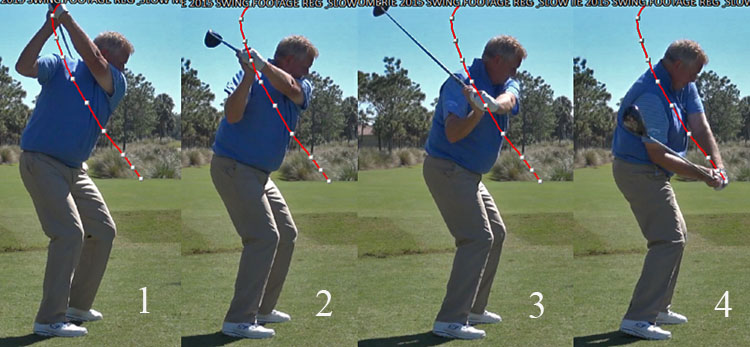
At P4, CM (who uses an on-top trail hand grip) has a flying trail elbow alignment.
However, he does a number of biomechanical actions that are not typical for an on-top golfer like Angel Cabrera and Patrick Reed. First of all, he shifts his pelvis a lot targetwards during his hip-squaring action that happens between P4 => P5 and secondly he uses an exaggerated pitch elbow motion of his trail arm where his trail elbow drops below his lead elbow very fast and he simultaneously supinates his trail forearm a lot that allows his clubshaft to shallow-out a lot between P4 => P6. So, when he gets to his P5.5 - P6 position, he does not look like the prototypical on-top golfer (eg. Patrick Reed and Angel Cabrera).
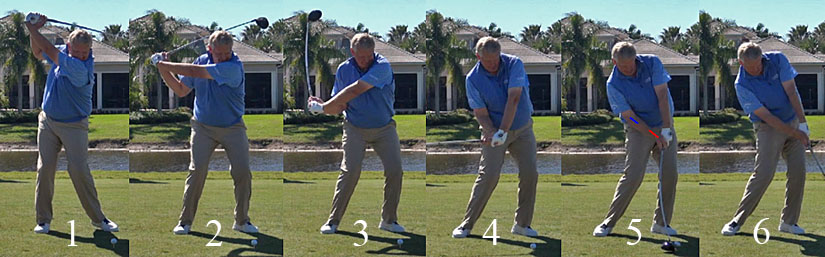
Note how much his trail elbow drops below his lead elbow at P5 (image 2) which is conducive to a pitch elbow motion and not a punch elbow motion.
Image 4 shows CM at his P6 position. Note how supinated his trail forearm is at P6 and how his trail elbow is more pitch elbow-aligned than punch-elbow aligned.
Then, note how much the back of his lead hand rotates counterclockwise between P6 => P7 secondary to a mandatorily-required PA#3 release action and how his trail forearm remains significantly supinated during his entire P6 => P7 time period. Note how much secondary axis tilt and right lateral bend he manifests between P6 => P7, and his upper torso does not cover the ball like a prototypical on-top golfer like Angel Cabrera.
Capture images of Angel Cabrera's late
downswing.

I can readily understand why Angel Cabrera has the body pivot motions of a prototypical on-top golfer, which is a perfectly acceptable alternative way to move the body in the downswing. I am merely asserting that if a golfer adopts an on-top trail hand grip that he can arbitrarily perform a different pattern of body motions than a prototypical golfer like Angel Cabrera.
Patrick Rodgers (another on-top golfer) also has a very different pivot motion than Angel Cabrera.
Capture images of Patrick Rodgers late
downswing action.
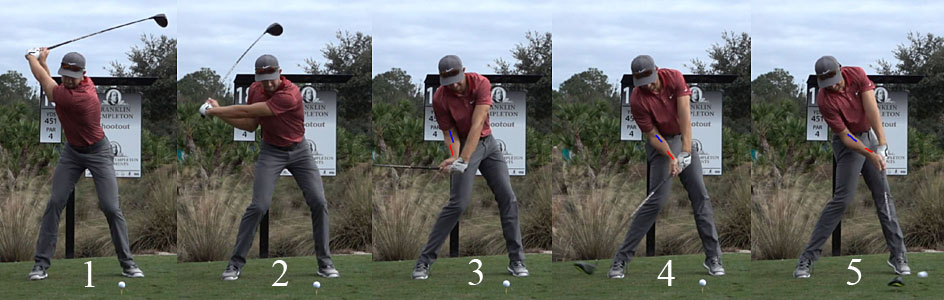
Image 3 shows his P6 alignment. He is using a pitch elbow motion between P5 => P6 (look at how his trail elbow is positioned well below his lead elbow at P5). Note how supinated his trail forearm is at P6. Note how much the back of his lead hand rotates counterclockwise between P6 => P7 secondary to a mandatorily-required PA#3 release action and how his trail forearm remains significantly supinated during his entire P6 => P7 time period.
Note how Colin Montgomerie and
Patrick Rodgers have a very open
pelvis alignment at impact -
compared to Angel Cabrera.
---------------------------------------------------------------------------------------------------------
Listen to what TR/MA state regarding
the choice of strength of the lead
hand grip between the 16:00 - 17:30
minute time point of the video.
They state that at impact the pelvis
is going to be more open to the
target compared to address and that
the hands will be more forward at
impact compared to address. They
state that this will naturally
result in an open clubface at
impact. They therefore recommend a
stronger lead hand grip especially
for golfers who want to have a very
assertive pelvis sway/pelvis-opening
motion during the downswing where
they reach impact with an open
pelvis and a lot of secondary axis
tilt secondary to the pelvis
lateral-shift motion that happens
during their very dynamic pivot
motion. Then, MA states that if a
golfer adopts a weak lead hand grip,
that he will not be able to
assertively shift-rotate the lower
body because that would cause the
golfer to hit the ball to the right,
and that the golfer needs to
shut-down the motion of the lower
body (= less pelvic sway and less
counterclockwise pelvic rotation)
and also slow down the targetward
motion of the lead arm so that the
golfer can roll the clubshaft more
counterclockwise into-and-through
impact.
Their explanation makes no sense to
me.
Let's consider two pro golfers who
use a weak lead hand grip.
Justin Thomas
Look at how assertively/dynamically he shifts and rotates his pelvis into impact, and through impact.
Note that he does not slow down
his lead arm motion near impact
so that he can roll his clubface
through impact by using a roller
subtype of non-DH hand release
action through impact. Note that
he is assertively keeping his
lead arm moving towards the
target all the way through
impact to P7.4 (image 4) so that
he can keep his lead arm
traveling at the same angular
velocity as his clubshaft from
an angular rotational
perspective (which will prevent
the clubshaft from bypassing his
lead arm from an angular
rotational perspective).
Will Zalatoris
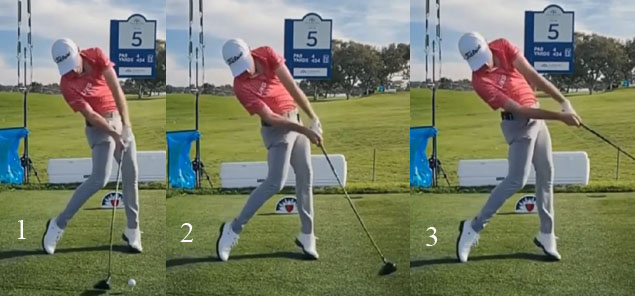
Look at how assertively/dynamically he shift-rotates his pelvis during his downswing action so that he comes into impact with a very open pelvis and with lots of secondary axis tilt.
Note that he does not slow down his lead arm motion near impact so that he can roll his lead arm more counterclockwise in order to square the clubface by impact.
Note that he is assertively keeping his lead arm moving towards the target all the way through impact to P7.7 (image 3) so that he can keep his lead arm traveling at the same angular velocity as his clubshaft from an angular rotational perspective (which will prevent the clubshaft from bypassing his lead arm from an angular rotational perspective).
Both of those pro golfers, who use a weak lead hand grip, have a very assertive/dynamic body motion during their downswing action and they do not have any problem squaring their clubface by impact and they both have no problem avoiding a clubface that is too open at impact.
It makes zero sense to me to say that all golfers who use a very active pivot motion-driven TGM swinging action must use a strong lead hand grip. Why can each golfer in that subgroup of golfers not independently decide which strength of lead hand grip he prefers to use?
Addendum added later:
I have decided to add a further
explanation to explain why
having a very assertive/dynamic
pelvic shift-rotation during the
downswing action does not make
it more difficult to complete
the release of PA#3 by impact. I
think that many golfers may
think that if the pelvis
shifts-rotates very fast during
the downswing that the body will
get ahead of the arms, and that
there will be insufficient time
to fully complete the lead
forearm supinatory motion, that
is casually responsible for the
PA#3 release action, before
impact if a golfer uses a weak
lead hand grip. However, the
reality is that the lead hand
position at P6 and P7 is the
same in golfers who have a very
dynamic pelvic motion versus a
less dynamic pelvic motion.
Consider Justin Thomas' late
downswing action.
Image 1 is at P6. Note that JT is manifesting a very dynamic pelvic rotation and that his pelvis is already slightly open at P6. However, note that his lead hand is located just outside his trail thigh at P6 and his lead arm is not lagging far behind his body.
Image 2 is at impact. Note
that JT continued to have a
very dynamic pelvic motion
between P6 => P7 and his
pelvis is even more open at
P7. However, note that his
lead hand is positioned
opposite his lead thigh at
impact, which is the usual
position. That means that he
had about 15" of
near-horizontal lead hand
travel distance between P6
=> P7 to complete his
release of PA#2 => PA#3, and
that distance is the same
for most pro golfers
irrespective of the dynamism
of their pelvic shift-rotary
motion. The fact that JT's
lower body and mid-torso are
rotating very dynamically to
a more open position between
P6 => P7 does not mean that
the lead shoulder socket and
lead hand are in a different
position at impact - note
that they are both
positioned a few inches
inside his lead foot at
impact. Note that JT has
enough time to complete his
PA#3 release action between
P6.5 (image 2) and impact
(image 3).
----------------------------------------------------------------------------------------------------
A few posts back I posted an
essay-length argument to
demonstrate that any
clubface closure that
happens relative to the
clubhead path during the
downswing is causally
correlated to the amount of
counterclockwise lead
forearm rotation
(supination) that happens
between P6 => P7 (and mainly
between P6 => P6.5), and I
also demonstrated that the
amount of counterclockwise
trail forearm rotation that
happens between P6 => P7 is
minimal and that it cannot
be casually correlated with
the amount of
counterclockwise clubface
rotation relative to the
clubhead path that is
happening between P6 => P7.
I will now provide further
reasoning/evidence that I am
correct.
Consider what TR states
between the 38:21 -
39:33 minute time point
of this video.
Note that TR states that an
on-top trail hand grip is a
face-opener grip, and that
the trail arm/hand must be
providing a clubface-closing
phenomenon during the
downswing in order to
counter that
clubface-opening effect. He
expands on that
clubface-closing phenomenon
by stating that the
clubface-closing action must
start from the very start of
the downswing as the trail
palm starts to push the club
handle downwards. Then,
amazingly, he quotes Sasho
MacKenzie between the 38:50
- 39:20 minute of the video
when he states that when the
trail palm is pushing the
club handle down the hand
arc path towards the ground
between P4 => P6 that it is
applying an "about-the-face"
torque that will twist the
clubshaft about its
longitudinal axis during
that time period in a
counterclockwise direction.
If TR is correct, then there
should be evidence of the
clubface closing phenomenon
relative to the clubhead
path happening between P4 =>
P6 and there should be
evidence that the trail
forearm is rotating
counterclockwise during that
time period to a degree that
can be correlated with the
degree of clubface-closing
relative to the clubhead
path.
So, lets examine the P4 =>
P6 downswing action of a
prototypical on-top golfer -
Angel Cabrera.
Angel Cabrera downswing
action between P4 => P6.
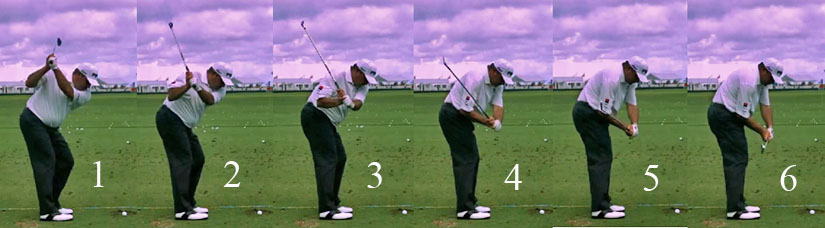
Capture images 1:
Capture images 2:
(cropped images of the
above capture images
which allows one to see
the clubface orientation
relative to the clubhead
path more distinctly).
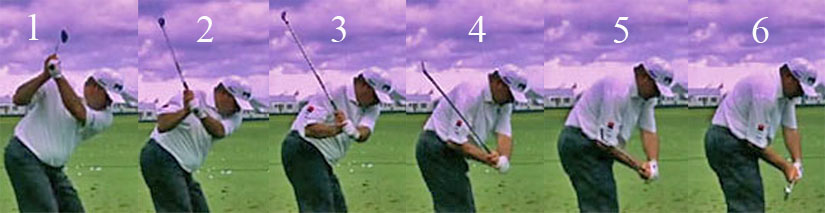
Image 1 is at P4, image 2 is at P4.5, image 3 is at P5, image 4 is at P5.2, image 5 is at P5.5 and image 6 is at P6.
At P4 (image 1) you can see that AC's clubface is ~10 degrees closed relative to the back of his lead hand (which is slightly cupped), and which is expected because he uses a neutral lead hand grip. Note that his clubface is wide open relative to his clubhead path by ~60 degrees.
Note that at P4.5 (image 2) that AC does not bow or cup his lead wrist more so his clubface is still closed relative to the back of his lead hand by ~10 degrees. Note that his clubface is still open to his clubhead path to the same degree and his clubface is not closing more relative to his clubhead path.
Note that at P5 (image 3) that AC does not bow or cup his lead wrist more so his clubface is still closed relative to the back of his lead hand by ~10 degrees. Note that his clubface is still open to his clubhead path to the same degree and his clubface is not closing more relative to his clubhead path.
Note that at P5.2 (image 4) that AC does not bow or cup his lead wrist more so his clubface is still closed relative to the back of his lead hand by ~10 degrees. Note that his clubface is still open to his clubhead path to the same degree and his clubface is not closing more relative to his clubhead path.
Note that at P5.5
(image 4) that AC is
palmar flexing his
lead wrist to a
small degree while
he is supinating his
lead forearm to a
small degree and
that combined
biomechanical action
will cause the
clubface to close
relative to his
clubhead path by a
very small amount.
Note what is
happening with
respect to his trail
forearm and trail
palm between P5.2 =>
P5.5 -
note that his trail
forearm is becoming
increasingly
supinated which will
rotate his trail
palm more clockwise
(and not
counterclockwise).
If the trail palm is
rotating in a
clockwise direction
it will apply a
"torque" to the club
handle that is
clockwise (and not
counterclockwise)
which means that it
cannot possibly be
applying a handle
twisting effect in a
clubface-closing
(counterclockwise)
direction.
Note that at P6
(image 1) that the
clubface is tilted
minimally towards
the ground and it is
not facing toe-up,
and that the very
small degree of
clubface-closing
relative to the back
of his lead hand and
relative to his
clubhead path that
exists at P6 is due
to the "combined
early lead forearm
supination + lead
wrist palmar
flexion" maneuver
that happened
between P5.2 => P6.
It cannot be
causally due to any
trail forearm rotary
motion in a
counterclockwise
direction, because
the trail forearm is
rotating in the
opposite clockwise
direction (secondary
to the fact that his
trail forearm is
increasingly
supinating between
P5 => P6).
These observations disprove TR's claim that the trail forearm's motion between P4 => P6 causes the club handle handle to twist in a counterclockwise direction, The amount of clubface-closing relative to the clubhead path that is happening between P4 => P6 is very small and it is causally due to the very small degree of combined "early lead forearm supination + lead wrist palmar flexion) action that happens in the early phase of the mid-downswing.
At P6, the clubface is still significantly open to the clubhead path, and the clubface-closing action needed to close the clubface relative to the clubhead path so that it becomes square by impact happens between P6 => P7, and mainly between P6.5 => P7.
Angel Cabrera's late downswing action.
Image 1 is at P6, image 2 is at P6.5 and image 3 is at impact.
Note that the back of his lead hand is rotating counterclockwise between P6 => P7 mainly due to a lead forearm supination phenomenon, and that most of the counterclockwise rotation of the lead forearm happens between P6.5 => P7 - and that causes his clubface to close relative to his clubhead path so that it can become square by impact. During that time period, his trail forearm is always supinated and only slightly less supinated at P7 relative to P6 - so it cannot be causally responsible for the large amount of club handle twisting in a counterclockwise direction that is happening between P6 => P7.
Phil Cheetham did his PhD dissertation paper on the topic of factors related to the handle twist velocity phenomenon in pro golfers.
Here are two graphs from his paper.
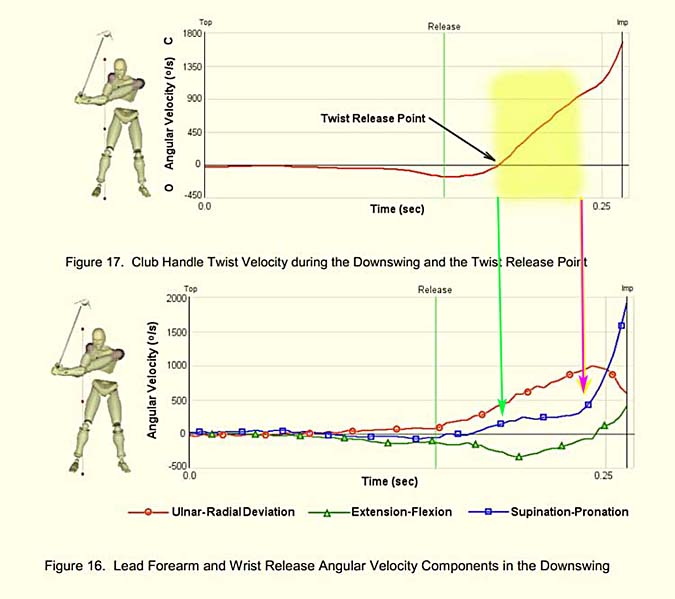
The top
graph shows
the degree
of club
handle twist
velocity in
a
counterclockwise
direction
(measured as
angular
velocity).
The bottom
graph shows
the angular
velocity of
lead forearm
supination.
The green vertical release line represents the start of the club release phenomenon (lead wrist uncocking phenomenon) which usually starts between P5.2 = P5.5 in most pro golfers. Note that there is no counterclockwise handle twist happening before the twist release point, which probably happens at ~P5.5.
Note that the slow phase of handle twist velocity in a counterclockwise direction happens in the yellow-colored zone, and the vertical green/violet arrows shows how it correlates with the slow angular velocity of lead forearm supination (blue graph) happening during that same time period. Note how the lead forearm supination velocity increases rapidly after the vertical violet arrow, and that causes the handle twist velocity to reach its peak counterclockwise rotational velocity in the later downswing (probably between P6.5 => P7).
So, Phil Cheetham has clearly shown that there is a direct correlation between the speed of lead forearm supination happening in the late downswing just before impact and the speed of handle twist velocity in a counterclockwise direction.
Phil
Cheetham did
not study
the trail
forearm's
rotary
motion in
his research
study and
try to
correlate it
to the
handle twist
velocity
because he
was
obviously
smart enough
to know that
there is no
reason to
believe that
there is a
direct
causal
connection.
-------------------------------------------------------------------------------------------------------------
In my previous post,
I stated the
following-: "Note
that TR states that
an on-top trail hand
grip is a
face-opener grip,
and that the trail
arm/hand must be
providing a
clubface-closing
phenomenon during
the downswing in
order to counter
that
clubface-opening
effect. He expands
on that
clubface-closing
phenomenon by
stating that the
clubface-closing
action must start
from the very start
of the downswing as
the trail palm
starts to push the
club handle
downwards. Then,
amazingly, he quotes
Sasho MacKenzie
between the 38:50 -
39:20 minute of the
video when he states
that when the trail
palm is pushing the
club handle down the
hand arc path
towards the ground
between P4 => P6
that it is applying
an "about-the-face"
torque that will
twist the clubshaft
about its
longitudinal axis
during that time
period in a
counterclockwise
direction.
If TR is correct,
then there should be
evidence of the
clubface closing
phenomenon relative
to the clubhead path
happening between P4
=> P6 and there
should be evidence
that the trail
forearm is rotating
counterclockwise
during that time
period to a degree
that can be
correlated with the
degree of
clubface-closing
relative to the
clubhead path."
I naturally inferred that the mechanism of a clubface-closing phenomenon that Terry Rowles (TR) claims must be happening in on-top golfers is due to the trail forearm rotating in a counterclockwise direction (see bold-highlighted statements above).
However, TR in a personal communication stated that he never talked about any counterclockwise rotation of the trail forearm and he only stated that the "about-the-clubshaft" torque would happen earlier and with greater magnitude". TR never explained what biomechanical action could provide that increased magnitude of handle twisting torque in a counterclockwise direction and I cannot fathom what other biomechanical action performed by the trail arm/forearm could provide that counterclockwise handle twisting torque.
Is there evidence that the club handle twisting phenomenon and its effect on the clubface closing phenomenon is happening earlier in on-top (face-opener) pro golfers versus under (face-closer) pro golfers who use a weak-or-neutral lead hand grip
I will start off by analysing the clubface-closing phenomenon seen in the under (face-closer) pro golfer - Justin Thomas.
Capture images of
Justin Thomas
late downswing
action.
Image 1 is at P6, image 2 is at P6.5, image 3 is at P7.
Note that the back of JT's lead hand is facing the ball-target line at P6. Note that his trail elbow is in a rear linkage position.
Note that the back of JT's lead hand has rotated minimally counterclockwise by P6.5 due to the slow phase of lead forearm supination happening between P6 => P6.5. Note that his clubface is still significantly open relative to his clubhead path.
Note how much JT
rotates his lead
hand in a
counterclockwise
direction between
P6.5 => P7 due to
the rapid phase of
lead forearm
supination that
happens between P6.5
=> P7 - look at his
lead forearm's lower
radial bone or the
glove logo on the
back of his lead
hand to see how much
lead forearm
supination he is
manifesting during
the P6.5 => P7 time
period.
Now, let's look at
three pro golfers
who use an on-top
trail hand grip.
Capture images of
Patrick Rodgers
late downswing
action.
Image 3 is at P6, image 4 is at P6.5 and image 5 is at impact.
Note that the back of PR's lead hand is facing the ball-target line at P6. Note that his trail elbow is in a rear linkage position.
Note that the back of PR's lead hand has rotated minimally counterclockwise by P6.5 due to the slow phase of lead forearm supination happening between P6 => P6.5. Note that his clubface is still significantly open relative to his clubhead path.
Note how much PR rotates his lead hand in a counterclockwise direction between P6.5 => P7 due to the rapid phase of lead forearm supination that happens between P6.5 => P7 - look at his lead forearm's lower radial bone or the glove logo on the back of his lead hand to see how much lead forearm supination he is manifesting during the P6.5 => P7 time period.
I can see no
evidence that PR
performed his handle
twisting phenomenon
that causes the
clubface to close
relative to the
clubhead path
earlier than JT and
it mainly happens
between P6.5 => P7
primarily due to the
rapid phase of lead
forearm supination.
Capture images of
Angel Cabrera's
late downswing
action.
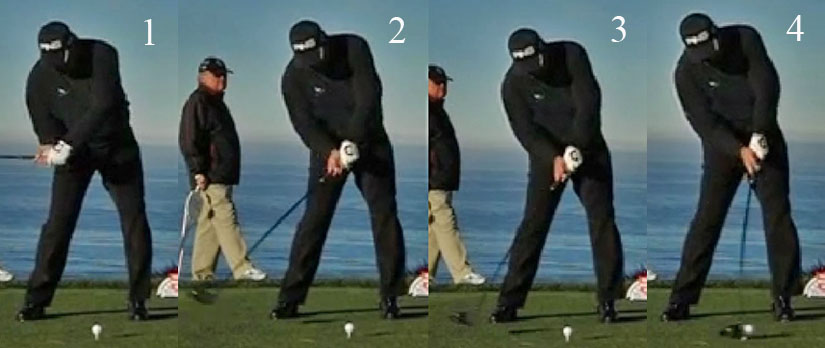
Image 1 is at P6, image 2 is at P6.5, image 3 is at P6.7 and image 4 is at impact.
Note that the
back of AC's
lead hand is
facing the
ball-target line
at P6. Note that
his trail elbow
is in a rear
linkage
position.
Note that the
back of AC's
lead hand has
rotated
minimally
counterclockwise
by P6.5 due to
the slow phase
of lead forearm
supination
happening
between P6 =>
P6.5. Note that
his clubface is
still
significantly
open relative to
his clubhead
path.
Note how much AC
rotates his lead
hand in a
counterclockwise
direction
between P6.5 =>
P7 due to the
rapid phase of
lead forearm
supination that
happens between
P6.5 => P7 -
look at his lead
forearm's lower
radial bone or
the glove logo
on the back of
his lead hand to
see how much
lead forearm
supination he is
manifesting
during the P6.5
=> P7 time
period.
I can see no
evidence that AC
performed his
handle twisting
phenomenon that
causes the
clubface to
close relative
to the clubhead
path earlier
than JT and it
mainly happens
between P6.5 =>
P7 primarily due
to the rapid
phase of lead
forearm
supination.
Capture images
of Scottie
Scheffler's late
downswing
action.
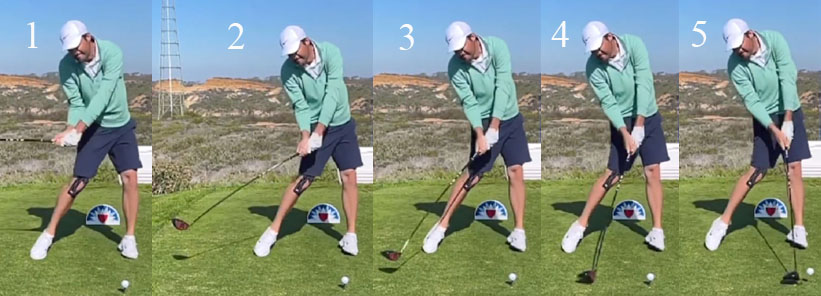
Image 1 is at P6, image 2 is at P3, image 3 is at P6.5, image 4 is at P6.75 and image 5 is at impact.
Note that the back of SS's lead hand is facing the ball-target line at P6. Note that his trail elbow is in a rear linkage position.
Note that the back of SS's lead hand has rotated minimally counterclockwise by P6.5 due to the slow phase of lead forearm supination happening between P6 => P6.5. Note that his clubface is still significantly open relative to his clubhead path.
Note how much SS rotates his lead hand in a counterclockwise direction between P6.5 => P7 due to the rapid phase of lead forearm supination that happens between P6.5 => P7 - look at his lead forearm's lower radial bone or the glove logo on the back of his lead hand to see how much lead forearm supination he is manifesting during the P6.5 => P7 time period.
I can see no
evidence
that SS
performed
his handle
twisting
phenomenon
that causes
the clubface
to close
relative to
the clubhead
path earlier
than JT and
it mainly
happens
between P6.5
=> P7
primarily
due to the
rapid phase
of lead
forearm
supination.
-------------------------------------------------------------------------------------------------------------
In my last
post, I
quoted Terry
Rowles as
stating that
weak trail
hand grip
strength
players are
producing
their
"about-the-shaft"
clubface-closing
action
earlier and
with greater
magnitude
and I could
not
understand
how that is
possible.
Terry also
stated to me
in an email
communication
that Sasho
MacKenzie
had
performed a
small
research
study that
proved that
weak trail
hand grip
strength
players
produced
more "about
the shaft"
torque than
strong trail
hand grip
strength
players.
I then
decided to
analyse
Sasho's
research
study.
Here is a
link to my
analysis -
perfectgolfswingreview.net/SashoTrailHandGripStudy.html
I addressed my analysis towards Terry and I asked many questions that I would like to see Terry Rowles (and/or Sasho MacKenzie and Phil Cheetham) answer.
I personally cannot conceive how the trail arm/forearm/wrist's motions can be causally responsible for the clubface-closing action that happens in the later downswing between P5.5 => P7 in pro golfers who use a pivot-driven lead arm swinging action. I also cannot understand how one can eliminate confounding bias in that type of study where the pro golfers may have lead hand grip strengths that can bias the study's results (eg. more strong lead hand grip strength golfers in the strong trail hand grip strength subgroup, and more weak lead hand grip strength golfers in the weak trail hand grip strength subgroup).
The most puzzling finding that I discovered in Sasho's research study is his claim that the "about-the-shaft" torque is increasing in the later downswing between P6.5 => P7 and peaking just before impact in weak trail hand grip strength golfers and that it happens at the same time as the handle twist velocity is reaching its highest velocity. I cannot understand what possible biomechanical action the trail arm/forearm/wrist can produce that would result in that effect in pro golfers, who supposedly all have a negative hand couple torque phenomenon present during the later downswing.
I would very much like to see Terry/Phil/Sasho provide an answer to that particular question.
Jeffrey Mann.