Capture images of his
backswing and early-mid downswing action.
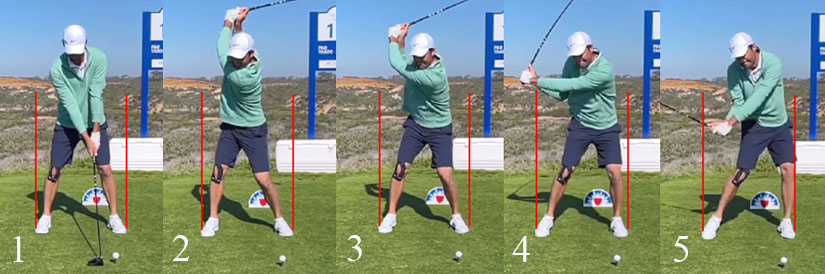
Image 1 is at address. I have drawn two vertical
red lines upwards from a point on the ground that is just outside his two
feet. Note that his pelvis is centered between his feet. Note that he has a
small degree of rightwards spinal tilt. Note that he has a weak lead hand
grip, and also a weak trail hand grip.
Image 2 is at his P4 position. Note that he
maintains his trail knee bend unchanged during the P1 => P4 time period, and
he does not allow his pelvis to laterally sway (shift) rightwards away from
the target during his backswing action (as recommended by Kwon). Note that
his trail hip joint is driven into a biomechanical condition of marked
internal rotation by P4. Note that he has a centralised pelvic loading
pattern and a rightwards-centralised upper torso loading pattern. Note that
he rotates his shoulders ~110-120 degrees and that torques his spine around
more to give him the "look" of arching his spine targetwards using an
arch-extension maneuver (as recommended by Kwon). However, he is not really
using an arch-extension (reverse pivoting) manuever and that "look" is
simply due to the fact that his upper thoracic spine is rotating clockwise
>90 degrees. Note that he has high hands at P4 and he can get his lead arm
to the 11:30 o'clock position. Because he only rotates his pelvis ~50
degrees clockwise between P1 => P4, he is generating a lot of static
X-factor at his P4 position.
Image 3 is at his P4.3 position. Note that he is
rotating his pelvis counterclockwise as he initiates his hip-squaring action
and that there is simultaneously a small degree of targetwards pelvic shift
motion happening at the same time. Note that he does not start his
counterclockwise pelvic rotation between P3.5 => P4 (as recommended by Kwon)
and he only starts to rotate his pelvis counterclockwise after P4.
Image 4 is at his P5 position. Note that he has
completed his hip-squaring action and that he manifests the "Sam Snead
sit-down" look where both hip joints are increasingly flexed and both femurs
are in a state of external rotation in their respective hip joints. Note
that his trail thigh is less vertical (compared to his lead thigh) because
his pelvis has shifted targewards to a significant degree during his
hip-squaring phase.
Image 5 is at his P5.5 position. Note that he has
shifted his pelvis targetwards a lot, but the outer border of his lead
pelvis is still well within the vertical boundary of his lead foot. Note
that he keeps his head stationary while his pelvis is shift-rotating between
P4 => P5.5, and that allows him to generate a lot of secondary axis tilt.
Capture images of his late downswing action.
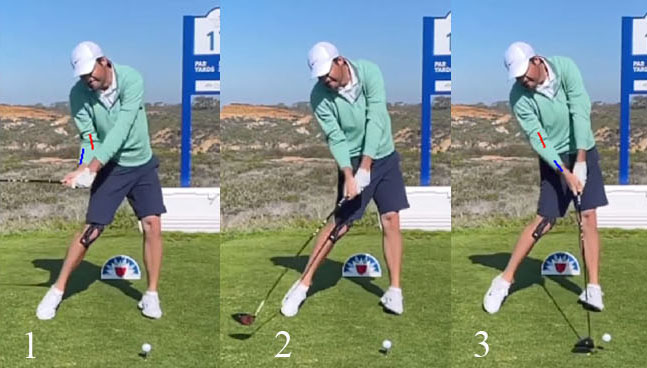
Image 1 is at his P6 position. I have drawn a red
line down the middle of his trail antecubital fossa and a blue line along
his lower radial bone in his lower trail forearm. Note that the blue line is
rotated clockwise relative to the red line by a large amount, which
indicates that his trail forearm is markedly supinated. Note that his trail
palm is partially under the club handle secondary to his marked degree of
trail forearm supination, but it is still seemingly on top of his club
handle due to the fact that he has a weak trail hand grip. Note that the
back of his lead hand and watchface area of his lead forearm are both facing
the ball-target line. Note that his trail elbow is still bent at a
right-angle and it is positioned in a pitch location alongside, and just
above, his trail hip joint area. Note that his lead wrist is still radially
deviated and that he has a ~110 degree clubhead lag angle.
Image 2 is at his P6.5 position. Note that he is
releasing PA#2 due to a lead wrist uncocking action. Note that the back of
his lead hand and watchface area of his lead lower forearm is still facing
the ball-target line to a significant degree, which means that he has not
yet released PA#3 (secondary to a lead forearm supinatory motion) to any
significant degree. Note that his clubface is still significantly open
relative to his clubhead arc and also relative to the ball-target line.
Image 3 is at impact where he has squared his
clubface relative to his clubhead arc and also relative to the target. Note
that the back of his lead hand and watchface area of his lead lower forearm
are nearly facing the target at impact, and that he squared his clubface by
impact by performing a PA#3 release, which is biomechanically due to lead
forearm supination. Note that his trail forearm is still slightly supinated
at impact, and he does not have a pronated trail forearm at impact (as
recommended by Mike Adams/ Terry Rowles for golfers who adopt a weak trail
hand grip). Note that he still has a partially bent trail ebow and
incompletely straightened trail wrist at impact - and he does not allow his
trail palm to roll-over his lead palm through impact due to trail forearm
pronation combined with a simultaneous "running-out-of-trail arm" phenomenon
(which Mike Adams/Terry Rowles recommend for golfers who adopt a weak trail
hand grip).
Note that he has a lot of secondary axis tilt and
right lateral bend at impact. Note that his trail shoulder and upper-lateral
chest area are not "covering" the ball (which Mike Adams/Terry Rowles
recommend for a golfer who adopts a weak trail hand grip).
I think that Scottie is essentially performing a
pivot-induced lead arm swinging action (TGM swinging action using an intact
LFFW/GFLW technique) and that he is not actively using his trail arm/hand to
power or control his club's motion. His trail arm/hand is mainly being used
as a RFFW unit to support the motion of his intact LFFW during his downswing
action.
Capture images of his early followthrough action.
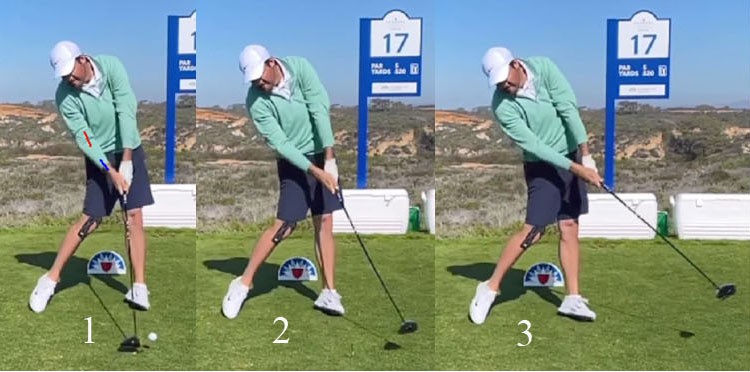
Image 1 is at P7, image 2 is at P7.3 and image 3
is at his P7.5 position.
Note that Scottie's clubface is relatively square
to his clubhead arc during his early followthrough time period, and that he
is using a borderline DH-hand release action. The term "borderline" means
that he is not a perfect DHer who prevents the clubshaft from bypassing his
lead arm (from an angular rotational perspective) between P7 => P7.2+, and
one can note that his clubshaft is bypassing his lead arm (from an angular
rotational perspective) between P7.3 => P7.5 due to a lead wrist extension
phenomenon that causes the clubshaft to flip slightly ahead of his lead arm.
The amount of lead wrist flipping that is happening is very small, and one
can note that there is seemingly no lead wrist circumductory motion
happening during his lead wrist flipping motion that can increase the
clubface ROC during that early followthrough time period.
Here is a comparative capture image of Cameron
Champ's DH-hand release action.
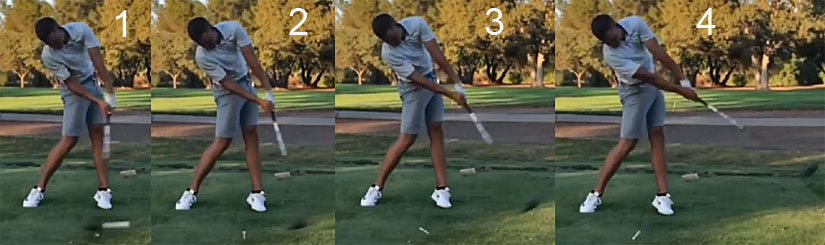
Note how much Cameron Champ's lead hand is moving
targewards between P7 (image 1) and P7.5 (image 3) due to the fact that he
keeps his lead arm moving targetwards fast enough between P7 => P7.5 to
allow him to perfectly match his lead arm's targetwards motion to the
clubshaft's targetwards momentum (from an angular rotational perspective).
That fact requires a finite amount of lead arm abduction during the P7 =>
P7.5 time period.
Note that Scottie Scheffler keeps his lead arm
adducted against his upper left-sided chest wall between P7 => P7.5 and that
his lead hand is only a few inches ahead of the outer order of his lead
thigh at P7.5. That produces a very small degree of difference in the speed
of targetwards motion of his lead arm (when compared to Cameron Champ),
which can causally result in a non-DH hand release action (flipping subtype)
through impact.
Another small difference between Scottie
Scheffler's and Cameron Champ's hand release action is that Scottie
"runs-out-of-trail arm" sooner (due to the fact that his trail shoulder
remains further back) and that causes his trail wrist to straighten by P7.5
- while Cameron still has a slightly bent trail wrist at P7.5. I personally
do not think that that this small differencee is biomechanically relevant
because I suspect that they both use a passive trail arm/wrist straightening
action through impact, and they do not use an active slap hinge hand release
action involving a positive trail hand torque phenomenon through impact. I
suspect that both Scottie and Cameron have a negative hand couple phenomenon
happening at the exact moment of impact, which potentially provides for
greater lead wrist stability through impact.
Note that both Scottie and Cameron have a very
open pelvis and upper torso alignment at impact, and also well beyond impact
to P7.5, which is very conducive to efficiently performing a no-roll subtype
of hand release action through impact. Note that both Scottie and Cameron do
not allow their lead humerus to externally rotate between P7 => P7.2+ (which
is routinely seen in pro golfers who use a delayed full-roll subtype of
DH-hand release action through impact).
Here is a DTL capture image of Scottie Scheffler's
early followthrough action in his driver swing.
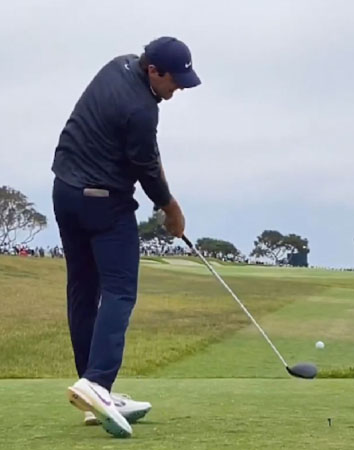
Note that his clubface
is still square to his clubhead arc despite the fact that he he probably
has a very small degree of lead wrist flipping motion happening in his
early followthrough time period between P7 => P7.4.
Here are DTL capture images of his early
followthough when swinging an iron.
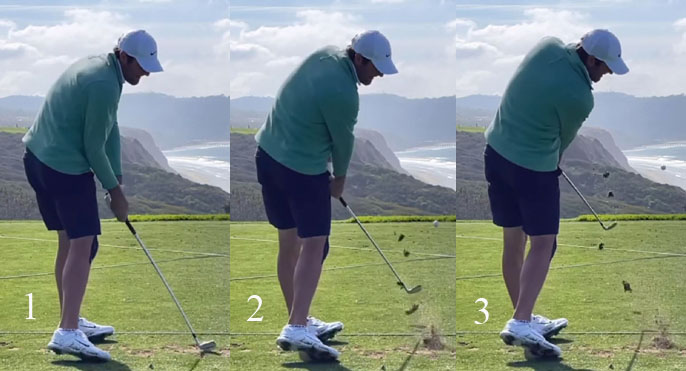
Image 1 is at P7,
image 2 is at P7.2 and image 3 is at P7.4.
Note that he has an open pelvis and
slightly open upper torso alignment at impact. Note how much he
continues to rotate his pelvis and upper torso counterclockwise
between P7 => P7.4 and that allows him to efficiently perform a
CP-arm release action combined with a no-roll DH-hand release action
during that time period, which then allows him to keep his clubface
square to his clubhead path all the way between P7 => P7.4.
Now, consider Scottie's footwork through
impact.
Image 1 is at impact. Note that his lead
ankle is inverted and that he is rolling his ankle so that he likely
has a lot of pressure-loading over the outer border of his lead foot
at impact. I suspect that it is secondary to the fact that he has
lot of targetwards pelvic shift motion happening during his
downswing action.
Note that his lead heel is grounded while
he is lifting up his lead forefoot. I suspect that it is due to the
fact that he is probably a front-foot golfer who has a large amount
of rotary pelvic torque happening between P5.5 => P7.5. In fact, he
seemingly has so much counterclockwise pelvic rotary torque being
generated by the active muscular contraction of his lead gluteus
maximus muscle that his lead femur externally rotates a lot through
impact - note how his lead thigh rotates counterclockwise between P7
=> P7.5 causing his lead knee cap to face more targetwards by P7.5
and it also causes his lead forefoot to spin counterclockwise at the
same time. In some of his more vigorous driver swings, his pelvis
rotates so assertively counterclockwise through impact that it
causes his lead heel to move backwards away from the ball-target
line during his early followthrough action - as can be seen in the
following video at
www.youtube.com/watch?v=g18IUXdFj1E
.That "lead heel shift" phenomenon creates a momentary unbalancing
motion, but it only happens post-impact (mainly in his driver swing
action) and I suspect that it does not necessarily affect the
pre-impact quality of his lead arm/clubshaft motion during his late
downswing and at impact.
Now, I will examine a series of his DTL
capture images in order to discover more features of his golf swing
action.
DTL capture image of his backswing action.
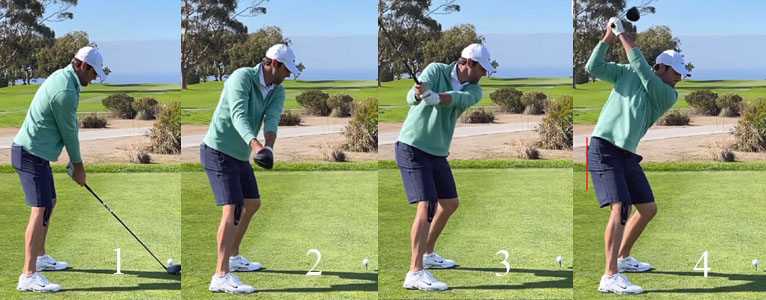
Image 1 is at address. Note that his
original shaft plane is intermediate in degree of steepness between
the hand plane and the elbow plane and that is probably due to his
more upright address posture.
Image 2 is at P2. Note that his clubshaft
is parallel to the ground and his clubface is vertical with the toe
pointing straight up. His clubface is straight-in-line parallel to
the back of his lead hand and watchface area of his lead lower
forearm because he uses a weak lead hand grip and he also uses an
intact LFFW/GFLW swing technique.
Image 3 is at P3. Note that he uses a
trail arm folding action that is intermediate in degree between a
Right Forearm Takeaway technique and an One-Piece takeaway
technique. Note that the butt end of his club is pointing at the
ball-target line at P3, which means that his clubshaft is on-plane.
If you watch his slow motion video, you will note that he uses an
on-plane clubshaft motion technique combined with an intact
LFFW/GFLW technique during his backswing action.
Image 4 is at P4. Note that his lead arm
is slightly steeper than his shoulder turn angle, and that his
clubshaft is positioned just above the TSP. Note that his RFFW is
perfectly aligned relative to his intact LFFW at P4, which
nessitates that he manifest a flying right elbow scenario at P4.
Note that his clubshaft is pointing
slightly right of the target at P4. That fact is simply due to the
factual reality that he rotates his upper torso >90 degrees by P4
and it is not due to any swing fault involving his arms/wrist/hands
(eg. excessive lead wrist cupping that disrupts his intact LFFW/GFLW
alignment).
Also, note that his clubhead is higher
than his hands at P4 secondary to a clubshaft angle that is angled
slightly upwards, which is partly due to the fact that his trail
wrist is not very extended at his P4 position.
Here is a comparison capture image of
Dustin Johnson at his P4 position.
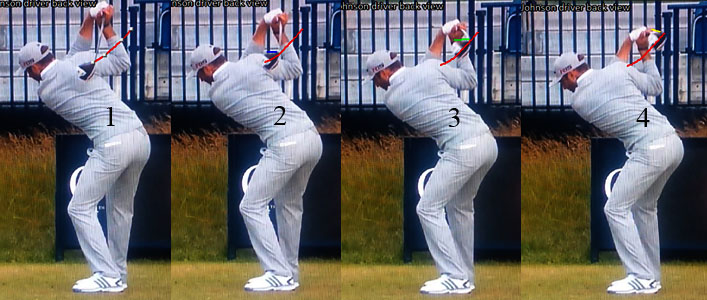
Image 1 is his P4 position - note that his
clubshaft is angled groundwards at P4 so that his clubhead is well
below the level of his hands. What is causing that groundwards
clubshaft angulation phenomenon? It is significantly due to the fact
that Dustin has a very bowed lead wrist and a very extended trail
wrist that allows him to position his clubshaft in a much more
"laid-off" position at P4.
Note how extended Dustin's trail wrist is
at the start of his early downswing action - images 2, 3 and 4.
Does that more extended trail wrist give
Dustin Johnson an advantage over Scottie Scheffler in terms of swing
power? I have seen a number of golf instructors express an opinion
that having a very extended trail wrist at P4 is advantageous
because it allows for a greater range of trail wrist motion between
P4 (when the trail wrist is very extended) and impact (when the
trail wrist is minimally extended). I personally reject that opinion
because I do not think that any trail wrist straightening motion
(moving from marked extension at P6 => minimal wrist extension at
P7) increases clubhead speed in a pro golfer who uses a
pivot-induced lead arm swinging action (like Dustin Johnson and
Scottie Scheffler). I will greatly expand on this issue in a future
thread.
DTL capture images of Scottie Scheffler's
early-mid downswing action.
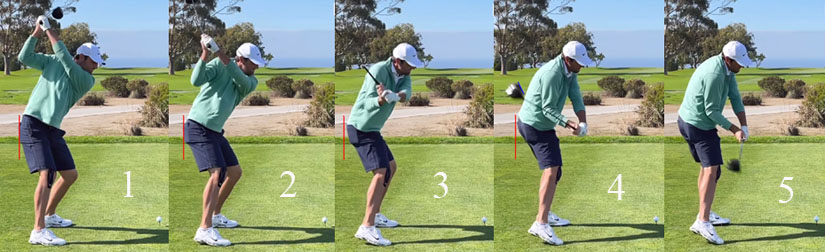
Image 1 is P4, image 2 is at P4.5, image 3
is at P5, image 4 is at P5.5 and image 5 is at P6.
Note that I have drawn a red line against
the back of his trail buttock at P4, and that represents the tush
line.
Note how Scottie starts his hip-squaring
action by rotating his lead buttock back towards the tush line while
keeping his trail buttock abutted against the tush line. I suspect
that his hip-squaring action between P4 => P4.5 is mainly due to the
muscular activation of his trail-sided lateral pelvic rotator
muscles +/- due to his lead forefoot generating a horizontal GRF by
pushing away from the ball-target line.
Note that he has completed his
hip-squaring action by P5 and his trail buttock has only moved away
from the tush line by ~2". Note that his pelvis is open by P5.5
while his shoulders are still slightly closed.
Note that he has very little head dropping
during his hip-squaring action, and he maintains his spinal bend
inclination angle constantly unchanged between P4 => P6.
Note how actively he adducts his right
upper arm between P4 => P5 - note how his trail elbow, which is
level with his lead elbow at P4, drops below the level of his lead
elbow by a large amount by P5. That active right arm adduction
maneuver, which is combined with a pitch elbow motion, allows him to
efficiently retain his clubhead lag angle of ~90 degrees, and avoid
casting, during his clubshaft shallowing action.
Note how he shallows his clubshaft from
being just above the TSP at P4 to being approximately on the elbow
plane by P5.5. The two major biomechanical actions that make this
clubshaft shallowing action possible are i) an active right arm
adduction maneuver using a pitch elbow motion and ii) a large amount
of trail forearm supination.
Note that he has an on-plane clubshaft
motion between P4 => P6 and that his clubshaft ends up being
parallel to both the ground and the ball-target line at P6 and lying
vertically above his toe line at P6. Note that the toe of his
clubface is pointing straight-up, which means that it is not square
to his clubhead arc.
Note that I have drawn a short blue line
parallel to his clubface at P5.5 (image 4) and it is wide-open
relative to his clubhead arc. I strongly suspect that Mike Malaska
would label this open clubface alignment at P5.5 a major swing
fault, and he has repeatedly stated that it will require an
inordinate amount of clubface rolling (due to a lot of lead forearm
supination happening after P6) in order to get a square clubface by
impact from that wide-open clubface position at P5.5. Mike Malaska
wants to avoid having to use a lot of lead forearm supination in his
later downswing and he therefore recommends his "Malaska Move"
maneuver, which he wrongheadedly believes is absolutely necessary to
get the clubface square to the clubhead arc by P6. Many modern-era
golf instructors also recommend a clubface closing maneuver between
P4 => P5.5 in order to avoid having that open clubface alignment at
P5.5. For example, Tyler Ferrell recomends the Motorcycle Move (more
correctly called the Reverse Motorcycle Move) and Brian Manzella
recommends his Twistaway Maneuver. Miles Lino and Eric Cogorno also
recommend a lead wrist flexing maneuver in the following video at
www.youtube.com/watch?v=LM_GJSZo9oo
.
By contrast, I don't think that Scottie's
clubface can be defined as being wide open at his P5.5 position and
I believe that his clubface alignment is
actually neutral and naturally expected
because he uses the combination of i) a weak lead hand grip and ii)
an intact LFFW/GFLW technique and an iii) on-plane clubshaft motion
during his downswing action. Why do I claim that it is naturally
expected for Scottie to have his clubface lying back in an open
position (relative to his clubhead arc) at his P5.5 position? First
of all, Scottie uses a weak lead hand grip, which means that his
clubface will be straight-in-line with the watchface area on the
back of his lower lead forearm if he has a GFLW alignment and an
intact LFFW alignment. Because Scottie uses the intact LFFW/GFLW
technique throughout his entire downswing action, his clubface will
always be straight-in-line/parallel to his lead lower forearm's
lower radial bone throughout the entire P4 => P7 time period.
Secondly, Scottie also maintains an on-plane clubshaft throughout
his downswing action, which means that when his clubshaft is
shallowing-out down to the elbow plane between P4 => P5.5, his
clubshaft is always lying on his instantaneous swingplane at every
instantaneous moment between P4 => P5.5. Note that his clubface is
lying on the surface of his instantaneous swingplane at P5.5 (image
4). Note that the watchface area of his lead lower forearm is also
straight-in-line with that instantaneous swingplane at P5.5.
Finally, because his clubface is straight-in-line with his watchface
area on the back of his lower lead forearm at P5.5, that means that
his clubface must also lie parallel to the surface of his swingplane
at P5.5.
Here is a capture image of Scottie
Scheffler at his P5.5 position.
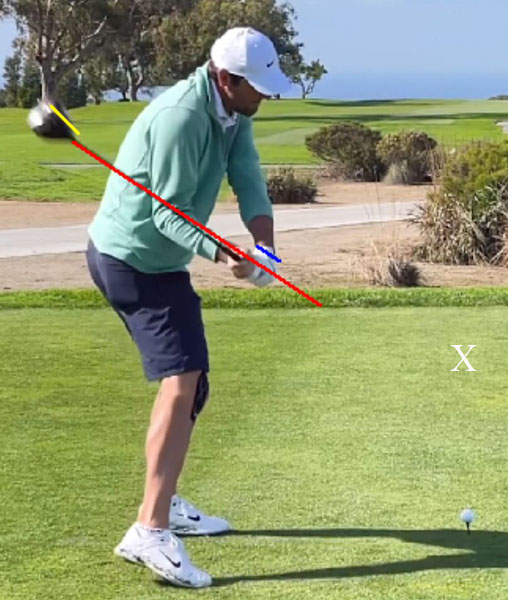
The red line shows his clubshaft lying on
his instantaneous swingplane at his P5.5 position. An imaginary
extension line drawn out from the butt end of his club will point at
the "X" mark on the ground, and point "X" is positioned on the
ball-target line. That means that his clubshaft is on-plane at his
P5.5 position.
I have drawn a blue line parallel to the
watchface area of the back of his lead lower forearm and that blue
line goes straight through his lower lead forearm's radial bone just
above the level of his lead wrist crease. That blue line is
straight-line-aligned with his clubface because he has an intact
LFFW/GFLW alignment at P5.5. Because he adopts a weak lead hand
grip, his clubface (yellow line) must be straight-line-aligned with
both the blue line and the red line. In other words, his clubface
must have that very specific
alignment at P5.5 if he has i) an
intact LFFW/GFLW alignment where ii) the clubshaft is on-plane on
his instantaeous swingplane at his P5.5 position. If his clubface
was more closed at that P5.5 position, then it would suggest he is
using a superadded clubface closing maneuver (eg. Reverse Motorcycle
Move) that is not necessary if one uses the intact LFFW/GFLW
technique.
To get a square clubface by impact,
Scottie Scheffler simply has to use a PA#3 release action during his
later downswing - as demonstrated in the following capture image.
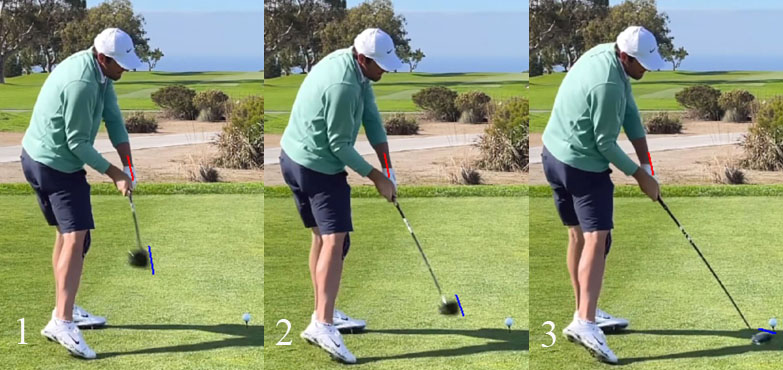
Image 1 is at
his P6 position. I have drawn a short red line through the axis
of his lead lower forearm's lower radial bone and a blue line
parallel to his clubface. Note that the red and blue lines are
straight-line-aligned because he has an intact LFFW/GFLW
alignment.
Image 2 is at his P6.5 position. Note
that the red and blue lines are still straight-line-aligned due
to the fact that he maintains an intact LFFW/GFLW during his
later downswing.
Image 3 is at the P6.8 position. Note
that the red and blue lines are still straight-line-aligned due
to the fact that he maintains an intact LFFW/GFLW during his
later downswing - while he is simultaneously releasing PA#2 and
PA#3.
Scottie Scheffler obviously has no
problem consistently timing his release of PA#3 (which is
primarily due to lead forearm supination) so that he
consistently gets a square clubface at impact, and that allows
him to consistently hit straight shots.
Many pro golfers have chosen to use
the optional choice of using a weak lead hand grip combined with
an intact LFFW/GFLW technique and notable examples include Tiger
Woods and Justin Thomas.
Here is a capture image of Tiger Woods
PA#3 release action from the Nike commercial video - captured in
the early 2000's when he used a weak lead hand grip and when his
golf swing action was at his personal career best.
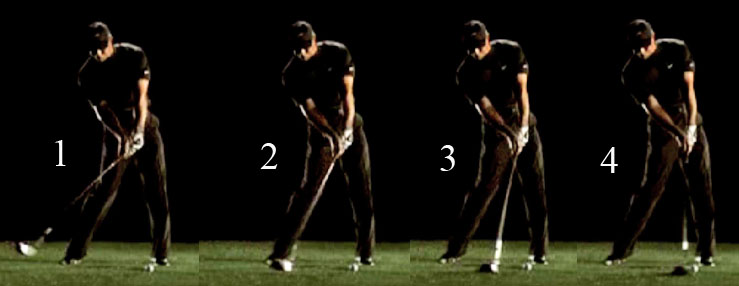
Image 1 is at P6.5 and image 4 is at
impact.
Note how he steadily rotates the back
of his lead hand counterclockwise between P6.5 => P7 due to a
PA#3 release action (which is primarily due to lead forearm
supination), and how his clubface is steadily closing during the
P6.5 => P7 time period.
A pro golfer who chooses to use a weak
lead hand grip can use either the intact LFFW/GFLW technique or
the bowed lead wrist technique - as described in my downswing
chapter here at
perfectgolfswingreview.net/downswing.htm#topic6
Scottie Scheffler, Tiger Woods and
Justin Thomas have chosen to use the intact LFFW/GFLW technique
while Jon Rahm, Collin Morikawa and Jordan Spieth have chosen to
use the bowed lead wrist technique. Both techniques require a
lot of lead forearm supination in the later downswing between
P6.5 => P7, and the I think that the only major advantages of
the bowed lead wrist technique is that it makes it easier to
acquire forward shaft lean at impact and I also suspect that a
bowed lead wrist at impact is likely to be more mechanically
stable at impact than a non-bowed lead wrist. However, I know of
no evidence that demonstrates that it is easier to time the
release of PA#3 when using the bowed lead wrist technique
(compared to the intact LFFW/GFLW technique).
Scottie Scheffler superlatively
demonstrates how a skilled pro golfer can use the trio
combination of a i) weak lead hand grip, ii) an intact LFFW/GFLW
technique and a iii) continuously on-plane clubshaft motion
between P4 => P7 to consistently hit straight shots at his
desired target.
Jeffrey Mann.
https://newtongolfinstitute.proboards.com/thread/940/scottie-scheffler-golf-swing-analysis