Analysing Jon Sinclair's opinions
Watch this Golf Lab video featuring Jon Sinclair.
In this video, JS is advising
Cordie Walker, the owner of Golf Lab, on how to generate a higher clubhead speed
at impact.
His golf instructional philosophy is very biased and
it reflects the swing pattern often seen in long-drive competitors who are also
reverse foot golfers.
Note that he specifically
wants CW to maximize his vertical GRF under the lead forefoot by P5 - P5.2
and he also wants CW to be pushing backwards (away from the target) and not
to be solely pushing upwards. What is the ideological basis for that type of
advice? I believe that part of it is derived from Kwon's opinions that a
golfer should generate a large moment arm about the body's COM in the early
downswing in order to generate a counterclockwise rotation of the upper body
about the body's COM. However, Kwon has never shown how that
counterclockwise force (operating in the frontal plane), which could cause
the upper body to move away from the target, can actually generate more
clubhead speed. I can certainly understand an opinion that it can help a pro
golfer maintain his balance in the later downswing and early followthrough
when releasing the club in a targetwards direction. JS takes this "idea"
further and he wants CW to push upwards-and-backwards using the vertical GRF
generated under his lead forefoot so that by impact the lead foot is
unweighted and has a tendency to spin backwards away from the target and not
only away from the ball-target line - which is a foot motional pattern often
seen in reverse foot golfers, who are competing in long-drive competitions.
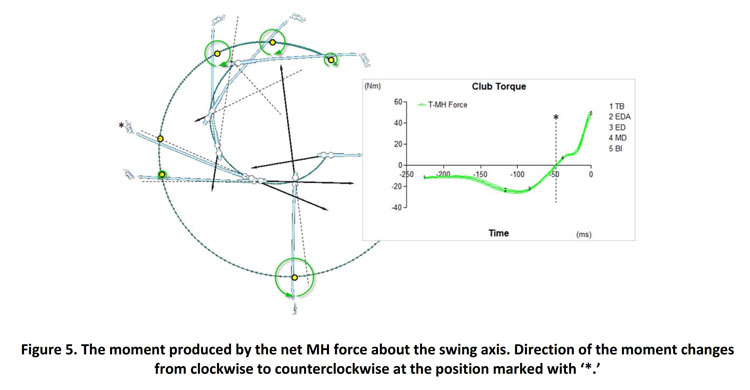
JS has further opinions that I think are non-scientific and irrational. At the 1:17 minute time point of the video, he infers that the lead wrist angle wants to let go (representing the release of PA#2) and JS infers that it will not happen efficiently if the lead foot is only pushing upwards, and not simultaneously pushing away from the target. JS claims that the lead shoulder socket must move backwards away from the target, and not solely move upwards, in order to release PA#2 efficiently. I disagree with JS, because I believe that the major "force" causing the release of the club (release of PA#2) is due to the efficient timing and the large magnitude of the centripetal component of the MoF that is due to the underlying biomechanical factors causing the lead hand's motion between P5.5 => P7.
Here is Kwon's graph showing that club releasing
force.
Note that the torque
causing rotation of the club changes direction at P5.5 so that the club is
induced to rotate counterclockwise
and the magnitude of that torque becomes increasingly positive in the later
downswing. Note the direction of the black arrows - note how the black arrow
becomes directed more centripetally (upwards) and it becomes greater in
magnitude in the later downswing prior to impact. What causes that torque to
be generated? It is due to the change in the hand arc path (hub path) where
it is becomes directed more upwards, and not solely directed targetwards -
and that is due to upward motion of the lead shoulder socket that happens
between P5.5 => P7.
Here is Dustin Johnson's
lead shoulder socket motion and hand arc path.
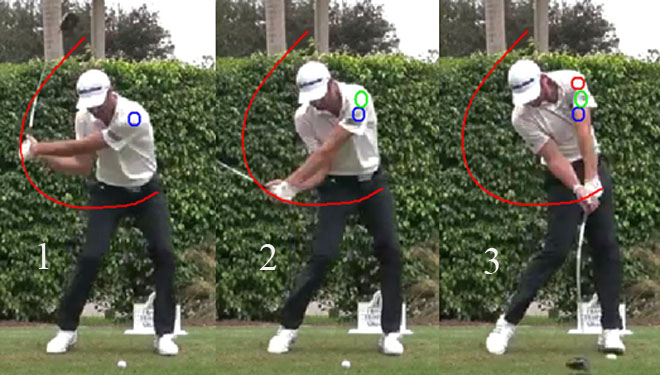
Image 1 is at P5, image
2 is at P5.5 and image 3 is at P7.
I have drawn a blue
circular marker over his lead shoulder socket at P5, a green circular
marker over his lead shoulder socket at P5.5 and a red circular marker
over his lead shoulder socket at P7.
Note that his lead
shoulder socket moves vertically upwards, and that it does not move
backwards (away from the target) between P5 => P7. It is a fallacy to
believe that it is mandatory for the lead shoulder socket to
simultaneously move away from the target during the P5.5 => P7 time
period in order to generate a large club releasing force (which I
believe is secondary to the biomechanical forces causing a shortened hub
path - where the hub path moves slightly more upwards between P5.5 =>
P7). What biomechanical forces are causing DJ's lead shoulder socket to
be moving vertically upwards between P5.5 => P7? I believe that it is
simply due to the straightening of his lead leg (which elevates his lead
hip joint) combined with an increased degree of extension of his lead
mid-upper torso. What causes his lead leg to straighten? I believe that
it is mainly due to the muscular contraction of the lead thigh's vastus
lateralis muscle that straightens the lead knee joint combined with the
muscular contraction of his lead gluteus maximus muscle that decreases
the degree of lead hip joint flexion.
Here is Gary Woodland's
driver golf swing action.
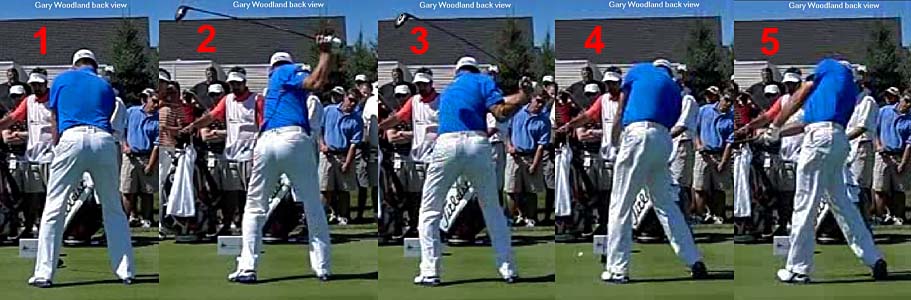
Image 3 is at P5
and image 4 is at P7.
Note how he
straightens his lead leg thereby elevating his lead hip joint and
note how he stretches out the lead side of his mid-upper torso -
causing his lead shoulder socket to move vertically upwards between
P5 => P7 without moving away from
the target.
Here is Gary
Woodland's Swing Catalyst measurements.

Note that GW
produces a very small magnitude of vertical GRF (cyan-colored
graph) and that it happens in the later downswing just before
impact.
Note how GW's
lead heel is solidly grounded at impact and how his lead
forefoot is slightly lifted upwards. That is a foot motional
pattern frequently seen in front-foot golfers, who have no
tendency for the lead foot to move backwards away from the
ball-target line, and simultaneously away from the target (as
frequently seen in reverse foot golfers).
Here is another
pro golfer who is a front foot golfer - Luke List.
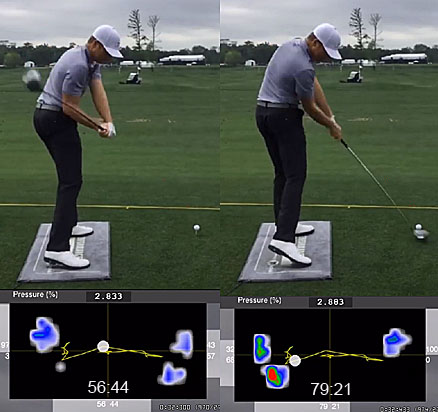
Image 1 is
at P5.5 and image 2 is at P7.
Note that
he only has 56% of his overall COP measurement under his
lead foot at P5.5, and he is not following JS's
recommendation to maximize the lead foot's vertical GRF
before P5.5. Note that he has 79% of his overall COP
measurement under his lead foot at impact - and it is mainly
under his lead heel. That pattern is characteristic of front
foot golfers.
Here are
capture motions of Luke List's head motion during his
downswing.
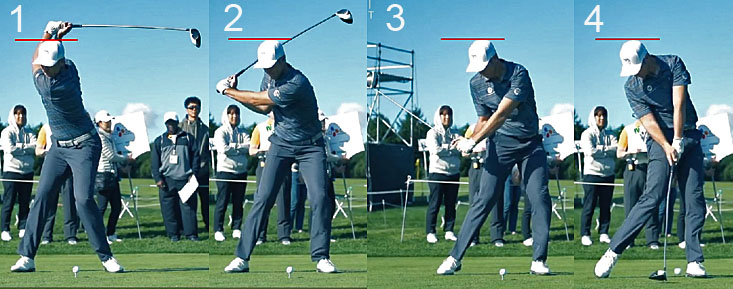
Image 1
is at P4, image 2 is at P5, image 3 is at P5.5 and image
4 is at P7.
Note
that LL's head does not drop down in his early downswing
(due to an exaggerated squat move) and it does not move
away from the target between P5 => P7. As a front foot
golfer, he shows no tendency to exhibit the foot
motional pattern seen in reverse foot golfers (and as
recommended by JS) where the lead foot moves backwards
away from the ball-target line and simultaneously away
from the target through impact. Note that his lead
shoulder socket moves vertically upwards between P5.5 =>
P7 without moving away from the target (as recommended
by JS).
Gary
Woodland and Luke List are two of the longest drivers on
the PGA tour and they definitely do not use the
biomechanical actions promoted by JS. I think that JS's
recommended swing pattern is optional and best suited
for reverse foot golfers, and not well suited for front
foot golfers. At the 8:43 minute time point of the
video, JS states that he wants CW to move his lead hip
with his lead foot (seemingly implying that the vertical
GRF and braking horizontal GRF are causally responsible
for moving the lead hip joint upwards and around to the
right). I much prefer the option of using muscular
forces (as previously described) to move the lead hip
joint upwards and around to the right (away from the
target) in a golfer who is a front foot golfer (like
Gary Woodland and Luke List).
Here is
Ben Hogan's pelvic motional pattern.
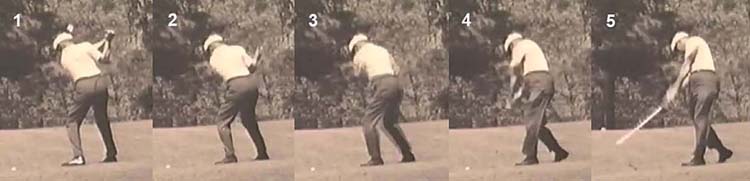
Note how he straightens his lead leg and
simultaneously rotates his lead buttock away from
the target between P5 (image 2) and P7 (image 4) and
I strongly suspect that it is primarily secondary to
muscular forces (contraction of his lead thighs
vastus lateralis muscle to straighten his lead knee
joint and contraction of his lead gluteus maximus
muscle to rotate his lead buttocks away from the
target).
At
the end of the Golf Lab video, JS even gets CW to
use his recommended swing pattern for iron shots,
which makes no sense to me because it promotes a
more uncontrolled release of PA#2 and a more
uncontrolled non-DH hand release action (flipping
subtype) through impact. It also increases the
likelihood of a golfer having insufficient forward
shaft lean at impact.
Jeffrey Mann.
https://newtongolfinstitute.proboards.com/thread/1134/analysing-jon-sinclairs-opinions