Major flaws in the golf instructional thinking of Chris Como, Terry Rowles, Chris Ryan, Eric Cogorno and many other golf instructors
Consider the following 3 videos presented by Chris Como, Chris Ryan and Eric Cogorno.
Chris Como
Chris Ryan
Eric Cogorno
Those 3 golf instructors are mainly discussing how to correctly move the trail arm during the late downswing action between P6 => P7.
They all correctly state that one should not internally rotate the trail upper arm near P6 and that one should get the trail elbow positioned near the front of the trail hip joint area, with the trail antecubital fossa (elbow pit) facing outwards in the direction of the ball-target line, by P6. They all correctly show that when the trail arm straightens between P6 => P7, and where the trail forearm becomes increasingly angled towards the target, that one should keep the trail upper forearm facing skywards.
However, they all incorrectly state that the trail forearm must rotate in a counterclockwise (pronatory direction) between P6 => P7 in order to square the clubface by impact. I will demonstrate in this post that a counterclockwise rotary motion of the trail forearm between P6 => P7 is not used by pro golfers to square the clubface by impact.
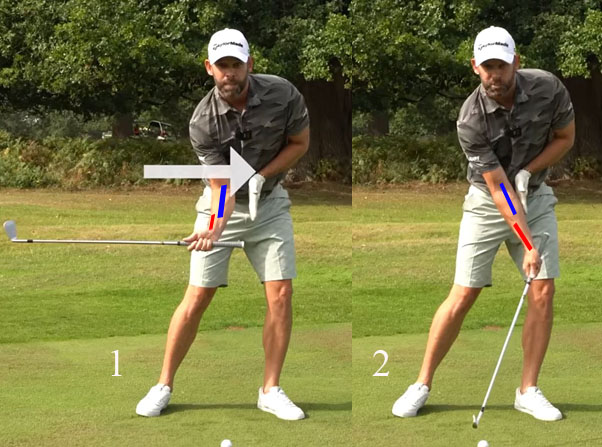
Consider the following capture image from the Chris Ryan video.
In this image, CR is only using his trail arm to demonstrate how the trail arm should move between P6 (image 1) => P7 (image 2).
He has drawn a white arrow in that image to correctly show that the trail elbow must move across the front of the trail hip joint area between P6 => P7 while keeping the trail upper forearm's ventral aspect facing skywards. He also correctly demonstrates how the trail forearm will be increasingly angled towards the target as the trail arm straightens.
Note that his trail palm is facing the ball-target line at P6 and then facing the target at P7 and CR correctly states that the trail palm must rotate in a counterclockwise direction to achieve that goal of getting the trail palm to face the target by P7. However, CR is wrong to state that it is mandatory that the trail forearm must rotate in a pronatory direction to achieve that goal. Note that I have drawn a blue line down the middle of his trail upper forearm and a red line along his trail lower forearm's radial bone that shows that his trail forearm is supinated in image 1 and roughly supinated to the same degree in image 2, and there is no evidence that his trail forearm is pronating in his P6 => P7 demonstration. What CR, and virtually all golf instructors, do not seemingly understand is that that there is another biomechanical method of getting the trail palm to rotate counterclockwise and that it happens at the level of the trail wrist, and not at the level of the trail forearm. Note that his trail wrist is partially straightening between P6 => P7, and while that is happening his trail palm can simultaneously rotate counterclockwise secondary to a trail wrist circumductory roll motion happening while the trail wrist straightens.
I have been studying the golf swing biomechanics of pro golfers for ~20 years, and I never seen any golf instructor discuss the phenomenon of a "trail wrist circumductory roll motion". In fact, I have never even seen any golf instructor use the term "circumduction" and it seems that they are intellectually ignorant regarding this biomechanical phenomenon as it applies to the trail wrist - even though it is the primary biomechanical mechanism that is used by pro golfers to rotate the trail palm counterclockwise between P6.5 => P7 if the club handle rotates counterclockwise about its longitudinal axis during that time period. I will provide a large amount of evidence in this post to support my opinion that a trail wrist circumductory roll motion is the primary biomechnical method used by pro golfers to rotate the trail palm counterclockwise during the "clubface closing" phenomenon that usually happens between P6.5 => P7.
However, I must first address the issue of what it means to state that the trail arm's motion between P6 => P7 has a "clubface closing effect".
When one talks of a "clubface closing" phenomenon happening between P6 => P7, one needs to clearly differentiate between a "clubface closing" phenomenon where the clubface closes relative to the ball-target line versus a "clubface closing" phenomenon where the clubface closes relative to the clubhead path. Look at the clubface angle in that CR-sourced image 1 above - note that the clubface is rougly parallel to the ball-target line and the toe of the clubhead is pointing straight up. That P6-clubface scenario is generally seen in in pro golfers who use a weak-or-neutral lead hand grip, and it means that the clubface is open relative to the clubhead path at P6. That means that in order to get a square clubface at impact, where the clubface is square to the clubhead path and simultaneously square to the target, that a certain amount of counterclockwise club handle twisting (= counterclockwise rotation of the club handle about its longitudinal axis) must happen between P6 => P7 in order to square the clubface relative to the clubhead path. Imagine a different scenario at P6, where the clubface is square to the clubhead path at P6 (which will mean that the clubface is rotated another ~40 - 50 degrees closed at P6). Then, there will be no need to rotate the clubshaft counterclockwise about its longitudinal axis between P6 => P7 (in order to square the clubface relative to the clubhead path) while the clubshaft moves from being parallel to the ball-target line at P6 to becoming vertical at P7 (or near-vertical depending on the degree of forward shaft lean present at impact). In that scenario, the trail palm must still rotate counterclockwise between P6 => P7 for the trail palm to face the target at P7 when it was previously facing the ball-target line at P6. However, one would naturally expect that the degree of trail palm counterclockwise rotation will be less because there is no need to add the additional biomechanical element required to rotate the clubshaft counterclockwise about its longitudinal axis while the clubshaft is moving from being parallel to the ball-target line at P6 to becoming perpendicular to the ball-target line at P7. I imagine that most golf instructors, who believe that a trail forearm pronatory motion is needed to square the clubface by impact, would attempt to argue that more trail forearm pronation is needed between P6 => P7 if the clubface is 40 - 60 degrees open relative to the clubhead path at P6 - compared to the scenario where it is square relative to the clubhead path at P6.
Let's examine the true "real life" facts by analysing the "real life" golf swing actions of a number of pro golfers.
I will start off by examining the trail arm motion in two pro golfers who use an ultra-strong (4+ knuckle) lead hand grip, where the clubface will be ~60 degrees closed relative to the back of their lead hand at address, and therefore at impact.
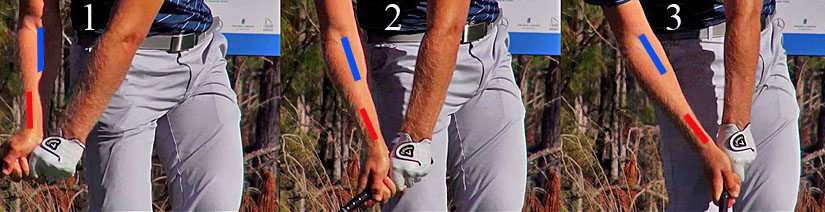
Capture images of Matthew Fitzpatrick's P6 => P7 golf swing action.

Image 1 is at P6, image 2 is at P6.5 and image 3 is at P7.
I have drawn a blue line down the middle of his trail antecubital fossa/trail upper forearm and a red line along his trail lower forearm's radial bone. One can easily note that his trail forearm is supinated at P6, then slightly more supinated at P6.5, before becoming slightly less supinated by P7 (where the degree of trail forearm supination is similar to the amount that existed at P6). Note that his trail forearm never becomes pronated between P6 => P7.
Note that the back of his lead hand remains roughly parallel to the ball-target line and his FSP between P6 => P7, which means that there is no (or a minimal amount of <30 degrees) of clubface closing happening relative to his clubhead path (secondary to a lead forearm supinatory motion that would cause the clubshaft to rotate counterclockwise about its longitudinal axis) during the P6 => P7 time period.
In my first post in this thread, I explained why the trail forearm shows this particular pattern of trail forearm supination - and it is due to the trail forearm motions needed to keep the clubshaft traveling parallel to the functional swingplane (FSP) between P6 => P7. When the clubshaft moves 45 degrees between P6 => P6.5 (without any counterclockwise clubshaft twisting about its longitudinal axis) the trail palm must rotate clockwise by a small amount to maintain its same position relative to the club handle, which is now angled 45 degrees to the right at P6.5. Then, when the clubshaft moves another ~45 degrees (without any counterclockwise clubshaft twisting about its longitudinal axis) to become near-perpendicular to the ball-target line at P7, the trail palm must rotate counterclockwise by a small amount to maintain its same position relative to the club handle. Note that his trail palm has rotated ~90 degrees between P6 (when it is facing the ball-target line) and P7 (when it is facing the target). Note that his trail wrist has straightened by a small amount between P6.5 => P7 but there is no reason to believe that it is simultaneously performing a counterclockwise circumductory roll motion during the P6.5 => P7 time period if the clubshaft is not rotating counterclockwise about its longitudinal axis.
Capture images of Daniel Berger's P6 => P7 golf swing action.
I have drawn a blue line down the middle of his trail antecubital fossa/trail upper forearm and a red line along his trail lower forearm's radial bone. One can easily note that his trail forearm is supinated at P6, then slightly more supinated at P6.5, before becoming slightly less supinated by P7 (where the degree of trail forearm supination is similar to the amount that existed at P6). Note that his trail forearm never becomes pronated between P6 => P7.
Note that the back of his lead hand remains roughly parallel to the ball-target line and his FSP between P6 => P7, which means that there is no (or a minimal amount of <30 degrees) of clubface closing happening relative to his clubhead path (secondary to a lead forearm supinatory motion that would cause the clubshaft to rotate counterclockwise about its longitudinal axis) during the P6 => P7 time period.
In my first post in this thread, I explained why the trail forearm shows this particular pattern of trail forearm supination - and it is due to the trail forearm motions needed to keep the clubshaft traveling parallel to the functional swingplane (FSP) between P6 => P7. When the clubshaft moves 45 degrees between P6 => P6.5 (without any counterclockwise clubshaft twisting about its longitudinal axis) the trail palm must rotate clockwise by a small amount to maintain its same position relative to the club handle, which is now angled 45 degrees to the right at P6.5. Then, when the clubshaft moves another ~45 degrees (without any counterclockwise clubshaft twisting about its longitudinal axis) to become near-perpendicular to the ball-target line at P7, the trail palm must rotate counterclockwise by a small amount to maintain its same position relative to the club handle. Note that his trail palm has rotated ~90 degrees between P6 (when it is facing the ball-target line) and P7 (when it is facing the target). Note that his trail wrist has straightened by a very small amount between P6.5 => P7 but there is no reason to believe that it is simultaneously performing a counterclockwise circumductory roll motion during the P6.5 => P7 time period if the clubshaft is not rotating counterclockwise about its longitudinal axis.
Now, let's consider the same P6 => P7 scenario if a pro golfer uses a weak lead hand grip where the clubface will be 40 - 50 degrees open relative to the clubhead path at P5.5 - P6.
Capture images of Will Zalatoris and Scottie Scheffler at their ~P5.7 position.
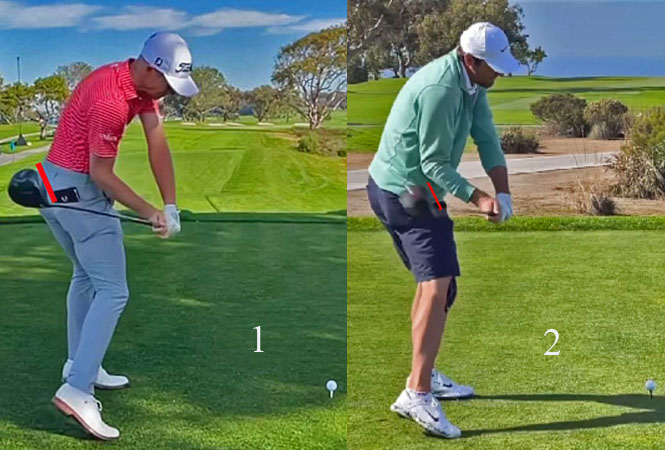
I have drawn a short red line parallel to their clubface.
Note that their clubface is straight-line-aligned relative to the back of their lead hand and the watchface area of their lead lower forearm, which is expected if a pro golfer adopts a weak lead hand grip.
However, note that their clubface is ~50 degrees open relative to their clubhead path, which means that they are going to have close their clubface by ~50 degrees relative to their clubhead path between P5.7 => P7 in order to get their clubface square relative to their clubhead path by impact. How do they achieve that goal? If you watch Eric Cogorno's video, he stated that if the clubface is more open at the P6 position in a pro golfer, then that pro golfer would have to use more trail forearm pronation, and start it earlier, in order to get the clubface square by impact.
Let's examine Scottie Scheffler's late downswing action between P6 => P7 in order to assess whether Eric Cogorno's prediction is true.
Capture images of Scottie Scheffler's P6 => P7 golf swing action.

Image 1 is at P6, image 2 is at P6.5 and image 3 is at P7.
I have drawn a blue line down the middle of his trail antecubital fossa/trail upper forearm and a red line along his trail lower forearm's radial bone. One can easily note that his trail forearm is supinated at P6, then slightly more supinated at P6.5, before becoming slightly less supinated by P7 (where the degree of trail forearm supination is similar to the amount that existed at P6). Note that his trail forearm never becomes pronated between P6 => P7.
The "idea" that the trail forearm must rotate more counterclockwise in a pronatory direction between P6 => P7 if a golfer uses a weak lead hand grip - because the clubface needs to rotate ~50 degrees more relative to the clubhead path during the late downswing - is not true! Note that Scottie Scheffler's trail forearm is approximately supinated to the same degree at P6.5 and P7 - when compared to Matthew Fitzpatrick and Daniel Berger (who both use an ultra-strong lead hand grip) at their P6.5 and P7 positions.
So, how does SS get that required ~50 degrees of counterclockwise rotation of his clubface relative to his clubhead path during his late downswing if he is not pronating his trail forearm more than a pro golfer who uses an ultra-strong lead hand grip?
Note that he rotates the back of his lead hand in a counterclockwise direction by ~10 - 15 degrees (secondary to an early lead forearm supinatory motion) between P6 => P6.5 in order to allow his clubshaft to execute a conical pendular motion that is needed to keep his clubshaft on his FSP.
However, note that he still needs to rotate his clubface by another 35 - 40 degrees between P6.5 => P7 in order to square his clubface relative to his clubhead path by impact.
Close-up capture images of Scottie Scheffler's hands during the P6.5 => P7 time period.

Image 1 is at P6.5 and image 2 is at P7.
I have drawn a blue line down the middle of his trail upper arm and a red line along his lower trail forearm's radial bone. I have also drawn a yellow line along his lead lower forearm's radial bone.
Note how much he is rotating that yellow line and the back of his lead hand counterclockwise between P6.5 => P7 and it is primarily due to a lead forearm supinatory motion. That will cause his lead hand to rotate his clubshaft about its longitudinal axis by ~35 - 40 degrees between P6.5 => P7. Note that SS uses the combination of a weak lead hand grip and a weak trail hand grip, so his two palms are facing each other across the club handle. That means that if his lead palm rotates counterclockwise by ~35 degrees between P6.5 => P7, then his trail palm must also rotate counterclockwise by the same amount.
How does it happen from a biomechanical perspective?
Note that SS is straightening his trail wrist between P6.5 => P7 and he must simultaneously be rotating his trail palm in a counterclockwise direction by performing a counterclockwise trail wrist circumductory roll motion that will allow his trail palm to be rotating counterclockwise to the same degree as his lead palm. In other words, we know that his trail palm must rotate counterclockwise by the required amount between P6.5 => P7 in order to get his trail palm to face the target at impact if the back of his lead hand faces the target at impact, but the required counterclockwise rotary motion happens biomechanically at the level of his trail wrist and not via a pronatory trail forearm motion (as predicted by Eric Cogorno).
One could easily imagine that all pro golfers, who adopt a weak lead hand grip, will be rotating their lead hand counterclockwise (secondary to a lead forearm supinatory motion) by roughly the same amount during the P6.5 => P7 time period in order to square their clubface relative to their clubhead path by impact. However, there is a huge variation in the amount of counterclockwise rotation of the lead hand happening between P6.5 => P7 in pro golfers who adopt a weak lead hand grip at address.
I will feature two pro golfers - Justin Thomas and Jon Rahm - who use a weak lead hand grip combined with a strong trail hand grip, and I will show how much their lead hand rotates counterclockwise between P6.5 => P7.
Capture images of Justin Thomas's golf swing action between P6 => P7.
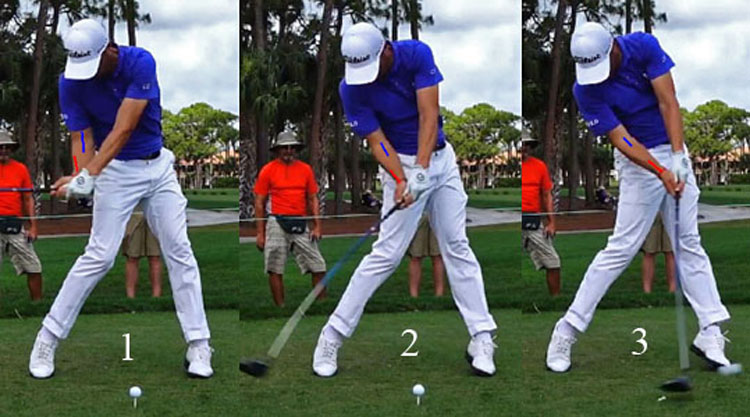
Image 1 is at P6, image 2 is at P6.5 and image 3 is at P7.
I have drawn a blue line down the middle of his trail antecubital fossa and trail upper forearm and a red line along his trail lower forearm's radial bone. One can easily note that his trail forearm is supinated at P6, then slightly more supinated at P6.5, before becoming slightly less supinated by P7 (where the degree of trail forearm supination is similar to the amount that existed at P6). Note that his trail forearm never becomes pronated between P6 => P7.
Note how much the back of his lead hand is rotating counterclockwise between P6.5 => P7 - it is slightly less in amount when compared to Scottie Scheffler, who also uses a weak lead hand grip. I suspect that JT uses a lesser amount of lead forearm supination, and therefore manifests a lesser amount of counterclockwise rotation of his lead hand, between P6.5 => P7 due to the fact that JT places his ball further back towards the middle of his stance and also due to the fact that his lead hand is more ahead of the ball at impact (when compared to the Scottie Scheffler scenario).
Now consider what happens with respect to his lead palm and trail palm between P6.5 => P7.
Close-up images of his hands between P6.5 => P7.

Image 1 is at P6.5 and image 2 is at P7.
I have drawn a blue line down the middle of his trail antecubital fossa and trail upper forearm and a red line along his trail lower forearm's radial bone. Note that his trail forearm is supinated at impact, but to a slightly lesser degree when compared to P6.5.
Note much the back of his lead hand rotates counterclockwise between P6.5 => P7. It is marginally less than the amount seen in Scottie Schefffler's P6.5 => P7 time period. Note that JT is straightening his trail wrist between P6.5 => P7 while simultaneously performing a counterclockwise trail wrist circumductory roll motion that allows his trail palm to rotate as much as his lead palm during the P6.5 => P7 time period. However, note that his trail palm still remains partially under the club handle at impact - because he uses a strong trail hand grip.
Now, I will analyse Jon Rahm's late downswing action - where he also uses a strong trail hand grip and a weak lead hand grip.
Capture images of Jon Rahm's late downswing golf swing action between P6 => P7.
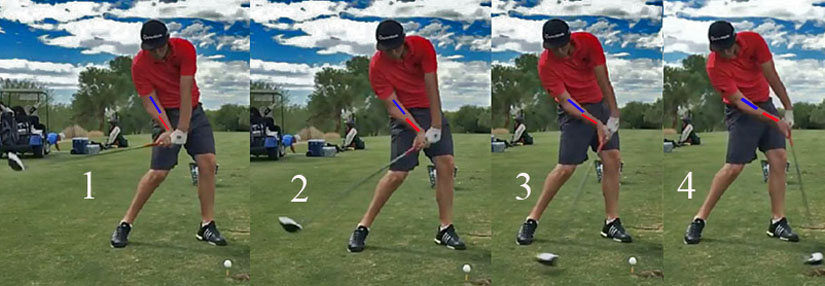
Image 1 is at P6, image 2 is at P6.5, image 3 is at P6.7 and image 4 is at P7.
I have drawn a blue line down the middle of his trail antecubital fossa and trail upper forearm and a red line along his trail lower forearm's radial bone. One can easily note that his trail forearm is supinated at P6, then slightly more supinated at P6.5, before becoming slightly less supinated by P7 (where the degree of trail forearm supination is similar to the amount that existed at P6). Note that his trail forearm never becomes pronated between P6 => P7.
Note that his clubface is still very open relative to his clubhead path at P6.5. I believe that it is due to the fact that he uses the bowed lead wrist golf swing technique which causes his clubshaft to be angled far back at P6.5 even though his hands have nearly reached his ball position where the ball is placed well forward in his stance and opposite his lead foot. Note how much the back of his lead hand rotates counterclockwise between P6.5 => P7 in order for him to square his clubface relative to his clubhead path by impact.
Let's consider his lead hand motion, and trail hand motion, between P6.5 => P7 in greater detail.

Image 1 is at P6.5, image 2 is at P6.7 and image 3 is at P7.
I have drawn a blue line down the middle of his trail antecubital fossa and trail upper forearm and a red line along his trail lower forearm's radial bone. One can easily note that his trail forearm is supinated at P6.5, before becoming slightly less supinated by P7 (where the degree of trail forearm supination is similar to the amount that existed at P6). Note that his trail forearm never becomes pronated between P6.5 => P7.
I have drawn a yellow line along his lead lower forearm's radial bone. Note how much the back of his lead hand/lead lower forearm's radial bone rotates counterclockwise between P6.5 => P7 and the amount is so large that his lead lower forearm's radial bone has rotated beyond a position where it would be perpendicular relative to the ball-target line at impact. He needs to rotate his lead hand counterclockwise (secondary to a lead forearm supinatory motion) much more than either Justin Thomas or Scottie Scheffler during their respective P6.5 => P7 time periods. Note that his trail palm must be rotating the same amount counterclockwise if his trail palm's position on the club handle remains unchanged between P6.5 => P7 and it is obviously not due to a trail forearm pronatory motion. Note that his trail palm rotates so much counterclockwise between P6.5 => P7 that it faces the target at impact (even though he uses a strong trail hand grip like Justin Thomas). What is biomechanically causing his trail palm to rotate so much counterclockwise between P6.5 => P7 if it is not due to a trail forearm pronatory phenomenon? The only rataional answer is that it is due to a counterclockwise circumductory roll motion of his trail wrist that happens while his trail wrist straightens a lot between P6.5 => P7.
Finally, we need to discuss what is causally responsible (from a biomechanical perspective) for the large amount of counterclockwise rotation of Jon Rahm's clubshaft about its longitudinal axis that must be happening between P6.5 => P7. One can postulate that the major biomechanical cause relates to the active motion of his lead forearm, which is supinating by a large amount between P6.5 => P7 in order to rotate his clubshaft about its longitudinal axis by the requisite amount, and that the trail wrist is passively straightening and rolling counterclockwise so that the trail palm can continuously maintain its positional alignment relative to the club handle. That is what I personally believe is happening in Jon Rahm's P6.5 => P7 time period. Alternatively, one could postulate that the trail wrist is actively straightening and rolling counterclockwise between P6.5 => P7 in order to cause the clubshaft to rotate counterclockwise about its longitudinal axis by the necessary amount and that the lead hand and lead lower forearm are reactively/passively rotating counterclockwise. I personally find the latter explanation implausible for a number of reasons.
The two golf instructors, who have a well-established reputation for promoting the idea that the trail arm's motion is causally responsible for the clubface closing phenomenon seen in pro golfers, are Terry Rowles (TR) and Mike Adams (MA). They have expressed their opinions in multiple videos and lessons.
Here is an example - featured in this Sportsbox video.
TR refers to two types of trail hand grips - a weak trail hand grip, which he calls a face-opener grip; and a strong trail hand grip, which he calls a face-closer grip. TR states that if a golfer adopts a weak trail hand grip, then he needs to perform the trail arm's clubface-closing action sooner and with greater magnitude. TR believes that the trail arm performs its clubface-closing action by pronating the trail forearm - as seen in the following capture image.
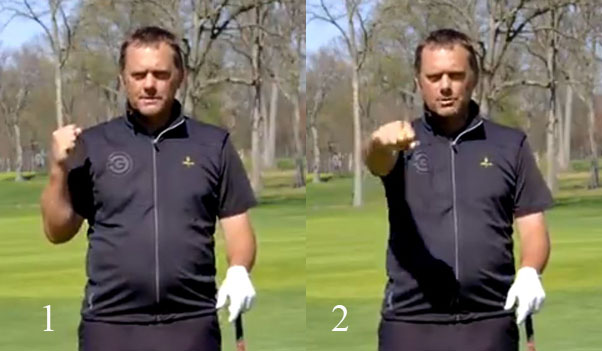
TR uses the analogy of throwing a punch where the trail arm straightens fully and where the trail hand rotates counterclockwise seondary to a trail forearm pronatory motion happening as the trail arm straightens. TR states that if a pro golfer uses a weak trail hand grip (= face-opener grip) then he needs to perform the trail forearm pronatory motion earlier and with greater magnitude.
Here are capture images of Mike Adams demonstrating a drill that he believes should be used by on-top golfers, who use a weak trail hand grip.

In this drill MA is wearing a swim paddle mitt on his trail hand, which he places behind the club handle.
He then wants an on-top golfer (who uses a weak trail hand grip) to start the trail forearm's pronatory action early and in such a way that the trail palm faces the ground at the P6 position (image 1) - note that his trail forearm is already slightly pronated at his P6 position. Then, he wants the trail forearm to continue to pronate more as the trail arm straightens more between P6 => P7 (image 2) and he also wants the trail palm to be applying push-pressure against the club handle in order to get the clubshaft to rotate counterclockwise about its longitudinal axis so that the clubface can close more relative to the clubhead path.
MA is obviously free to teach this trail forearm pronatory motion, but it is definitely not happening in most pro golfers.
Here again is Jon Sinclair's trail forearm rotation graphs - derived from his research study of ~100 pro golfers.
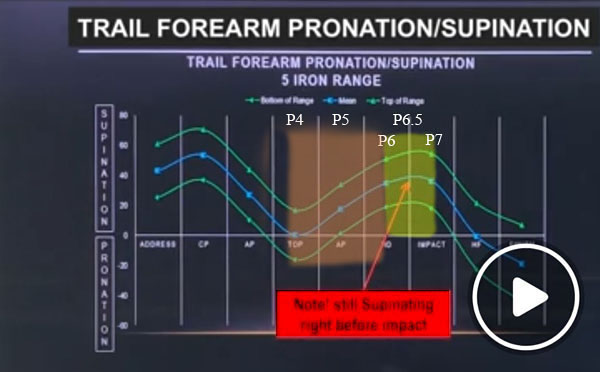
Note that most pro golfers fall within the limits of those two green graphs, which show that the trail forearm is supinated between P6 => P7. Their degree of trail forearm supination varies, but none of them are performing a trail forearm pronatory motion (as seen in image 2 of those MA-drill images).
MA also implies that the trail palm must be applying a push-pressure torque against the aft side of the club handle during the trail forearm's pronatory motion in order to get the club handle to rotate counterclockwise. However, where is there any "scientific evidence" that demonstrates that pro golfers are applying a positive push-pressure torque with the trail palm against the club handle during the P6 => P7 time period. During the pandemic, Michael Finney arranged a webinar conference featuring many well known golf biomechanists like Dr. Kwon and Sasho Mackenzie. They both discussed what the trail hand is doing during the late downswing between P6 => P7 in pro golfers, and they both agreed that the trail palm is not applying any push-pressure against the club handle during the later downswing. They both stated that the trail hand can barely keep up with the releasing club, which is traveling at a very fast speed in a pro golfer's driver swing between P6 => P7. Both Dr.Kwon and Sasho MacKenzie have also independently calculated the forces/torques being applied to the club handle by the two hands during the downswing using a modelling method based on inverse dynamics, and they have both stated that the trail hand is not applying a positive torque on the club handle after P6.
I think that TR/MA also ignore the fact that there are other factors that affect the amount of clubshaft rotation happening in the late downswing between P6 => P7 - other than the strength of the trail hand grip. As I have shown, using Jon Rahm as an example, that one also needs to consider other factors that affect the amount of clubshaft rotation about its longitudinal axis happening between P6.5 => P7 and that result in a greater degree of counterclockwise rotation of the clubshaft about its longitudinal axis eg. use of a weak trail hand grip, and the use of the bowed lead wrist technique. As I have shown in my analysis of Jon Rahm's hand action between P6.5 => P7, the trail palm is rotating a lot counterclockwise secondary to a counterclockwise trail wrist circumductory roll motion rather than due to a trail forearm pronatory action. Are TR/MA willing to concede that fact, and are they are still inclined to believe that the trail wrist's circumductory roll motion is active and causally responsible for the large amount of clubshaft rotation about its longitudinal axis seen in Jon Rahm's P6.5 => P7 time period. If that is their position, then I would like to see them present a detailed explanation of how that is possible. I would be very happy to carefully analyse their explanation in order to determine whether it is sensible and also concordant with the "real life" golf swing actions of pro golfers.
Jeffrey Mann.