Analysing Shaun Webb's pelvic motion
In this post, I am going to discuss how Shawn Webb (SW) is attempting to improve his downswing's pelvic rotary motion so that he gets his pelvis more open at impact.
Watch the following video where SW acts as a sudent-golfer while Mike Granato (MG) acts as his personal golf instructor.
SW states that he has a tendency to slide his pelvis too much during his early downswing and that he comes into impact with his pelvis only open by ~25 degrees. He wants to get his pelvis more open by ~45 - 48 degrees at impact, which is an amount frequently seen in pro golfers. SW also states that he has an undesirable tendency to "kick-in" his right knee so that his right knee is bent a lot at impact and where it has moved ~10" targetwards during his downswing action so that it is closer to the target than his right hip joint at impact. SW believes that these swing faults predispose him to hit golf balls in a direction that will likely miss left-of-his-target.
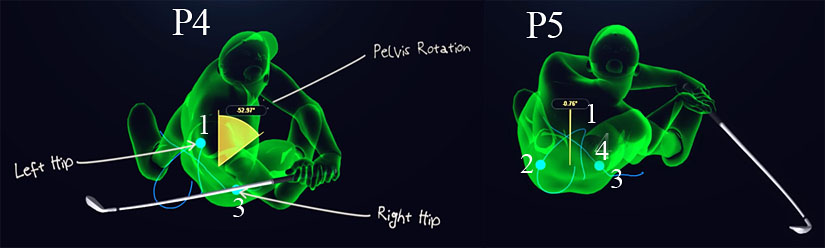
SW is wearing a GEARS-belt during this video lesson that allows one to measure his pelvic motion and knee motion. Swing #1 represents what he calls his usual "on course" golf swing action and at the 4:35 minute time point of the video one can see that he has 48 degrees of clockwise pelvic rotation at P4 while his trail femur/knee has rotated ~31 degrees clockwise and that allows him to drive his trail hip joint into a condition of internal rotation by P4, which is desirable if one wants to optimally pre-stretch the trail-sided lateral pelvic rotator muscles. At the 5:13 minute time point of the video, note that he has rotated his pelvis counterclockwise by 23 degrees by P6, but his trail femur/knee has rotated 34 degrees by P6 (which is undesirable). Impact is at the 5:15 minute time point of the video, where his pelvis is open by 32 degrees while his trail femur/knee has rotated 54 degrees, which means that his trail hip joint is undesirably moving towards a greater degree of internal rotation. Also, note that his trail femur/knee is 38 degrees open at impact, which means that his lead hip joint is not internally rotated at impact.
SW then performs a sequence of ~9 golf swings where he tries to correct these swing faults. Note that his mental focus is entirely focused on the trail side of his pelvis and trail leg. Note that he does get his pelvis ~45 degrees open by impact and he seemingly believes that it is casually due to what he is doing with his trail leg. SW talks about turning his trail upper femur around-and-inwards and moving it away from his trail foot and he also talks about how he needs to stretch his hip flexor muscles in his trail upper thigh so that his trail thigh becomes slanted targetwards in such a way that his trail hip joint will be closer to the target at impact than his trail knee. He actually believes that this mental focus on the motion of his trail thigh is a desirable golf instructional solution that will enable him to more consistently get a more open pelvis of ~45 degrees at impact. I totally disagree! However, before I explain how I would personally instruct SW on how best to improve his rotary pelvic motion between P4 => P7, I want to first show how much MG/SW are primarily forcused on the trail side of the pelvis and the trail knee by analysing other AMG videos.
Watch the following AMG video.
Note what MG states between the 0:51 - 1:20 minute time point of the video - he states that when the pelvis rotates it should involve an equal degree of motion of each hip joint area. So, if the lead hip joint moves back towards the tush line in the early downswing, then the trail hip joint must move away from the tush line by roughly the same amount. MG does not want a golfer to "feel" that the early downswing's pelvic rotation happens around a "fixed" hinge joint where the trail hip joint area remains closely approximated relative to the tush line while the lead hip joint moves a larger distance along a "sharks fin-shaped arc" towards the tush line. Also, listen to what MG states between the 5:00 - 5:30 minutes time point of the video. He states that the trail knee must move early and be the first to move and that it must move ahead of the trail hip joint during the early downswing until ~P6 and then the trail hip joint area can subsequently bypass the trail knee during the later downswing. Therefore, note that he wants the trail heel to lift up very early in the downswing so that the right femur can move inwards thereby creating the biomechanical condition of more internal rotation of the trail femur in the trail hip joint. I disagree with all of MG's opinions and I will soon show what really happens in SW's "real life" early downswing action and also in a pro golfer's early downswing action.
Here is another AMG video where MG again claims that the trail hip joint area must move away from the tush line very fast during the early downswing.
Listen to what MG states between the 0:41 - 1:10 minute time point of the video when he describes SW's habitual pelvic motion - he states that SW's lead hip joint moves back towards the tush line along a long sweeping path (= shark fin-shaped arced path) during the early downswing while the trail hip joint just hangs back there near the tush line. SW then demonstrates that habitual pelvic motional tendency where he states that his trail hip remains "back in its corner" and he calls this trail pelvic motional pattern his "lazy trail hip" golf swing action. SW then demonstrates between the 2:48 - 2:57 minute time point of the video what be believes should happen - the trail hip joint should move around early during the downswing so that it can induce the lead hip to open earlier and to a greater degree. This "idea" that an early rotational motion of the trail hip in a counterclockwise direction causes the lead hip joint to move back towards the tush line thereby causing the pelvis to open more efficiently is echoed again in the video when MG instructs SW to repeat his golf swing action but "instructs him to get the trail hip joint area "out of the gate earlier by waking up the right side of the pelvis" - watch SW's pelvic motion between the 4:00 - 5:10 minute of the video. Note that MG claims that the hips get square earlier and more efficiently. However, I believe that's not true and SW's hips still only get square by P5!
Here are capture images showing what really happens in SW's pelvic motion.
These capture images show SW's pelvic motion during his habitual pelvic motional pattern - captured from the 0:41 - 1:05 minute time points of the video.
Note the large distance that the lead hip joint moves along the "sharks fin-arced path" between P4 => P5 (moving from position 1 to position 2) while the trail hip joint hardly moves its position at all, and it only moves from position 3 to position 4. MG refers to this scenario as a "lazy trail hip" scenario (although I believe that it is a very desirable trail hip motional pattern as I will soon explain). If you look at the comparative pelvic motional images posted between the 4:54 - 5:05 minues time point of the AMG-video, I can agree with MG that the lead hip joint's motional path should be more sharply backwards with less pelvic sway in a targetwards direction, but I disagree that SW's trail hip joint is moving "out of the gate" in a significantly different manner - note that his trail buttocks is still closely approximated relative to the tush line at his P5 position when his hips become square.
I will now explain how I think that SW can improve his pelvic motion so that he can more consistently get his pelvis open by ~45 degrees at impact.
Here are capture images (derived from a different AMG video) showing SW's pelvic motion when he successfully gets his pelvis open by ~45 degrees at impact.
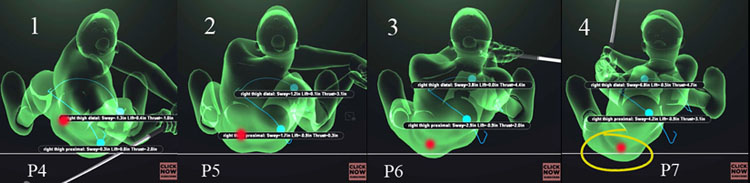
Image 1 is at P4, image 2 is at P5, image 3 is at P6, and image 4 is at P7.
I have placed a red dot over his lead hip joint and there is a blue dot showing his trail hip joint's position.
The white line represents the tush line (also referred to as the "plane of glass" line if one imagines a vertical glass plane positioned at the tush line).
Note what happens between P4 => P5 ( which I call the "hip squaring phase") - note how his lead buttocks moves back away from the ball-target line and then already reaches the tush line by P5 while the trail buttocks still remains closely approximated relative to the tush line. How is that best accomplished from a biomechanical perspective?
I believe that this hip squaring phase happening between P4 => P5 is best accomplished by optimally using the trail-sided lateral pelvic rotator muscles. By rotating the pelvis ~45 degrees clockwise between P1 => P4, while keeping the trail knee slightly flexed and while avoiding any excessive clockwise rotation of the trail femur, it is possible to drive the trail hip joint into a biomechanical condition of internal rotation by P4, which will optimally pre-stretch the trail-sided lateral pelvic rotator muscles. Then, one needs to keep the trail leg "stabilised" between P4 => P5 while actively contracting the trail-sided lateral pelvic rotator muscles and that will cause the pelvis to rotate counterclockwise away from the trail femur. That muscular action will cause the trail hip joint to become externally rotated to a small degree by P5 where one can manifest the "squat move" (often called the "Sam Snead sit-down" look) where the hips are square by P5 and where both hip joints are roughly in a symmetrical condition of dual external rotation to a small degree. The lead hip hip joint, which was in external rotation at P4, must become less externally rotated by P5 and that naturally happens when the pelvis rotates counterclockwise between P4 => P5, and a golfer should simultaneously be applying a horizontal GRF under his lead forefoot in a direction towards the ball-target line that will synergistically help him to drive his lead buttocks back towards the tush line between P4 => P5. I described this hip squaring phase in great detail in the following review paper. To keep the trail femur adequately "stabilised" between P4 => P5 one should avoid prematurely unweighting the trail foot by lifting-up the trail heel and avoid moving the trail knee outwards in the direction of the ball-target line and/or in a targetwards direction, which is why I do not like MG's "idea" of "getting the trail hip joint out of the gate earlier by waking up the trail hip". Note that SW's trail hip joint (blue dot) only moves assertively away from the tush line between P5 => P6, and even more so between P6 => P7, and I do not believe that it should be happening prematurely to an excessive degree between P4 => P5 (as recommended by the AMG instructors).
Now, let's consider the 2nd phase of pelvic rotation that happens between P5 => P7. Between P4 => P5 SW's pelvis rotated ~ 45 degrees counterclockwise to become square by P5. Then, between P5 => P7 his pelvis must rotate another 45 degrees counterclockwise if he wants the pelvis to become ~45 degrees open by impact. How is this goal best accomplished from a biomechanical perspective? Look at those capture images above, and note that the lead buttocks has already moved back to reach the tush line by P5. Then, between P5 => P7, the lead buttocks does not move further away from the ball-target line to a significant degree and it mainly moves away from the target as the lead hip joint (red dot) moves further away from the target. What biomechanical actions cause the lead hip joint to rotate further away from the target during the later downswing between P5.5 => P7 when the lead leg is increasingly being pressure-loaded and braced as the golfer progressively straightens his lead leg and elevates his lead pelvis? Because a pro golfer is increasingly bracing his lead leg during the later downswing between P5.5 => P7 as he increasingly straightens his lead leg and elevates his pelvis, it is going to take a lot of muscle force to cause the lead hip joint to continue to rotate counterclockwise under those conditions. I therefore believe that pro golfers most likely use a muscular contraction of their lead gluteus maximus muscle to supply the force need to rotate the lead hip joint area counterclockwise during the later downswing (as seen in those capture images of SW's pelvic motion).
Consider the following capture image.
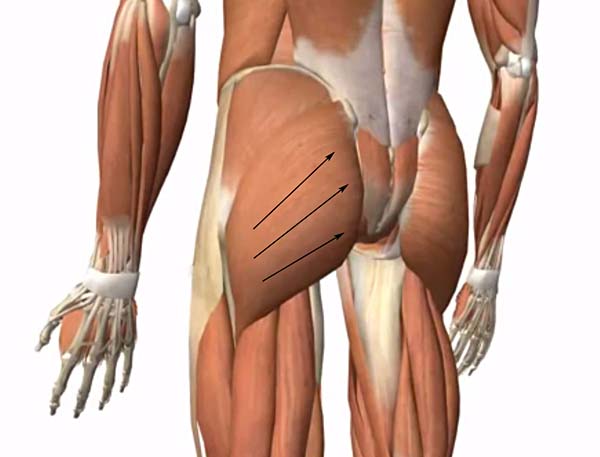
The muscle lying under the black arrows is the left gluteus maximus muscle, and it is attached medially (at its origin) to the outer (lateral) left edge of the sacrum and to a significant section of the posterior pelvic crest and it inserts at the back of the upper left femur. When that muscle contracts (and shortens in the direction of the black arrows) it pulls the left upper femur towards the sacrum (midline) and thereby contributes to the counterclockwise rotation of the left hip joint away from the target as the left hip joint increasingly extends (causing the pelvis to simultaneously move towards a greater degree of posterior pelvic tilt between P5 => P7). During the later downswing, one often notes that a pro golfer's left femur externally rotates to a variable degree and that is also due to the continued isotonic contraction of the left gluteus maximus muscle. The reason why contraction of the left gluteus maximus muscle causes external rotation of the left femur, as well as extension of the left femur in the left hip joint, is the "fact" that the gluteus maximus muscle's point of insertion on the back of the left upper femur is on the outer (lateral) side of the center of the back of the left femur. Although muscular contraction of the lead gluteus maximus mucles causes external rotation of the lead femur during the later downswing, the amount is limited by the fact that the straighening lead leg is increasingly becoming braced, and that limits the amount of external rotation of the femur that can happen between P5.5 => P7. Instead, what often happens in pro golfers is that the lead hip joint becomes more internally rotated between P5.5 => P7 and another likely muscular force contributing to this phenomenon is the active muscular contraction of the lead adductor magnus muscle. A golf research study using EMG (electromyography) probes has demonstrated that the lead adductor magnus muscle is very active during the later downswing in pro golfers.
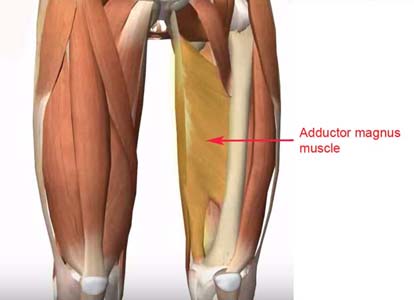
The lead adductor magnus muscle is a large muscle that is attached to the medial side of the mid-lower lead femur and it is also attached to the lower part of the lead pubic ramus bone. Normally, when that muscle contracts it will pull the lead femur towards the midline thereby inducing adduction of the femur (presuming that the pelvis is stabilised). However, if the lead leg is stabilised (as naturally happens between P6 => P7 in a pro golfer's golf swing action), then the active muscular contraction of that muscle will pull the lead (ipsilateral) lower pelvis towards the lead femur, thereby inducing a greater degree of counterclockwise contraction of the lead pelvis, which will also drive the lead hip joint towards a greater degree of internal rotation.
Here are back-view capture images of Jamie Sadlowski's driver golf swing action.
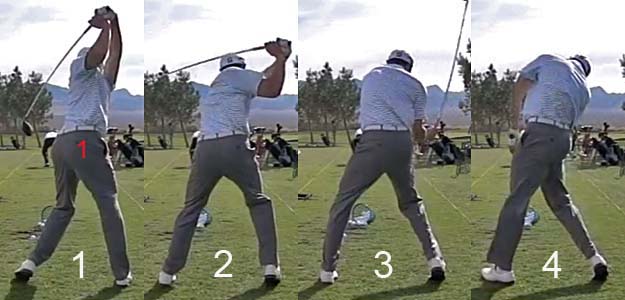
Image 1 is at P4, image 2 is at P4.5, image 3 is at P5.5 and image 4 is at P7.
Note that JS has such an efficient hip squaring action that he has already squared his pelvis by P4.5.
Note how much his lead buttocks rotates counterclockwise and simultaeously moves further away from the target between P5.5 => P7 and note how his lead hip joint simutaneously becomes more internally rotated during that same time period. I strongly suspect that JS is very actively contracting his lead gluteus maximus muscle and his lead adductor magnus muscle during the P5.5 => P7 time period.
If SW wants to improve the counterclockwise rotation of his lead pelvis during his P5.5 => P7 time period so that his pelvis can become more open by impact (as seen in image 4 of the JS capture images), then he needs to maximise his efficiency of use of his lead gluteus maximus muscle and his lead adductor magnus muscle during the P5.5 => P7 time period.
How can letting his trail hip joint "leave its corner" earlier during P4 => P5 time period help SW to rotate his pelvis more efficiently counterclockwise during the P5.5 => P7 time period? I don't believe that it will be helpful and it may predispose to a trail hip spinning motion that can the "block" the motion of the trail elbow when it approaches the trail hip joint area by ~P5.5. I believe that the motion of the trail hip joint between P5 => P7 should be passive and I believe that it will happen naturally/automatically in an optimum manner if the "lead hip clearing action" (where the lead pelvis is actively rotated counterclockwise to an open position of ~45 degrees by impact) is actively induced by the timely muscular contraction of the lead gluteus maximus muscle and lead adductor magnus muscle (that is simultaneously assisted by vertical GRFs being generated under the lead forefoot during the lead leg straightening action that elevates the lead pelvis and that also pushes the lead hip joint "deeper"). I agree with the AMG instructors that one should not try to keep the trail heel solidly grounded during the P5 => P7 time period as that will hamper the trail pelvis's passive rotary motion that should naturally happen during an active "lead hip clearing action".
Jeffrey Mann.
https://newtongolfinstitute.proboards.com/thread/1228/analysing-shaun-webbs-pelvic-motion